
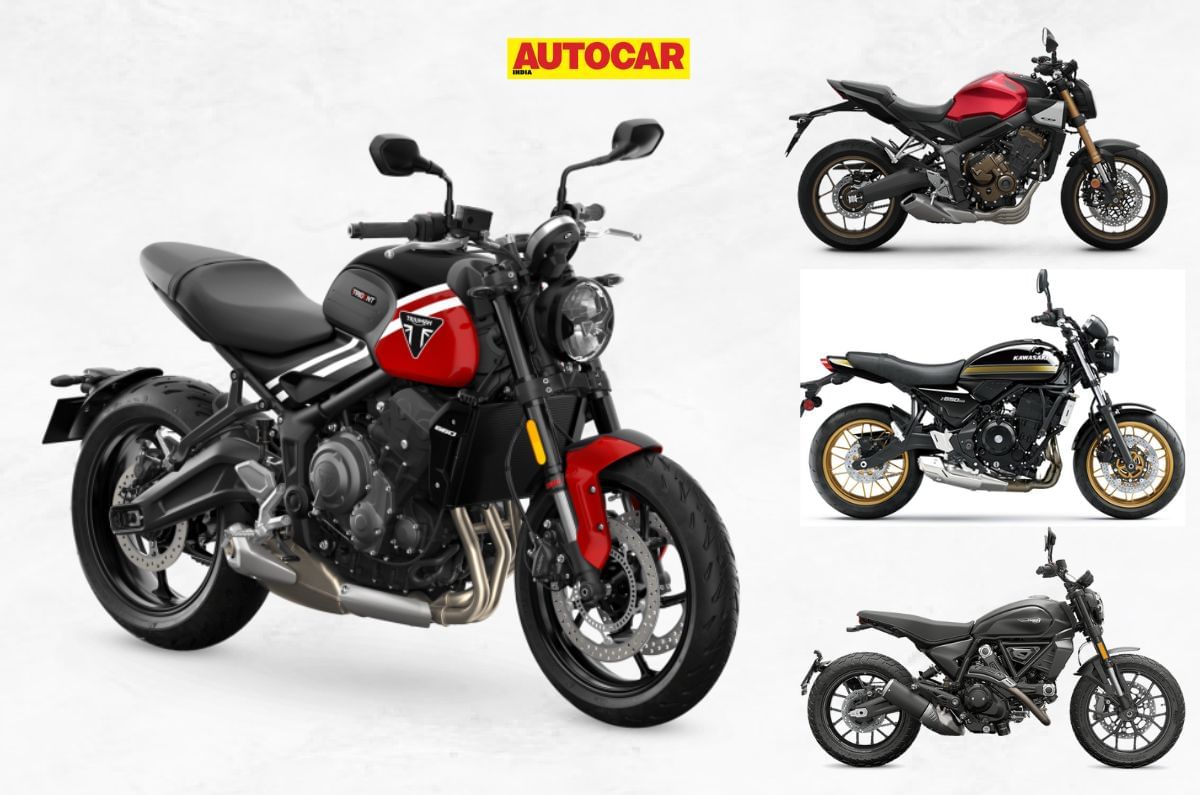
Triumph has revealed prices of the 2025 Trident and we pit it against its chief rivals
Triumph has launched the 2025 iteration of the Trident 660. For this model year, it gets a few new features as standard, and we’ve compared it against its key rivals to see how the smallest triple from Triumph stacks up on paper.
Triumph Trident 660 vs rivals: engine and output
| Engine and output | ||||
|---|---|---|---|---|
| Triumph Trident 660 | Honda CB650R | Kawasaki Z650RS | Ducati Scrambler Icon Dark | |
| Engine | 660cc, inline-3, liquid-cooled | 649cc, inline-4, liquid-cooled | 649cc, parallel-twin, liquid-cooled | 803cc, V-twin, air-cooled |
| Power | 81hp at 10,250rpm | 95hp at 12,000rpm | 68hp at 8,000rpm | 73hp at 8,250rpm |
| Torque | 64Nm at 6,250rpm | 63Nm at 9,500rpm | 64Nm at 6,700rpm | 65.2Nm at 7,000rpm |
| Gearbox | 6-speed | 6-speed | 6-speed | 6-speed |
| Power-to-weight ratio | 428.5hp/tonne | 458.9hp/tonne | 361.7hp/tonne | 414.7hp/tonne |
The Ducati is the only one to get a V-twin engine
No two motorcycles compared here share the same engine configuration. Starting with the Trident, it features the smallest triple-cylinder engine in Triumph’s portfolio. It delivers strong mid-range performance reminiscent of a parallel twin, accompanied by a smooth soundtrack. Earlier, the CB650R and Trident 660 were closely matched in terms of peak output, but now the CB650R has seen a significant increase in power, which is also reflected in its improved power-to-weight ratio.
The Z650RS produces the least amount of power among the group and uses a parallel-twin engine with a 180-degree crank. Although it lags in outright horsepower, it delivers torque figures on par with the others. While the Trident, CB650R, and Z650RS all feature inline-cylinder, liquid-cooled engines, the Ducati stands apart with its V-twin configuration (L-twin for Ducati purists), a layout typical of the brand. Interestingly, despite the V-twin’s characteristic focus on torque over peak power, the Ducati manages to produce slightly more torque than its rivals. It is also a relatively slim motorcycle, which should translate to more agile and flickable handling.
All motorcycles here come equipped with a six-speed gearbox. However, the CB650R is the only one to feature Honda’s e-clutch technology. This system offers both manual control when required and automatic clutch engagement/disengagement via an actuator, leaving only the foot-operated gear shifting to the rider. The Trident too, now gets a bi-directional quickshifter as standard, which was earlier an optional extra.
Triumph Trident 660 vs rivals: weight and dimension
| Weight and dimension | ||||
|---|---|---|---|---|
| Triumph Trident 660 | Honda CB650R | Honda CB650R | Ducati Scrambler Icon Dark | |
| Kerb weight | 190kg | 207kg | 188kg | 176kg |
| Fuel capacity | 14 Litres | 15.4 litres | 12 litres | 14.5 litres |
| Ground clearance | NA | 150mm | 125mm | NA |
| Seat height | 805mm | 810mm | 800mm | 795mm |
| Wheelbase | 1401mm | 1450mm | 1405mm | 1,449mm |
The Honda CB650R is the heaviest
The Scrambler is the lightest of the four, followed by the Z650RS. The Trident is just 2 kg heavier, while the CB650R comes out as the heaviest. One might assume the added weight is due to the innovative e-clutch system, but it contributes only around 2 kg to the overall mass. Despite the weight disadvantage, the CB650R manages a significantly better power-to-weight ratio by offsetting it with added power. It also features the largest fuel tank among the group.
These motorcycles are likely to be a rider’s first big bike, and their street-focused nature naturally results in accessible seat heights — a plus in this segment. All four bikes differ by just 5mm, a difference that’s unlikely to be noticeable in real-world use.
Triumph Trident 660 vs rivals: suspension, brakes and tyres
| Suspension, brakes and tyres | ||||
|---|---|---|---|---|
| Triumph Trident 660 | Honda CB650R | Kawasaki Z650RS | Ducati Scrambler Icon Dark | |
| Suspension (F/R) | USD fork /monoshock | USD fork / monoshock | Telescopic fork / monoshock | USD fork / monoshock |
| Brakes (F/R) | 310mm discs / 255mm disc | 310mm discs / 240mm disc | 300mm discs / 220mm disc | 330mm disc / 245mm disc |
| Tyres (F/R) | 120/70R-17 / 180/55R-17 | 120/70-17 / 180/55-17 | 120/70 R-17 / 160/60 R-17 | 110/80 R18 / 180/55 R17 |
The Z650RS gets a slimmer 160-section rear tyre
The Kawasaki Z650RS is the only motorcycle in this group equipped with a conventional telescopic fork, whereas the others feature upside-down (USD) forks. None of the bikes offer adjustability beyond preload, but all four are fitted with 41mm forks. The Triumph and Honda use units from Showa,, while the Ducati is equipped with a Kayaba fork.
The Ducati also stands out in its braking setup, being the only one to use a single front disc. However, it shouldn’t lag in braking performance, as it features the largest rotor of the group paired to a radial monobloc Brembo caliper and is also the lightest motorcycle here.
All four bikes come with similar tyre widths, though the Kawasaki Z650RS runs the narrowest rear tyre, with a 160-section profile. It’s the Ducati, though, that doesn’t run on conventional 17-inch wheels at both ends; instead, it gets an 18-inch front wheel. And while the Scrambler name might suggest otherwise, this isn’t an out-and-out off-roader — though it can comfortably handle light off-road trails.
Triumph Trident 660 vs rivals: features
Kawasaki Z650RS features an analogue instrument cluster
A TFT dash has quickly become the norm in today’s motorcycles. While three out of these four bikes feature a TFT display, each takes a different approach.
The Honda features a conventional rectangular display. Whereas, the Kawasaki features a retro-style dual pod analogue instrument cluster with a negative LCD display in between. The Honda CB650R now gets a TFT display with smartphone connectivity.
The Triumph setup pairs a digital rev counter with a much smaller colour TFT display below that can show only one widget at a time. Previously, the Bluetooth module was a costly accessory, priced at over Rs 20,000, but it is now offered as standard.
The Ducati, on the other hand, has the most distinct-looking TFT dash. It combines a rectangular TFT screen with a circular outer form on the right side, evoking the look of a classic round analog speedometer or tachometer. However, this circular effect comes from the binnacle’s design — the actual display itself is rectangular.
Triumph Trident 660 vs rivals: price
| Price | ||||
|---|---|---|---|---|
| Triumph Trident 660 | Honda CB650R | Kawasaki Z650RS | Ducati Scrambler Icon Dark | |
| Price (ex-showroom, Delhi) | Rs 8.49-8.64 lakh | Rs 9.60 lakh | Rs 7.20 lakh | Rs 9.97 lakh |
The Kawasaki Z650RS is the most affordable
Triumph recently unveiled the updated price of the Trident 660, which has gone up by Rs 37,000. The Honda CB650R was earlier launched at Rs 9.20 lakh, but that variant did not feature the E-Clutch functionality. The standard variants have now been discontinued, and the updated price stands at Rs 9.60 lakh.
The Kawasaki Z650RS remains the most affordable of the lot, which isn’t surprising given that it makes the least power, features a twin-cylinder engine, and comes with a conventional suspension setup. However, it still offers the trusted Kawasaki badge, its tried-and-tested 649cc motor, and retro styling.
The Scrambler Icon Dark, on the other hand, is the most affordable Ducati in India. However, in the scheme of this story, it’s the most expensive motorcycle — and unlike the other three, it isn’t a typical street naked.
Also see
