
The Nissan Magnite and Toyota Taisor are among the many that vie in the fiercely competitive compact SUV space. Both these sub-four-metre crossovers have naturally aspirated petrol engines with an AMT option, and a 100hp, 1.0-litre turbo-petrol engine with manual and automatic options. Here, we compare the real world fuel economy of the Magnite Turbo and Taisor Turbo in their respective manual and automatic forms.
- Nissan Magnite Turbo ARAI efficiency is 19.9kpl (MT) and 17.9kpl (CVT)
- Toyota Taisor Turbo ARAI efficiency is 21.18kpl (MT) and 19.86kpl (AT)
Nissan Magnite MT vs Toyota Taisor MT price and specifications
| Nissan Magnite vs Toyota Taisor Turbo price and specs | ||||
|---|---|---|---|---|
| Magnite MT | Taisor MT | Magnite CVT | Taisor AT | |
| Engine type | 3 cyl, turbo-petrol | 3 cyl, turbo-petrol | 3 cyl, turbo-petrol | 3 cyl, turbo-petrol |
| Displacement (cc) | 999 | 998 | 999 | 998 |
| Power (hp) | 100 | 100 | 100 | 100 |
| Torque (Nm) | 160 | 148 | 152 | 148 |
| Gearbox | 5-speed MT | 5-speed MT | CVT | 6-speed AT |
| Kerb weight (kg) | 1013 | 1030 | 1103 | 1060 |
| ARAI efficiency (kpl) | 19.9 | 21.18 | 17.9 | 19.86 |
| Auto start stop | No | Yes | No | Yes |
| Fuel tank (litres) | 40 | 37 | 40 | 37 |
| Price range (Rs, lakh) | 8.56-9.64 | 9.79-10.78 | 9.14-10.76 | 11.07-12.06 |
In terms of specifications and price, the Magnite and Taisor are well-matched, with Nissan’s compact SUV coming across as the more affordable one, and having a lower kerb weight, and a 12Nm higher torque figure in manual guise. However, the Toyota boasts auto start-stop tech, and higher ARAI mileage figures. However, the Magnite’s fuel tank is larger than the Taisor’s by 3 litres.
Nissan Magnite MT vs Toyota Taisor MT real world efficiency test result
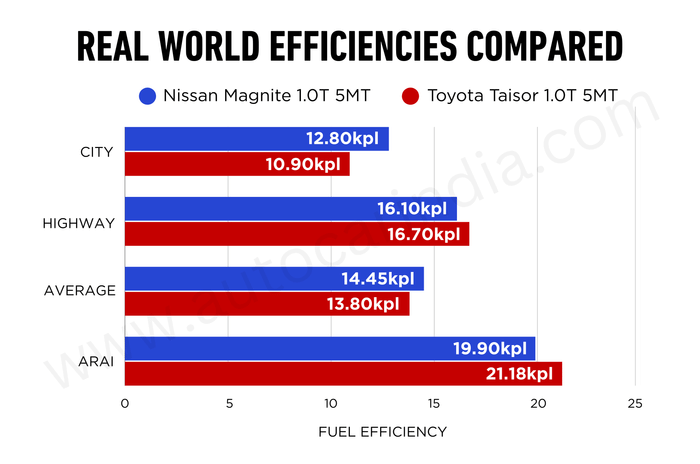
Magnite Turbo MT real world mileage is 0.65kpl more than Taisor Turbo MT
| Real world mileage – Manual gearbox | ||
|---|---|---|
| Magnite Turbo MT | Taisor Turbo MT | |
| Tested city mileage (kpl) | 12.80 | 10.90 |
| Tested highway mileage (kpl) | 16.10 | 16.70 |
| Tested average mileage (kpl) | 14.45 | 13.80 |
| ARAI range (km) | 796 | 784 |
| Tested range (km) | 578 | 511 |
In our real world fuel efficiency tests, the Nissan Magnite turbo-petrol-manual managed to go 12.8km on a litre of petrol in the city, while our highway tests saw it achieve 16.1kpl. This averages to 14.45kpl, which is 5.45kpl less than the ARAI figure of 19.9kpl, The Taisor Turbo manual managed to better the Magnite’s highway run by 0.6kpl, posting a 16.7kpl figure. However, Toyota’s compact SUV delivered 10.9kpl in our city fuel economy tests, which has brought the average real world efficiency to 13.8kpl. Not only does this mean the Magnite is more frugal than the Taisor in our real world tests, the 13.8kpl number is a whopping 7.38kpl less than the ARAI mileage figure of 21.18kpl. The magnite’s larger fuel tank and higher real world mileage also means that the Nissan compact SUV can go 67km further than the Toyota, when both are in manual form.
Nissan Magnite CVT vs Toyota Taisor AT real world efficiency test result
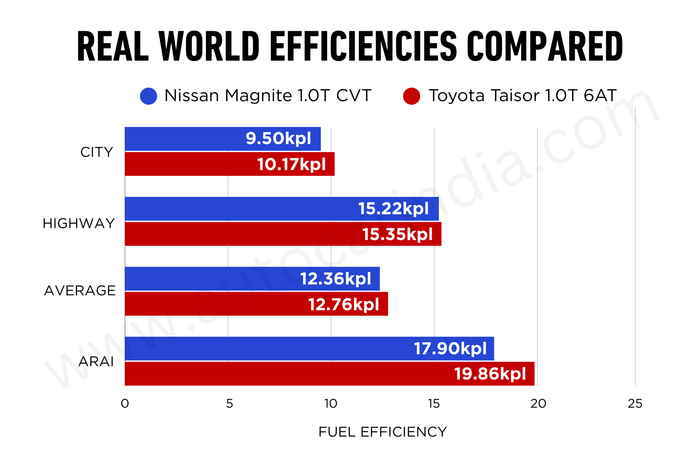
Taisor Turbo AT’s tested mileage is 0.4kpl higher than Magnite Turbo CVT
| Real world mileage – Automatic gearbox | ||
|---|---|---|
| Magnite Turbo CVT | Taisor Turbo AT | |
| Tested city mileage (kpl) | 9.50 | 10.17 |
| Tested highway mileage (kpl) | 15.22 | 15.35 |
| Tested average mileage (kpl) | 12.36 | 12.76 |
| ARAI range (km) | 716 | 735 |
| Tested range (km) | 494 | 472 |
In the city and highway efficiency runs, the Taisor Turbo with the 6-speed torque convertor automatic managed to just outperform the Magnite Turbo CVT by margins of 0.67kpl and 0.13kpl. This means Toyota compact SUV’s average mileage is 0.4kpl higher than the Nissan. On the other hand, the Taisor Turbo AT’s tested figure is a significant 7.1kpl short of the ARAI figure, while the Magnite Turbo CVT’s real world mileage number is 5.54kpl less than the claimed figure. It should be noted that the Magnite’s larger fuel tank means it could go 22km further on a single tank of petrol.
Autocar India’s fuel efficiency testing
Before our real-world fuel-efficiency tests, we fill our test cars’ tanks to the brim and maintain tyre pressures based on the manufacturer’s recommendation. These cars are driven in fixed city and highway loops in and around Navi Mumbai, and we maintain certain average speeds. Throughout the tests, there is only one person in each car, running the aircon and other electricals, such as the audio system, indicators and wipers, when required, just like a regular user would. Periodic driver swaps further neutralise variations in driver patterns. At the end of each cycle, we calculate efficiency by filling the tanks to full again.
