
Some teasers simply announce a comeback. Others open a door to history.
When BTS dropped the animated trailer for their upcoming album ARIRANG on Thursday, the video looked at first like a cinematic teaser.
But the deeper fans and historians looked, the clearer it became that the clip was rooted in a little-known episode from 1896, when seven Korean students in the United States recorded what is believed to be the earliest audio version of the folk song Arirang.
More than a century later, BTS appears to be drawing a quiet but powerful parallel between those students and themselves.
A Teaser That Reaches Back 130 Years
The animated trailer, released on BANGTANTV across BTS’s official social media platforms, begins in the year 1896. Seven young men gather around a phonograph as the melody of Arirang plays.
The narrative then shows the characters travelling across the Pacific Ocean before recording the song in a foreign land. The story eventually shifts to the present day, ending with BTS performing on stage before a crowd illuminated in purple light, a colour long associated with the group and its fanbase.
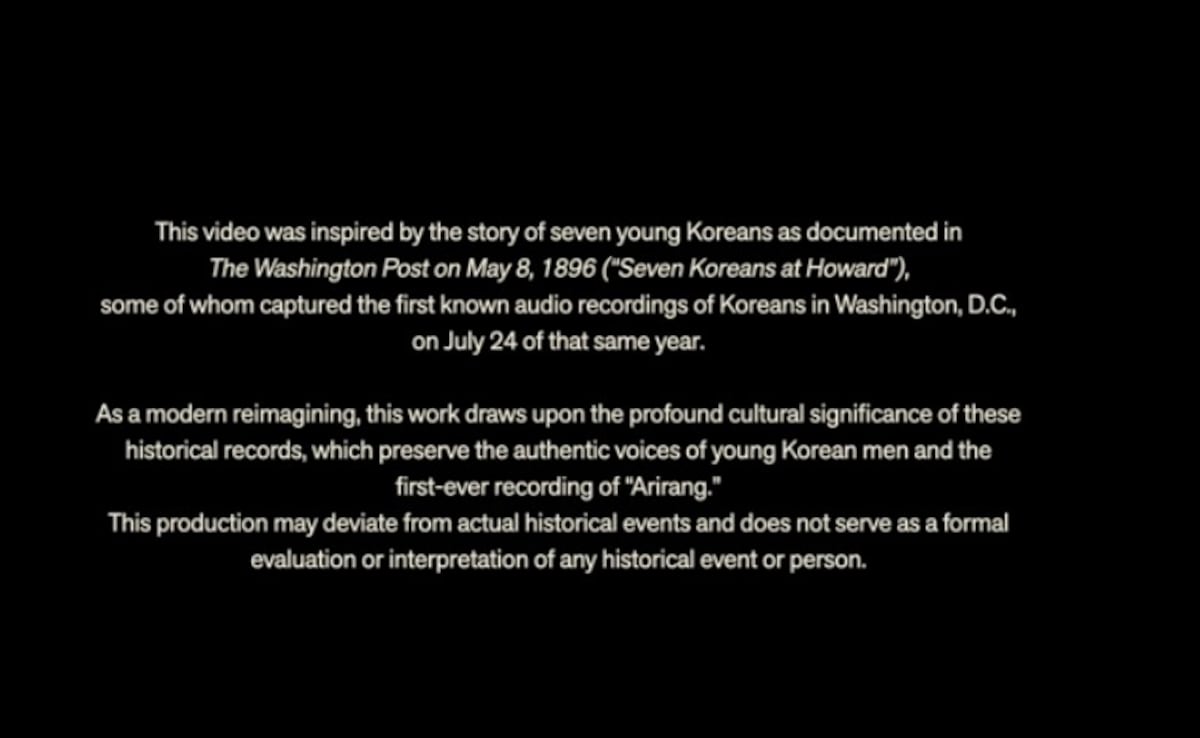
Before the animation begins, a disclaimer explains the historical inspiration. The video references a Washington Post article from May 8, 1896, titled Seven Koreans at Howard, which documented seven Korean students studying in the United States.
A still from Arirang trailer.
Historical records suggest that some of those students later made what are believed to be the earliest recordings of Korean voices in Washington, DC, on July 24 of the same year, including the first known recorded version of the folk song Arirang.
Big Hit Music noted that the trailer should not be taken as a documentary recreation.
“We wanted to share the story behind ‘Arirang’ with those who may not be familiar with the song,” the label said, adding, “We hope more people will look up its lyrics and connect with the uniquely Korean emotions embedded in the music.”
The Real Story Of The Seven Students
The original newspaper report described the students in dramatic terms.
On May 8, 1896, The Washington Post published an article titled “Seven Koreans at Howard: Ran Away from Home to be Educated in United States.” The story described them as young men from elite families who had unexpectedly travelled to America.
The article framed their journey as adventurous and mysterious, calling it “somewhat wild and romantic.”
Historical records offer additional details. According to historian Rayford W. Logan’s history of Howard University, cited by researcher Karis Lee, six of the students had fled Japan after allegedly stealing money from a Korean bank in the spring of 1896.
Their names are believed to include: Im Byung Goo, Lee Bum Su, Kim Hun Sik, Ahn Jung Sik, Eyo Byung Hyun and one unidentified student.
A seventh student later joined them in Washington.
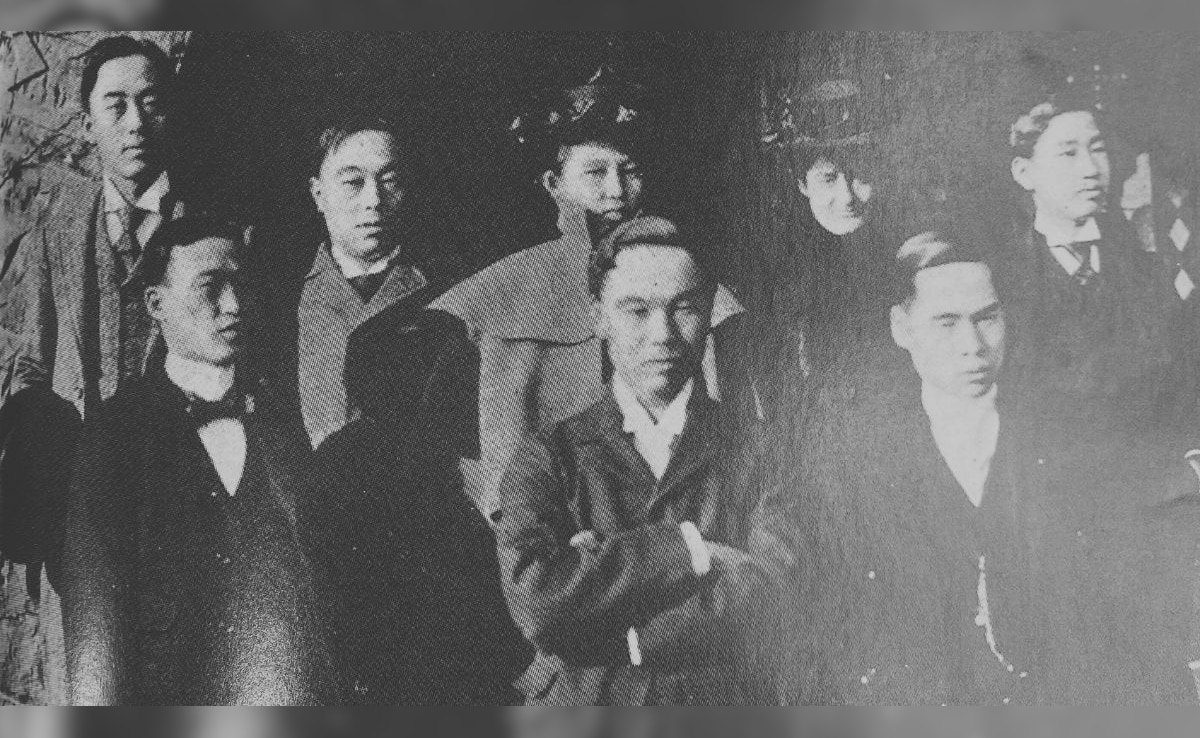
A throwback image of the Korean students.
The Library of Congress notes that the Korean students who eventually made the recordings were not linked to political uprisings and that they had run out of funds after leaving Japan. By the spring of 1896, the group found themselves stranded in Canada and sought assistance from the Korean Legation in Washington.
A Diplomat Who Understood Exile
The man who helped them was Suh Kwang Bum, Korea’s envoy to the United States at the time.
His decision to assist the students was shaped by his own complicated past. Suh had participated in the Gapsin Coup of 1884, an attempted reformist uprising in Korea. When the coup failed, he fled the country and eventually returned to Washington, where he had earlier diplomatic connections.
By 1896, Suh was again serving in the United States as Korean Envoy and Minister Plenipotentiary.
Recognising the students’ predicament, he intervened. Records from Howard University show that on April 29, 1896, Suh requested that the school provide accommodation for the Korean students.
Howard’s Executive Committee agreed to provide rooms in Clark Hall free of charge, while Suh offered to pay for furniture.
Why The Students Ended Up At Howard
Howard University, founded in 1867 to educate formerly enslaved African Americans, became an unusual but important destination for the students.
In the late 19th century, racial barriers limited where international students of colour could study in the United States. Howard, however, had already established itself as a place willing to educate students who might face discrimination elsewhere.
The Washington Post reported that professors at Howard took a personal interest in helping the students adapt.
During summer vacation, they were placed with professors’ families who would “coach” them in English. When they first arrived, the students communicated largely through gestures and the few English phrases they had picked up during their journey.
The Singers Who Charmed Their Hosts
One detail repeatedly mentioned in historical accounts was their musical talent.
According to the Washington Post, a social gathering took place on the night of their arrival at Howard. The students were described as quiet and observant, as guests encouraged them to sing.
At first, the young men hesitated.
They explained that they could not sing in English. But their hosts insisted that it did not matter.
Eventually, the evening’s programme – which had included songs such as Suwanee River – was “diversified by specimens of real Korean melody.”
Those melodies would soon become historically significant.
Recording Arirang In Washington
On July 24, 1896, American ethnologist Alice C Fletcher invited three of the Korean students to her Washington home.
Fletcher, known for her research on Native American music, recorded the students performing traditional Korean songs on wax cylinders, an early recording technology.
Over two days, the students produced six recordings.
Among them was a song labelled Love Song: Ar-ra-rang. It is believed to be the first recorded version of the folk song Arirang.
The singers identified in the recordings include Ahn Jeong-sik, Lee Hee-Cheol and Son Rong.
One student, Jong Sik Ahn, performed a piece that Fletcher partially transcribed. The lyrics included references to Korea’s mountains, moonlit nights and centuries-old traditions.
Today, those wax cylinder recordings are preserved by the Library of Congress. In 2017, they were exhibited at the Seoul Arirang Festival, returning to Korea 121 years after they were made.
A Song Recorded During A National Crisis
The recordings were made at a turbulent moment in Korean history.
In the 1890s, Korea was caught in a geopolitical struggle between powerful neighbours. Japan had defeated China in the First Sino-Japanese War, fought largely over influence on the Korean peninsula.
In October 1895, Japanese agents assassinated Queen Min. Just months later, in February 1896, King Gojong fled to the Russian legation in Seoul for protection.
For the students recording Arirang in Washington that summer, their homeland was facing profound uncertainty.
Full Japanese annexation would arrive in 1910, but the loss of sovereignty was already looming. Recording a Korean folk song in a permanent medium during such a moment carried symbolic weight, preserving a piece of cultural identity far from home.
The Symbolic Bridge To BTS
The parallels drawn in BTS’s trailer are hard to miss.
Seven Korean students in 1896. Seven BTS members in 2026.
Both groups represent Koreans carrying their culture across borders and presenting it to global audiences.
In the trailer, a red thread appears as a visual bridge between the historical story and the present-day group. In Korean cultural symbolism, the red thread is often associated with fate and connection.
Fans have long used the imagery to describe the bond between the seven members and their audience.
The trailer’s visual design also leans heavily into the aesthetics of the late 19th and early 20th centuries. The album artwork shows BTS dressed in formal tailored suits reminiscent of historical portrait photography, echoing the kind of images the Howard students themselves might have taken.
A Global Campaign Built Around A “Love Song”
The trailer arrives as part of a wider promotional campaign for ARIRANG.
The phrase “What is your love song?” first appeared on billboards in London shortly before Valentine’s Day. The campaign soon spread to Seoul and New York, with similar displays appearing near Seongsu Station and in neighbourhoods such as SoHo, East Village and Brooklyn.
In Seoul, an art installation at COEX covered in roses invited visitors to remove flowers from the wall. As they did so, the BTS logo gradually appeared underneath.
Big Hit Music described the idea behind the campaign in simple terms: a “love song” could be a memory, a source of comfort or a symbol of strength.
BTS Return After Military Hiatus
ARIRANG will mark BTS’s first full album in more than three years, following a period during which all seven members completed their mandatory military service.
The 14-track album is scheduled to release on March 20, 2026.
Production credits include Pdogg, Kevin Parker of Tame Impala, Flume, JPEGMAFIA, Mike WiLL Made-It and Ryan Tedder.
The group will perform BTS Comeback Live: ARIRANG at Gwanghwamun Square in Seoul on March 21, with the concert livestreamed globally on Netflix.
The Legacy Of The Seven Voices
The identities of the seven Korean students are only partially known today.
Some names appear in historical records: Im Byung Goo, Lee Bum Su, Kim Hun Sik, Ahn Jung Sik and Eyo Byung Hyun. One remains unidentified.
What happened to them afterwards is unclear. Some may have returned to Korea. Others might have remained abroad.
But their recordings survived: six wax cylinders, preserving Korean voices from more than a century ago.
Today, there are more than 60 recognised regional versions of Arirang and thousands of lyrical variations built around its famous refrain: “arirang, arirang, arariyo.”
Across 130 years, the melody has endured.
And now, with BTS returning to it on a global stage, the song’s journey – from a phonograph in Washington in 1896 to stadiums in the 21st century – continues.
