
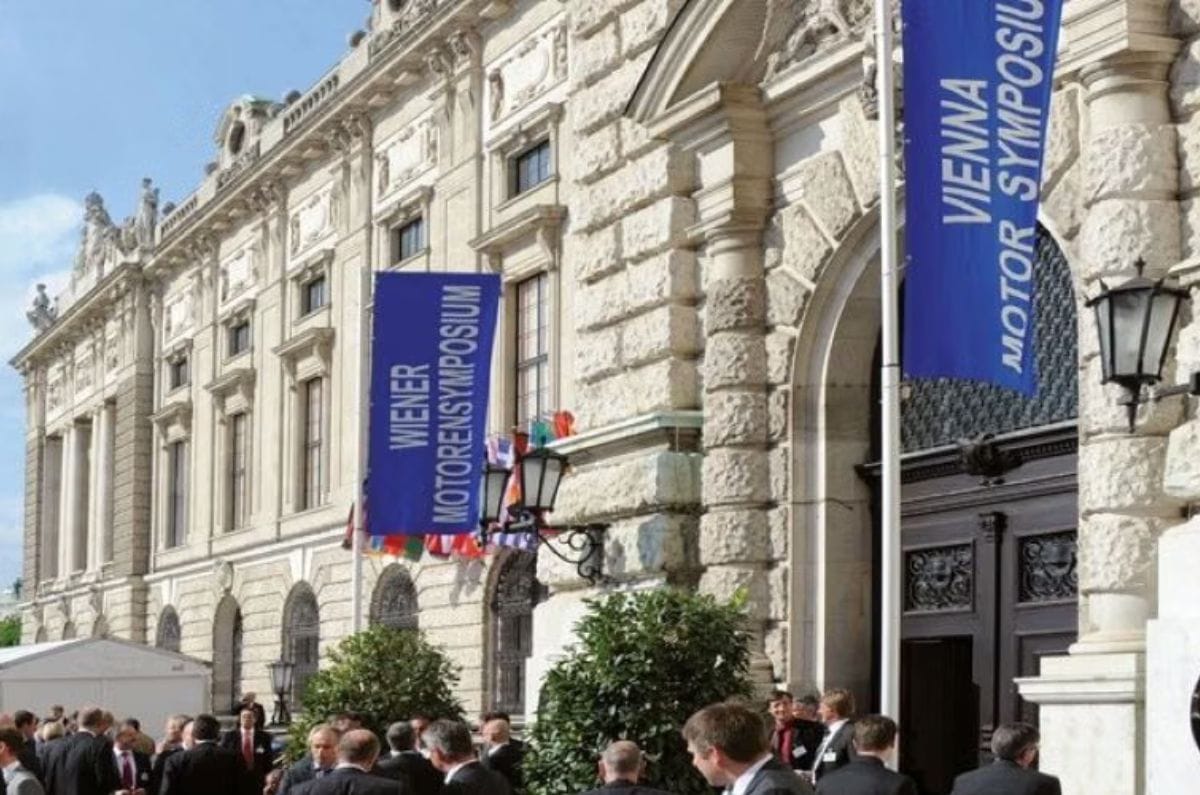
The International Vienna Motor Symposium will take place from April 22 to 24, 2026, with more than 1,000 attendees expected from over 20 countries. The event serves as one of the automotive industry’s principal forums for engineers, researchers, and executives to present and debate developments about future powertrain technologies.
- Vienne Motor Symposium to discuss and debate future powertrain technologies
- First-time attended China SAE underlines growing relevance of Chinese auto engineering
- The event has a history spanning nearly five decades
A notable addition this year is the participation of the Society of Automotive Engineers of China (China SAE), marking its first appearance at the symposium. The inclusion reflects the growing role of Chinese automotive engineering on the global stage, particularly as Chinese manufacturers expand their presence in electric and hybrid vehicle markets. Discussions at the symposium will cover developments in range extender technology, as well as current efficiency benchmarks for hybrid gasoline engines.
Frank Blome, CEO of PowerCo SE — Volkswagen’s battery subsidiary — will conduct the closing plenary session scheduled for Friday. Blome is expected to speak about Volkswagen’s revised battery strategy and the status of production at the company’s Salzgitter plant in Germany, a facility central to the automaker’s plans for large-scale battery cell manufacturing.
What is the Vienna Motor Symposium?
The symposium’s broader theme this year centers on the argument that no single propulsion technology can address the full range of challenges facing the automotive sector. Prof. Dr. Bernhard Geringer, chairman of the Austrian Society of Automotive Engineers (ÖVK) and host of the event, has framed the conversation around what he describes as a need for a resilient technology portfolio rather than a commitment to any one drive system. He noted that current and future pressures around energy supply call for the combined development and deployment of all available technologies.
The position reflects a wider debate within the industry about the pace and nature of the transition away from internal combustion engines, with some manufacturers and policymakers advocating for a more gradual, technology-neutral approach.
The event has a history spanning nearly five decades. It was conceived by Prof. Dr. Hans Peter Lenz of the Vienna University of Technology in the 1970s and held for the first time in 1979. Since 1985, it has been organized by the ÖVK, which was founded the same year and currently counts approximately 750 full members. The society’s stated goal is to promote the responsible application of automotive engineering through scientific events that build expertise across the industry. Geringer has led the organization since 2017.
