
OpenAI is said to be moving towards building new custom processors for smartphones. According to an analyst, the San Francisco-based artificial intelligence (AI) company has partnered with MediaTek and Qualcomm, and both chipmakers are expected to benefit from long-term demand if smartphones with agentic AI capabilities gain traction. The project, however, is still believed to be in the infancy stage, with mass production currently targeted for 2028. The analyst said that the supply chain is expected to involve Luxshare as the exclusive system co-design and manufacturing partner.
OpenAI’s Phone May Prioritise Power Efficiency, Memory Management
In an X post, TF Securities International analyst Ming-Chi Kuo writes that OpenAI’s ambitions extend beyond building chips, with the company reportedly exploring a broader push into AI-centric smartphones. The analyst said that MediaTek and Qualcomm are expected to benefit from long-term demand if AI agent smartphones gain traction.
According to claims, the processor design is expected to prioritise power efficiency, memory management, and on-device AI capabilities, while more complex tasks would be offloaded to cloud infrastructure. Specifications and supply chain partners of the said processor may be finalised by late 2026 or early 2027.
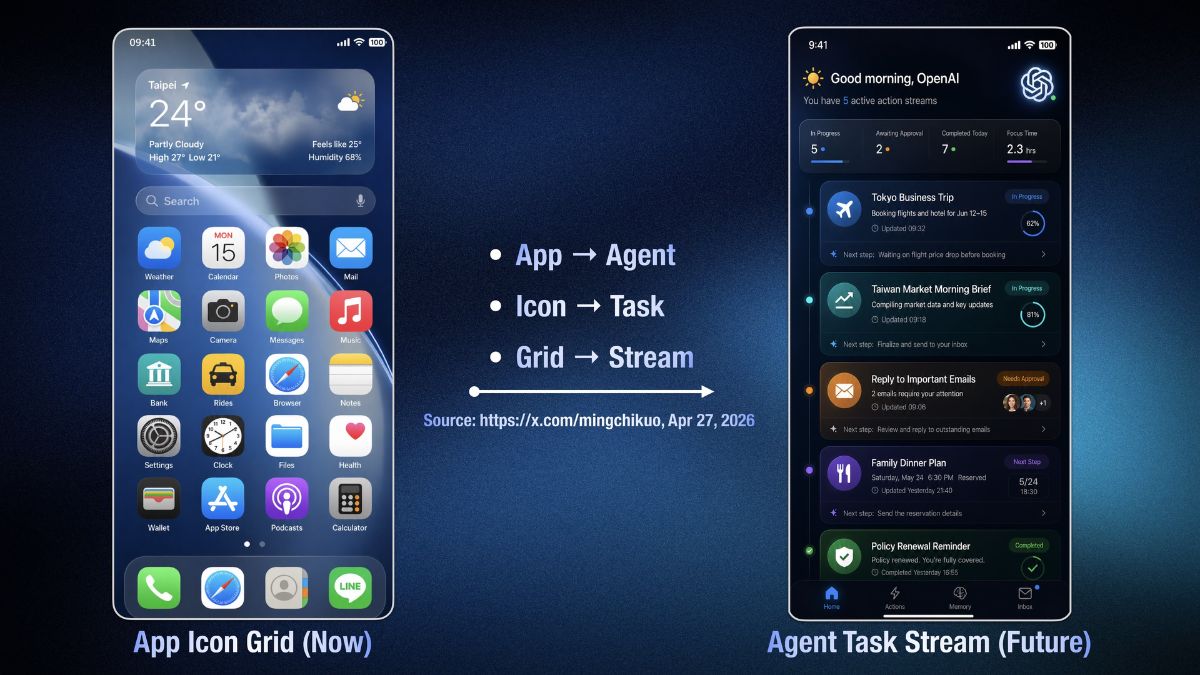
A conceptual smartphone interface to illustrate the potential evolution of the AI-driven experience, with iPhone as a reference point
Photo Credit: X/ Ming-Chi Kuo
The concept of an AI agent is said to be a driving force behind OpenAI’s latest initiative, which could potentially bring about a shift in how users interact with their devices. Instead of navigating multiple apps, they may rely on a unified system that directly completes tasks, as per the analyst. If this move comes to fruition, it would signal a departure from the traditional app-based ecosystems toward more context-aware computing.
According to Kuo, OpenAI views the tighter integration of software, operating systems, and physical hardware as essential to its long-term strategy. To deliver a seamless AI agent experience, the company is said to be prioritising control over both hardware and software ecosystems. The analyst further noted that smartphones remain the most critical device category for capturing the real-time user data necessary for effective AI inference.
The analyst further suggests that OpenAI could take advantage of its strengths in AI models, consumer brand recognition, and accumulated user data to build an ecosystem. Apart from this, the AI firm may also explore bundling hardware with subscription-based services.
OpenAI, notably, has already signalled its interest in developing chips and other AI-centric hardware. It is believed to be building an AI device in partnership with former Chief Design Officer at Apple, Jony Ive. The AI firm also announced a multi-year strategic collaboration with Broadcom in 2025 — a move that would see the two companies design and develop chips and systems to power the growing demands of AI compute.
