
By the time Prada’s Spring-Summer 2026 menswear show wrapped up in Milan last June, the applause had barely faded before the outrage began. On the runway were toe-loop leather sandals that looked unmistakably familiar to anyone who has ever walked the lanes of Kolhapur or browsed a Maharashtra handicrafts fair.
Prada’s show notes, however, described them simply as “leather sandals,” with no mention of India, no nod to the 12th-century craft tradition they had drawn from so liberally. Now, nearly a year later, Prada is back with the same silhouette. But this time, with a very different story to tell.

The backlash was swift and vocal. India’s fashion community erupted. Artisans from western Maharashtra, who make Kolhapuri chappals for a living, sometimes earning as little as ₹500 to ₹1,000 per pair, were furious at seeing their heritage repackaged without credit at a price point of €750 (roughly ₹70,000) a pair. MACCIA (Maharashtra Chamber of Commerce, Industry and Agriculture) wrote directly to the brand. BJP MP Dhananjay Mahadik led a delegation of artisans to meet Maharashtra Chief Minister Devendra Fadnavis, pushing him to act on what they saw as a violation of their Geographical Indication rights, The Indian Express reported earlier.
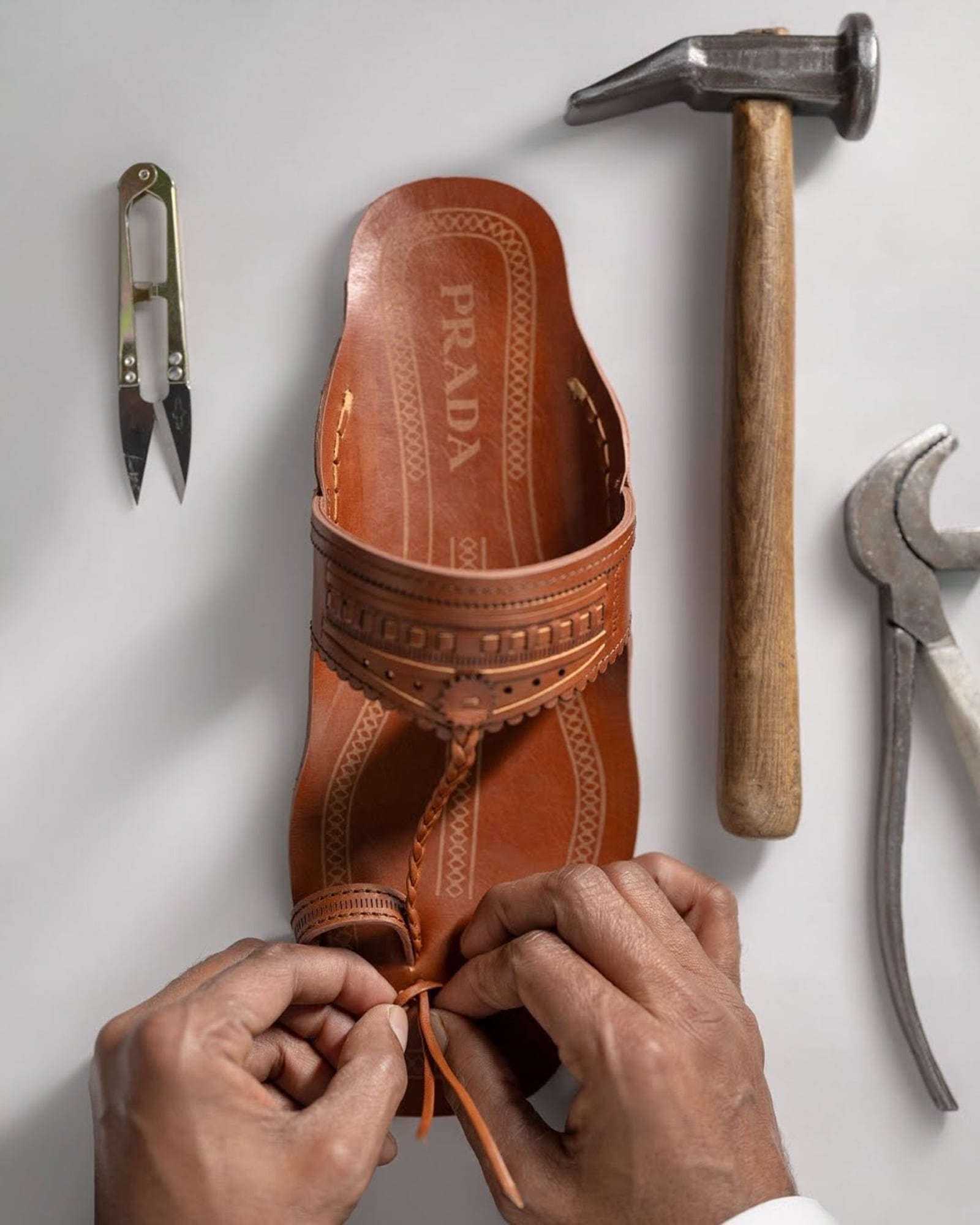 A Kolhapuri sandal by Prada (Source: Instagram/Prada)
The GI tag matters enormously here. Granted by the Government of India in 2019, it is a formal certification that ties the Kolhapuri chappal to its region of origin. Using the design without acknowledging that origin, artisans argued, wasn’t just bad optics. It was an ethical breach.
Prada, to its credit, did not stonewall. In a reply to MACCIA, a company representative stated: “We acknowledge that the sandals featured in the recent Prada Men’s 2026 Fashion Show are inspired by traditional Indian handcrafted footwear, with a centuries-old heritage. We deeply recognise the cultural significance of such Indian craftsmanship.”
Lorenzo Bertelli, Prada Group’s head of corporate social responsibility, added that the company was “committed to responsible design practices, fostering cultural engagement, and opening a dialogue for a meaningful exchange with local Indian artisan communities.”
A step in the right direction
Prada’s answer has now arrived in the form of a limited-edition collection that it is calling Prada Made in India x Inspired by Kolhapuri — and for once, the label tells you exactly what it is. According to the brand, the sandals have been manufactured in India by skilled artisans from LIDCOM and LIDKAR, organisations working with craftspeople in Maharashtra and Karnataka, the two states at the heart of Kolhapuri production.
The collection is available across 40 Prada stores worldwide and online, with each pair handmade. The brand describes the line as one that “combines traditional techniques with contemporary design and premium materials,” creating what it calls “a dialogue between Indian heritage and modern luxury expression.” The price remains high, but the supply chain now runs through Indian workshops rather than past them.
Story continues below this ad
Despite this, netizens are not impressed. One user wrote: “This isn’t inspired by the Kolhapuri. This IS the Kolhapuri.” Another pointed out the high price, stating, “The fact that people can get original Kolhapuri sandals at half the price is wild. Why copy an inspired design and charge more for it? Make no sense for me.” A third user poked fun at the collection, drawing a parallel: “Turmeric latte inspired by haldi doodh.”
A new training programme
The more consequential announcement is what comes alongside the collection. Prada has committed to a three-year training programme for artisans from the eight Indian districts traditionally associated with Kolhapuri production, funded by the brand, including through proceeds from the sale of the limited-edition sandals.
Developed in collaboration with two of India’s leading design institutions like the National Institute of Fashion Technology (NIFT) and the Karnataka Institute of Leather and Fashion Technology (KILT), the programme will train 180 artisans through six-month modules, with select participants potentially continuing their training at the Prada Group Academy in Italy.
A brief history and what this means
Kolhapuri chappals, as Shweta Navandar, Associate Professor in Fashion Communication at Pearl Academy Mumbai, has noted in an earlier conversation with indianexpress.com, trace their origins to the 12th century, to the reign of King Bijjal of Karnataka and his prime minister Vishwaguru Basavanna, who worked to uplift cobbler communities.
It was not until the 20th century, under Chhatrapati Shahu Maharaj of Kolhapur, that the footwear began to be widely traded. More than 800 years of craft history, in other words, sat behind those runway sandals last June.
Story continues below this ad
As such, Prada’s response has moved beyond an apology into something more structural: actual production in India, actual artisan involvement, actual investment in skills. For now, the artisans of Kolhapur and Karnataka have something they didn’t have a year ago: a modest seat at the table of a global luxury brand.
