
Headless commerce and composable commerce are often discussed together, but they are not interchangeable.
Headless commerce separates the frontend experience from the backend commerce engine, allowing teams to build custom storefronts while continuing to rely on a single core platform for checkout, catalog, and order management. It is often the first step away from a monolithic ecommerce system.
Composable commerce goes further by breaking the entire commerce stack into modular, API-first services. Instead of one backend, teams assemble best-of-breed components, such as project information management (PIM), search, content management system (CMS), checkout, and payments, all connected through APIs and orchestration layers.
In general, I recommend the following:
- Headless commerce, if you want frontend flexibility with lower architectural complexity
- Composable commerce, if you need maximum modularity, long-term flexibility, and are prepared to manage integration, governance, and ongoing operational costs.
What “headless” and “composable” commerce actually mean
Both headless and composable commerce move away from monolithic ecommerce platforms, but their main difference is how far that decoupling goes. With headless, the frontend experience is separated from a single backend system. Meanwhile, composable commerce breaks the entire commerce stack into modular, API-connected services.
Headless commerce
In headless architecture, the frontend is decoupled from the backend commerce platform. The user interface can be built using modern frameworks such as React or Vue, while the backend exposes commerce functionality through APIs.
The backend still acts as a centralized system of record for product data, pricing, checkout, and orders.
Typical outcomes of a headless commerce approach include faster frontend iteration, greater control over the user experience, and continued reliance on a single commerce engine to manage core functions such as checkout, pricing, and order processing.
Read more: What Is Headless Commerce and Why It Matters for Retail
Composable commerce
Composable commerce uses a modular approach built from independent, API-first services. Each commerce capability is treated as a replaceable component rather than a feature bundled within a single platform.
Composable stacks often align with MACH principles by relying on microservices, API-first design, cloud-native infrastructure, and headless delivery. Together, these principles support modular development, independent scaling, and the ability to evolve individual services without tightly coupling the entire commerce stack.
In practice, this means teams select separate services for catalog management, checkout, search, content, personalization, and analytics, then integrate them through orchestration and middleware layers.
Typical outcomes of a composable commerce approach include deep flexibility across the entire stack, reduced reliance on any single vendor, and increased integration and operational overhead as teams manage multiple interconnected services.
Key terminology at a glance
- Decoupled frontend: The presentation layer is independent of backend systems
- API-first: All functionality is accessed through APIs
- Microservices: Small, independent services that perform specific functions
- MACH (microservices, API-first, cloud-native, and headless): A set of architectural principles commonly associated with composable commerce
The diagram below shows how these two approaches differ at a structural level.
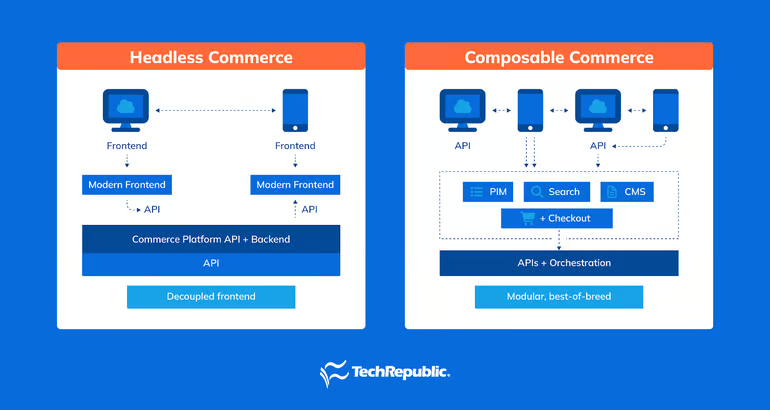
Headless vs composable commerce: A side-by-side comparison
The following comparison table outlines how headless and composable commerce differ across key architectural, operational, and organizational criteria to help teams evaluate which approach aligns best with their current capabilities and long-term goals.
| Architecture diagram | Decoupled frontend with a single backend | Fully modular services across frontend and backend |
| Typical tech components | Frontend framework + commerce platform APIs | PIM, OMS, CMS, search, checkout, payments as separate services |
| Speed to market | Faster than monoliths | Slower initial setup, faster long-term change |
| Developer experience | Frontend flexibility, simpler backend | High flexibility, heavier integration workload |
| Total cost of ownership | Moderate | Higher upfront and operational costs |
| Operational overhead | Manageable | Requires strong integration governance |
| Scalability | Good | Excellent for large, multi-brand operations |
| Omnichannel support | Strong | Strong, with more customization options |
| Vendor lock-in risk | Reduced, but still present | Significantly reduced |
| Organizational fit | Mid-market to enterprise organizations | Large enterprises or technically mature mid-market teams |
Composable commerce typically delivers more flexibility, but that flexibility comes with additional integration, monitoring, and governance responsibilities.
Pros, cons, and hidden tradeoffs
While headless and composable commerce both improve flexibility compared with monolithic platforms, each comes with distinct advantages and tradeoffs.
Headless commerce
| Pros | Cons |
|---|---|
| ✅Faster frontend development cycles | ❌Backend constraints still apply costs |
| ✅Lower architectural complexity than composable | ❌Limited flexibility for replacing individual backend services |
| ✅Easier to staff and support | ❌Less future-proof than fully modular approaches |
| ✅Works well with existing commerce platforms |
Headless commerce offers faster frontend development and simpler operations compared with composable architectures, making it easier to staff, support, and maintain. Teams gain flexibility at the presentation layer while keeping familiar backend workflows intact, reducing implementation risk and shortening time to value.
The tradeoff is that core commerce capabilities remain tied to a single backend, limiting how easily individual services can be replaced or optimized. As business requirements grow more complex, backend constraints may slow innovation, requiring additional customization or eventual re-architecture to avoid accumulating technical debt.
This approach favors incremental modernization over full-stack transformation for many organizations today.
Composable commerce
| Pros | Cons |
|---|---|
| ✅Best-of-breed components for each function | ❌Higher integration and maintenance costs |
| ✅Easier to adopt new technologies, such as AI-driven search or personalization | ❌Requires mature DevOps and API governance |
| ✅Reduced long-term vendor dependency | ❌Longer initial implementation timelines |
Composable commerce delivers maximum architectural flexibility by allowing organizations to assemble best-of-breed services across the commerce stack. This approach reduces long-term vendor dependency and supports continuous optimization of individual capabilities as needs change.
The tradeoff is higher operational overhead, including integration management, monitoring, and cross-service governance. Teams must coordinate releases, handle failures across systems, and invest in DevOps maturity to maintain reliability.
For organizations without sufficient engineering resources, composable architectures can slow execution despite their flexibility, shifting effort from platform limitations to ongoing operational and integration responsibilities. Clear ownership models and strong documentation become critical for sustaining velocity at scale.
When to choose between composable and headless commerce
When to choose headless commerce
Choose headless commerce if:
- Your primary goal is frontend flexibility
- You want faster time to value
- Your team has limited DevOps or integration capacity
- You are modernizing an existing platform incrementally
Headless commerce is typically the better choice when the primary objective is improving frontend flexibility without introducing significant architectural overhead. It works well for organizations that want faster time to value, have limited DevOps or integration resources, or are incrementally modernizing an existing commerce platform.
When to choose composable commerce
Choose composable commerce if:
- You operate multiple brands, regions, or channels
- You need to swap or add services frequently
- Your engineering team is comfortable with distributed systems
- Long-term flexibility outweighs short-term complexity
Composable commerce is better suited for organizations operating across multiple brands, regions, or channels, where backend flexibility is as important as frontend control. It is a stronger fit when teams need to add, replace, or scale individual services frequently and have the engineering maturity to manage distributed systems
How different teams or stakeholders evaluate the decision
- CTO: For a CTO, the decision centers on architectural scalability, integration risk, and long-term platform sustainability.
- Head of product: Heads of product focus on speed of experimentation — how quickly teams can test, iterate, and launch new experiences.
- Platform engineering: Platform engineering teams are responsible for observability, reliability, and system coordination, which become more demanding in composable environments.
- Ecommerce operations: Ecommerce operations teams prioritize day-to-day stability, support workflows, and incident response, making simpler architectures easier to manage at scale.
Implementation considerations
Beyond architectural differences, headless and composable commerce introduce very different implementation requirements.
Team and skills
Implementation requirements differ significantly between headless and composable architectures. Composable commerce typically requires greater engineering maturity, including experience with API design and governance, DevOps and SRE practices, and frontend development with modern frameworks. Because multiple services must work together reliably, teams also need clear ownership models and strong cross-team coordination.
Headless commerce, by contrast, can often be supported by smaller teams with less specialized infrastructure expertise, since core backend responsibilities remain centralized within a single platform.
Cost
Cost structures also vary by approach. Headless commerce concentrates spending around platform licensing and frontend development, while composable commerce introduces additional costs tied to integration, middleware, and ongoing operations. Monitoring, logging, incident response, and long-term maintenance become more prominent cost drivers as the number of services increases.
In many cases, composable commerce shifts overall spend away from licensing and toward engineering and operational investment.
Key costs include:
- Licensing across multiple vendors
- Integration and middleware development
- Monitoring, logging, and incident response
- Ongoing platform maintenance
Security and performance
Both approaches rely heavily on APIs, making security and performance critical. Common best practices include CDN-based caching to reduce latency, API rate limiting to protect backend services, centralized authentication and authorization, and regular performance testing to identify bottlenecks across interconnected systems. Strong observability becomes increasingly important as architectures grow more distributed.
Migration and rollout patterns
Most organizations do not move directly from a monolithic commerce platform to a fully composable architecture. Instead, they adopt a phased migration strategy that reduces risk while preserving business continuity. A common starting point is headless commerce, where the frontend is decoupled first to enable faster experience updates without disrupting backend operations. From there, individual backend capabilities can be replaced incrementally with composable services as requirements evolve.
The strangler pattern is frequently used in these migrations. New services are introduced alongside existing systems and gradually take over specific functions, such as search, content, or checkout. This approach allows teams to test integrations in production, roll back changes if failures occur, and avoid large, high-risk cutovers. Hybrid architectures are common during this transition period and may persist long term.
Practical rollout timelines
A typical timeline begins with a minimal viable headless implementation focused on frontend performance and flexibility. Once stable, teams add composable components one at a time, prioritizing areas with the highest impact or constraints. Throughout the rollout, staging environments, observability tooling, and clear rollback strategies are essential to maintaining reliability as architectural complexity increases.
Many organizations follow a phased approach:
- Start with headless to decouple the frontend
- Introduce composable services one function at a time
- Gradually retire monolithic backend dependencies
The strangler pattern is commonly used to minimize risk and allow rollback if integrations fail.
Case studies: Headless and composable commerce in practice
Real-world implementations help clarify how headless and composable commerce work in practice. The following case studies highlight how large organizations have applied these architectures to solve different challenges, including frontend agility, omnichannel scale, and long-term flexibility.
Rather than representing one-size-fits-all solutions, these examples illustrate common adoption patterns: using headless commerce to modernize experiences, evolving toward composable architectures over time, and deploying fully modular stacks to support complex, customization-driven use cases.
Nike: From headless foundations toward modular commerce
Nike is frequently cited as an example of an enterprise that used headless commerce as a foundation before adopting more modular, composable patterns over time. The company decoupled its frontend experiences from backend systems to support faster iteration across web and mobile channels, while relying on APIs to integrate inventory, personalization, and loyalty services.
This headless approach enabled Nike to improve performance and deliver more dynamic customer experiences at scale. Over time, Nike layered in additional modular services, moving closer to a composable model to support advanced personalization, real-time data integration, and global scalability without a single backend bottleneck.
Target: Enterprise headless commerce for omnichannel scale
Target adopted a headless commerce architecture to support consistent digital experiences across its website, mobile apps, and in-store touchpoints. By separating frontend delivery from backend commerce systems, Target improved site performance, handled high-traffic events more reliably, and accelerated content and feature updates without disrupting core operations.
This architecture allowed teams to integrate third-party services and real-time data more efficiently, supporting Target’s complex omnichannel fulfillment and seasonal demand. The headless model helped balance frontend agility with backend stability in a large-scale retail environment.
LEGO: Composable commerce for customization and flexibility
LEGO is often referenced as an enterprise example of composable commerce used to support rich product customization and evolving digital experiences. By adopting a modular, API-driven architecture, LEGO integrated specialized services for content, product configuration, payments, and customer engagement rather than relying on a single commerce platform.
This composable approach allowed teams to introduce new capabilities and optimize individual services without large-scale platform changes. The result was greater flexibility to support interactive product experiences and ongoing innovation, albeit with higher integration and operational requirements.
Future trends and what to watch
Composable architectures are increasingly aligned with emerging ecommerce trends that prioritize flexibility, speed, and intelligent decision-making. AI-driven personalization and recommendation engines are easier to integrate and evolve in best-of-breed stacks, where individual services can be upgraded or replaced without impacting the rest of the system. This allows teams to experiment with new models and data sources while limiting architectural risk.
At the infrastructure level, standards such as MACH, API mesh, and edge computing are shaping how commerce systems are designed and operated. Edge-based rendering and distributed orchestration can improve performance and resilience but also influence vendor selection, as not all platforms support these patterns equally. Together, these trends continue to push large organizations toward modular architectures while increasing the need for strong operational governance and engineering discipline.
Frequently asked questions
Is headless commerce the same as composable commerce?
No, it isn’t. Headless focuses on frontend decoupling, while composable applies modularity across the entire stack.
Is composable commerce always more expensive?
Upfront and operational costs are typically higher, but long-term flexibility may offset those costs for large organizations.
Can you combine headless and composable approaches?
Yes, you can. Many teams start with headless and adopt composable services over time.
Conclusion and next steps
Headless and composable commerce are best viewed as stages along an architectural maturity curve rather than competing approaches. The right choice depends on an organization’s technical capabilities, growth trajectory, and willingness to manage ongoing operational demands. Headless commerce can deliver meaningful gains in flexibility and speed with lower risk, while composable commerce offers deeper long-term adaptability for teams prepared to support a more distributed architecture.
To evaluate the best path forward, organizations should run a short proof of concept, assemble a cross-functional review team, and build a realistic model that accounts for both costs and required skills. Testing assumptions against production-like workloads can help surface tradeoffs early and reduce the risk of expensive re-platforming decisions later.
