
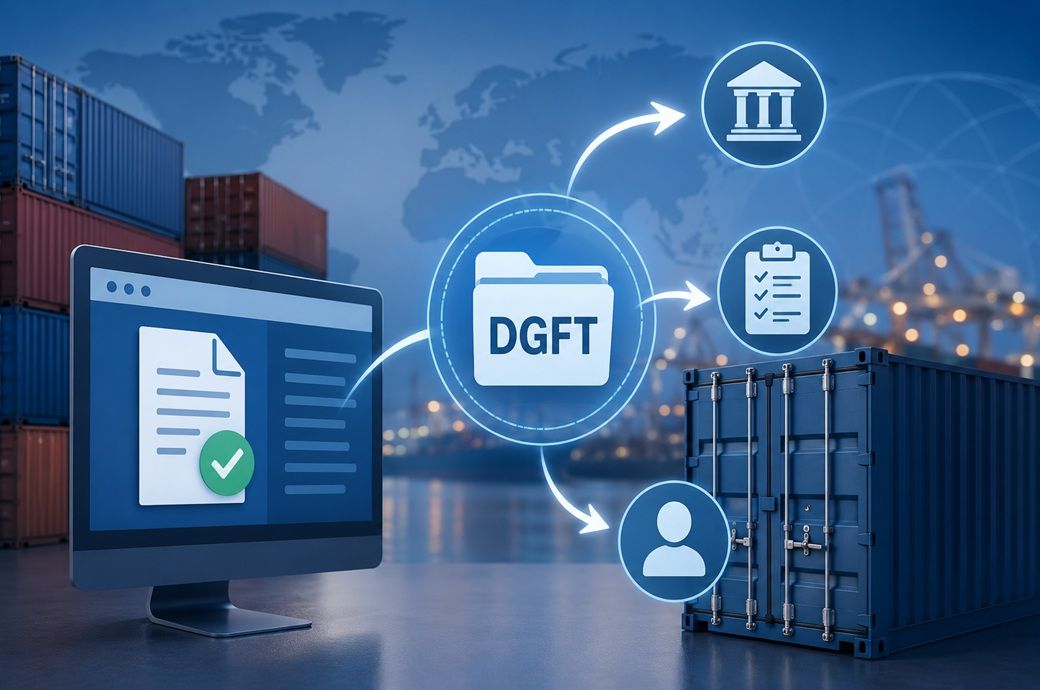
The change is relevant for textile and apparel exporters managing authorisation closure processes, as licence-wise voluntary duty payment data received from Customs/ICEGATE has been integrated with DGFT’s online systems. This enables authenticated verification of payments directly against the concerned authorisation.
India’s DGFT has removed physical duty payment challans for EODC applications under Advance Authorisation and EPCG schemes.
Customs/ICEGATE duty payment data will feed DGFT systems, enabling authenticated licence-wise checks by exporters and regional authorities.
The shift is aimed at faster closures, lower compliance costs and less manual follow-up, with MSME exporters set to benefit.
For voluntary duty payments made on or after August 1, 2026, exporters will no longer need to submit physical challans with applications for closure of authorisations, as per a press release by India’s Ministry of Commerce & Industry. Authenticated payment details will be available on the DGFT Customer Portal, allowing exporters to check that the payment has been correctly mapped to the relevant authorisation before filing an application.
The same authenticated payment record will be available to Regional Authorities on the DGFT Back Office, removing the need for manual verification of payment particulars. This is expected to support faster processing, reduce avoidable correspondence and bring greater consistency in decision-making across DGFT Regional Authorities, the release added.
The digital facility has been implemented through an application programming interface-based data exchange between DGFT and ICEGATE. Under the arrangement, duty payment particulars are transmitted electronically from Customs systems into DGFT’s EODC processing workflow.
Replacing manual submission and verification with authenticated digital records is expected to shorten processing timelines, improve data accuracy, minimise human intervention and enhance transparency in the closure process.
The measure is also expected to reduce transaction costs and compliance burden for exporters by cutting documentation, follow-up and physical interface.
The change is expected to particularly benefit MSME exporters handling closure formalities in-house.
DGFT has issued Trade Notice No. 15/2026-27 dated August 5, 2026, for exporters and other stakeholders.
The initiative forms part of the government’s wider digital transformation agenda for trade facilitation, aimed at creating a more efficient, predictable and trust-based regulatory environment. Stronger integration between trade-related digital systems and reduced reliance on physical documentation supports the vision of ‘Minimum Government, Maximum Governance’ and enables exporters to focus on trade and growth, the release mentioned.
The Advance Authorisation Scheme permits duty-free import of inputs that are physically incorporated in the export product, while the EPCG Scheme permits import of capital goods at concessional or zero customs duty, in both cases against an export obligation.
Where the export obligation is not fulfilled in full, the authorisation holder regularises the case by voluntarily paying the proportionate customs duty saved along with applicable interest and then applies for an EODC to close the authorisation.
Earlier, proof of such payment had to be submitted physically and verified manually by the Regional Authority.
Fibre2Fashion News Desk
