
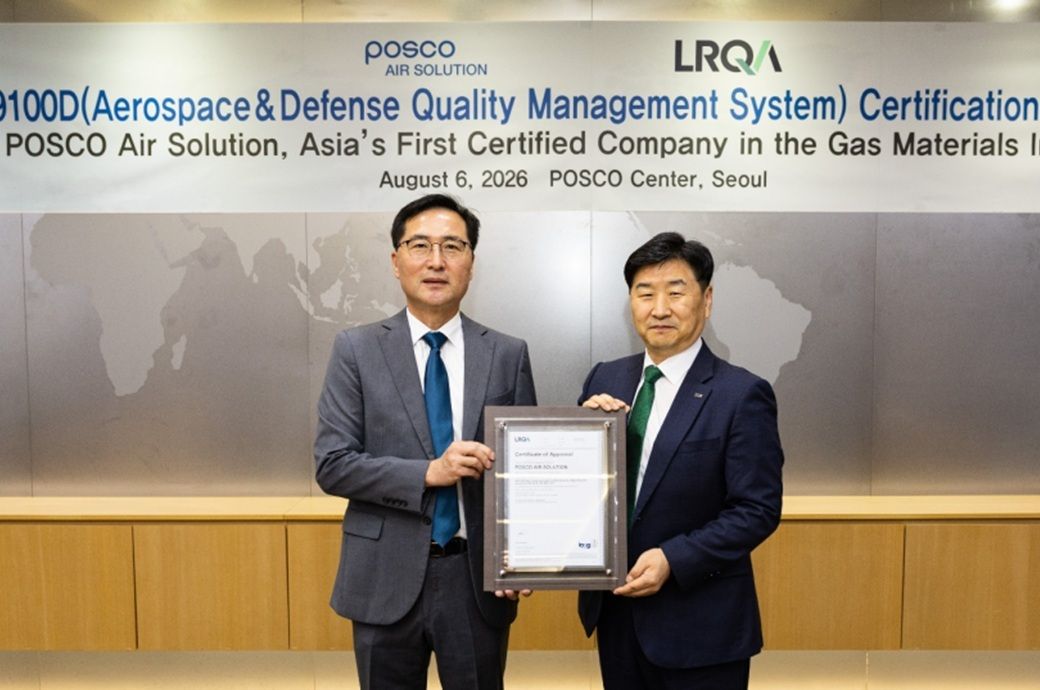
On August 6, POSCO AIR SOLUTION held a certification ceremony for the AS9100D at the POSCO Center in Seoul, attended by Kim Dae-Yeon, President of POSCO AIR SOLUTION, and Lee Il-Hyung, Representative Director of LRQA Korea.
POSCO AIR SOLUTION has received LRQA’s AS9100D certification for high-purity rare gas production, which it says is a first in Asia.
The approval supports entry into aerospace and defence rare gas supply, with focus on xenon and krypton for launch propulsion systems.
A 130,000 Nm³-a-year plant at Gwangyang Steelworks underpins its mass-production value chain.
The AS9100D certification is a global standard based on ISO 9001 that incorporates the stringent, sector-specific requirements of the aerospace and defense industries. Given the nature of these sectors — where even the slightest quality deviation can lead to critical consequences — the certification requires an advanced quality assurance system covering product safety, process consistency, full traceability, and risk management. As such, it is regarded as an essential gateway for entering the rare gas manufacturing market for aerospace and defense applications.
POSCO AIR SOLUTION’s achievement is particularly significant not only because it is the first of its kind in Asia’s rare gas manufacturing sector, but also because it marks the successful localization of rare gas production for the aerospace industry. Through this certification, the company plans to expand its business beyond its existing focus on semiconductors and displays, establishing a stable supply base for high-purity xenon and krypton, which are essential for launch propulsion systems. In doing so, POSCO AIR SOLUTION aims to further strengthen its unique position as a specialized producer of rare gas resources for future industries.
In June, POSCO AIR SOLUTION completed the construction of a high-purity rare gas production plant with an annual capacity of 130,000 normal cubic meters (Nm³)* at the Donghoan site of Gwangyang Steelworks. With this facility, the company became the first in Korea to establish a complete value chain covering everything from raw material procurement to product manufacturing for four types of rare gases, securing a stable mass production system. More recently, in electric thruster propellant technology development tests for satellites and space exploration vehicles conducted by the Korea Aerospace Research Institute (KARI), the company’s xenon (Xe) and krypton (Kr) gases demonstrated performance equivalent to imported products, proving globally competitive quality suitable for aerospace applications.
* Normal cubic meter (Nm³) is a unit used to measure flow and volume. “N” stands for “Normal,” referring to standard conditions (typically 0°C and 1 atmosphere), and “m³” refers to cubic meters.
Kim Dae-Yeon, President of POSCO AIR SOLUTION, stated, “This AS9100D certification proves that our high-purity rare gas manufacturing capabilities and quality management system are at a world-class level. Based on the high quality standards required by global customers, we will establish ourselves as a trusted key supplier in the aerospace and defense rare gas market.” He added, “By ensuring the stable supply of high-quality rare gases, we will serve as a core pillar of POSCO Group’s strategic resources portfolio.”
Lee Il-Hyung, Representative Director of LRQA Korea, noted during the ceremony, “POSCO AIR SOLUTION’s achievement in meeting these rigorous international standards for rare gas quality is particularly meaningful as it marks a first in Asia. We expect the company to play a vital role in the future development of the global aerospace industry.”
In July, POSCO Group announced its vision to become a leading supplier of key national resources by reshaping its business portfolio and establishing a “Triple Core” system encompassing industrial resources (steel), strategic resources (including lithium, rare earths, and rare gases), and energy resources (such as LNG). In particular, the Group plans to foster rare and specialty gases—essential materials for the semiconductor and aerospace industries—as strategic resources, creating new growth engines and helping stabilize supply chains for the nation’s future industries.
Note: The headline, insights, and image of this press release may have been refined by the ALCHEMPro staff; the rest of the content remains unchanged.
ALCHEMPro News Desk (MS)
