
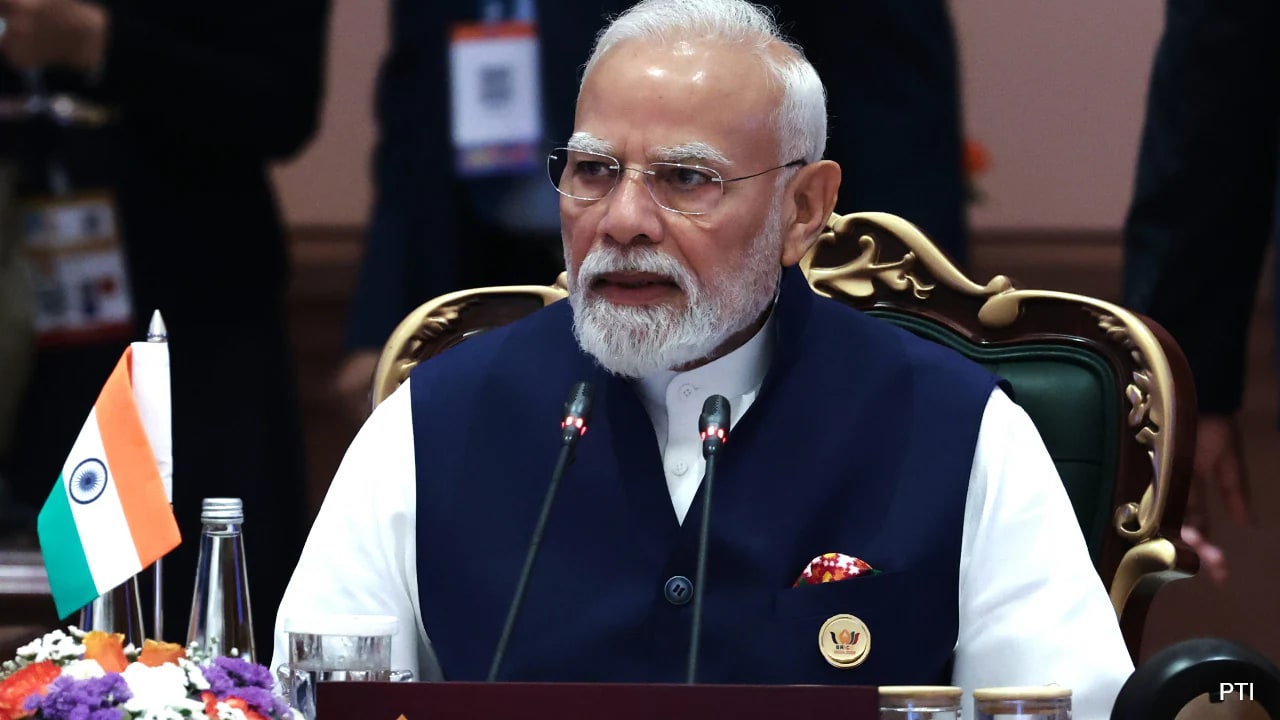
Prime Minister Narendra Modi will complete 25 years in continuous executive office on October 7, spanning more than a decade as Gujarat Chief Minister and his tenure as India’s PM since 2014.
The Bharatiya Janata Party (BJP) has launched a month-long nationwide outreach programme, Sewa Sankalp Abhiyan, to mark the milestone. The campaign will run from September 17 to October 17 and will focus on Modi’s 25-year journey in government.
Before entering government, PM Modi spent years working within the RSS and the BJP, taking on organisational responsibilities on the grassroots and then the national level.
2001: Narendra Modi Takes Charge As Gujarat Chief Minister
Narendra Modi took charge as Gujarat Chief Minister on October 7, 2001. He went on to serve in the Chief Minister office for more than 12 years before moving to national politics.
The early years of his tenure focused on rebuilding Gujarat after the 2001 earthquake, along with a series of development initiatives aimed at strengthening the state’s infrastructure and public services.
2003-2012: Development Push In Gujarat
The following years saw a focus on development across different sectors, including electricity, agriculture, water management, healthcare and social welfare.
Initiatives such as Jyotigram, the Vibrant Gujarat Summit, water conservation and agricultural programmes, as well as healthcare and social welfare measures, were introduced.
2012-2014: Taking The Gujarat Model Forward
The 2012-2014 period marked another phase of development in Gujarat, with a greater focus on healthcare, affordable housing, solar energy and infrastructure. Efforts were also directed towards restoring water bodies, while the development experience in the state began taking shape as a model for a larger national agenda.
2014: From Gujarat To New Delhi
In 2014, Narendra Modi became the 14th Prime Minister of India, taking his political journey from the state level to the national stage.
His initial years at the Centre saw the launch and expansion of major programmes, including Jan Dhan Yojana, Swachh Bharat Mission, Ujjwala and Ayushman Bharat.
2014-2024: Major Policy And Development Push
The next decade brought several significant policy decisions and programmes, including the abrogation of Article 370, Jal Jeevan Mission and PM-KISAN.
The period also saw a major push for infrastructure development, alongside initiatives in healthcare, sanitation, financial inclusion and welfare.
In 2016, he announced the demonetisation of Rs 500 and Rs 1,000 notes as part of the government’s efforts to tackle black money. In 2017, he introduced the Goods and Services Tax (GST), replacing multiple state and central taxes with a unified tax regime.
During the 2020–2022 period, he also led the government’s response to the COVID-19 pandemic, including nationwide lockdowns and a large-scale vaccination drive. The period also saw rapid growth in India’s Digital Public Infrastructure, particularly UPI.
2024-Present: The Next Phase
He took oath as India’s Prime Minister for a third consecutive term, returning to office after the 2024 Lok Sabha elections. The period from 2024 onwards marks another phase of his tenure, with a focus on initiatives such as the PM Surya Ghar Muft Bijli Yojana and the expansion of Ayushman Bharat.
The period has also included developments in defence and space, infrastructure and welfare, as well as Operation Sindoor.
He has continued to push the Viksit Bharat 2047 vision, with a focus on strengthening India’s position as a global economic power. These initiatives form part of the next phase of Narendra Modi’s political journey, which began in Gujarat in 2001 before expanding to the national stage in 2014.
June 10, 2026: Narendra Modi Surpassed Jawaharlal Nehru’s Record
Narendra Modi’s tenure as Prime Minister has also crossed the previous record for continuous service as an elected PM attributed to Jawaharlal Nehru. According to the figures cited by the Union Cabinet, Narendra Modi crossed 4,398 continuous days in office – Nehru’s tenure between 1952 and 1964.
