
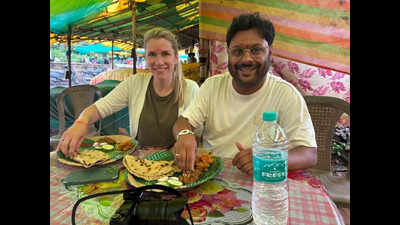
Nagpur: Born out of wedlock and abandoned as a three-day-old baby in Nagpur, Falgun Binnendijk, now Mayor of Heemstede in the Netherlands, still wakes up staring at the pristine canals with a yearning for his umbilical roots. Forty years on, he came to the city of his birth for the third time, hoping to trace his mother who left him at Matru Sewa Sangh (MSS) on Ambazari Road here.As per official records, Falgun was born on February 10, 1985, and surrendered three days later by his 21-year-old unmarried mother at MSS, an institution that shelters abandoned infants and women in distress. He was at the institution for a month, and it was here that he got his name. A nurse named him after the month of his birth — February or Falgun — last month of the Hindu calendar.Weeks later, legal adoption procedures were initiated, and the infant was taken to Mumbai, where a Dutch couple adopted him. They took him to the Netherlands, where he grew up in a well-to-do household, unaware of India, barring a distant speck on the map in geography books. Slowly, curiosity began to strike root.Adoption, Falgun says, was never concealed from him. “It was like an open book,” he told TOI during his visit to Nagpur last month. Raised in the Netherlands, Falgun went on to build a life defined by public service, eventually entering politics and being elected Mayor of Heemstede, 30km off Amsterdam.He first visited India in 2006, when he was 18 years old. He travelled as a tourist, exploring the country, including south India. Falgun says he felt an inexplicable sense of familiarity. “People would walk up to me and start speaking in Hindi. They assumed I was Indian.” That trip planted a deeper curiosity about his origins.For several years, the curiosity remained alive, until Falgun finally felt the calling. Another major catalyst was his reading of the Mahabharata, in which the character of Karna and his relationship with Kunti held a special place in his heart. “Every Karna deserves and must have the right to meet his Kunti,” he says.Finally in 2017, Falgun returned to India with a purpose. This time, he came to Nagpur and approached Matru Seva Sangh, hoping to trace records linked to his surrender. While the institution was able to retrieve limited documentation, including his date of birth and the name of his biological mother, lack of details stalled the search. Addresses were missing, and decades had passed. “We tried, but we couldn’t reach her. At that point, I felt maybe this is it,” he says, recalling the disappointment.Falgun subsequently returned to the Netherlands, where he got married, became a father of four, and continued with his political career. However, the search for his roots remained unresolved. “Everything in my life was complete, but there was something unfinished,” he said, adding it was his wife who nudged him to resume the search.In August 2024, Falgun returned to Nagpur again, this time seeking official assistance. Support from municipal commissioner Abhijeet Chaudhari and district collector Vipin Itankar enabled access to older records and facilitated coordination between departments. While officials explored archives, the search once again hit a wall.Undeterred, Falgun returned once more in December 2025. During this visit, govt officials and his team led by senior district administration official, Vinod Jadhav, traced a retired nurse who worked at MSS at the time of his surrender and was now associated with an NGO. The team visited her residence as part of the search.It was during that meeting that the Heemstede Mayor realised she was the nurse who named him ‘Falgun’. She recalled the infant, the month of his birth, and the circumstances of his admission. Falgun, in turn, understood he had unknowingly met one of the first people in his life, leaving both in tears. “It was overwhelming for me. I had just met the woman who gave me my name — my identity,” he told TOI.When asked about his mother and how he imagines a possible meeting after four decades, Falgun said, “I believe she may be living in guilt, thinking she had done something unpardonable. I just want to meet her once and tell her that I am okay, I have a beautiful life, and that her child grew up loved,” he said, his voice softening.This time, Falgun had come with his family — his wife and four children. He has given his children both Indian and Dutch names and has named his daughter after his biological mother. Falgun said he would return again next year. The search continues.
