
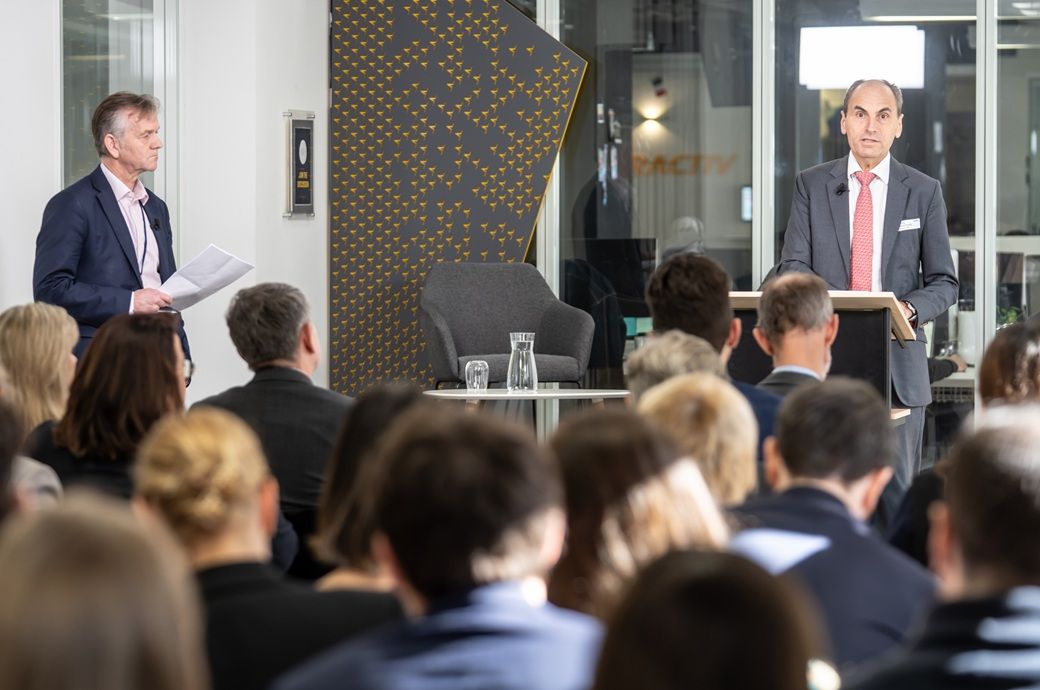
Speakers included Aurel Ciobanu-Dordea, Director for Competitive Circular Economy and Clean Industrial Policy at the European Commission’s DG Environment, Dr. Daniel Bradley, Deputy Counsellor & Head of Climate and Environment at the UK Mission to the EU, and Patricia A. Sargeant, Executive Vice President Nonwovens Commercial at the Lenzing Group.
Lenzing Group highlighted bio based cellulose fibres as strategic materials for Europe’s economic security at a Brussels roundtable with EU policymakers and industry leaders.
Discussions emphasised their role as scalable, biodegradable alternatives to fossil-based materials and called for clear, coherent policies to strengthen competitiveness and accelerate Europe’s clean industry transition.
A key topic of discussion was the potential of cellulosic fibers1 as fully bio-based, biodegradable alternatives in nonwoven applications such as wet wipes. While Europe has the industrial foundation to scale these fossil-free materials, competitiveness is constrained by global regulatory and cost asymmetries. Clear, coherent policy signals – Including possible updates to the Single Use Plastics Directive (SUPD) – were identified as essential for investment certainty and broader market uptake.
“Europe has set ambitious goals for a clean-industry transition. Our roundtable in Brussels showed that bio-based materials are not a future vision – they are a practical, scalable reality today. As an integrated cellulosic fiber producer with deep European roots, Lenzing helps strengthen industrial resilience while accelerating the shift away from fossil-based synthetic fibers,” said Georg Kasperkovitz, Member of the Management Board of Lenzing Group.
Lenzing reaffirmed that industrial competitiveness and climate ambition can reinforce each other. Its specialty fibers, produced from renewable wood, offer lower greenhouse gas emissions compared to generic alternatives and are certified biodegradable and compostable. The company’s climate targets align with the 1.5-degree pathway and have been validated by the Science Based Targets initiative.
“Maintaining and expanding European production capacity is essential for supply-chain resilience and strategic autonomy. Lenzing operates major integrated pulp and fiber sites in Austria, Czechia, and the UK, with Europe-based R&D supporting jobs, innovation, and technological know-how within the region. Cellulosic fibers play a critical role in single-use products for hygiene applications – underscoring the need to redesign products toward biodegradable material solutions that address SUPD concerns and microplastic pollution,” emphasized Patricia A. Sargeant.
With its longstanding commitment to climate leadership, innovation, and European manufacturing, the Lenzing Group will continue to work closely with policymakers and industry partners to advance a resilient, fossil-free materials economy.
Note: The headline, insights, and image of this press release may have been refined by the Fibre2Fashion staff; the rest of the content remains unchanged.
Fibre2Fashion News Desk (MS)
