
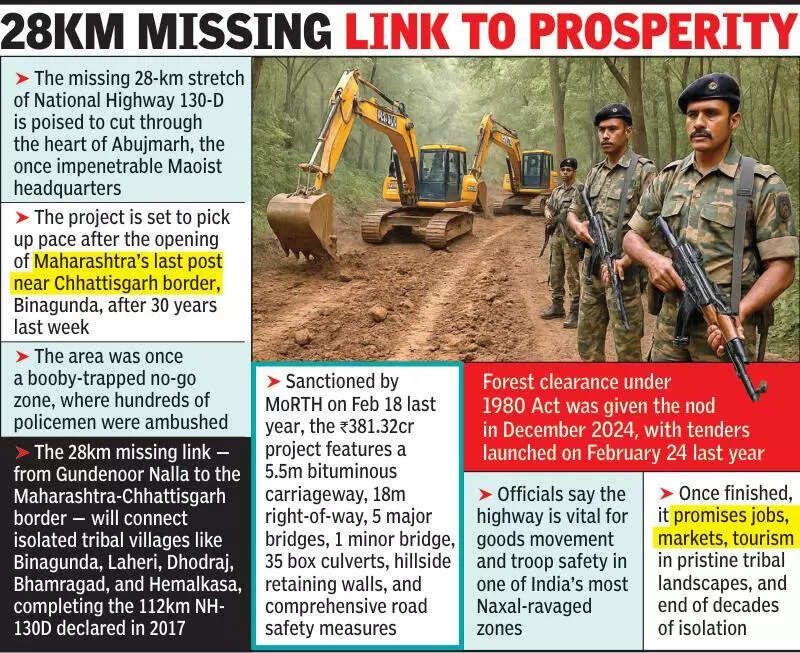
Known as the “graveyard of police personnel”, Abujmarh was the Maoists’ iron-fisted domain for over half a century before C-60 commandos dismantled the ‘Jantana Sarkar’ or the Maoists’ own govt, where rebels ran kangaroo courts, extorted tribals, banned schools and hospitals, and turned the region into a development black hole — freezing progress for five decades. Electricity, roads, mobile signals, and basic governance were treated as enemy intrusions. Now, that era is ending.The 28km missing link — from Gundenoor Nalla to the Maharashtra-Chhattisgarh border — will connect isolated tribal villages like Binagunda, Laheri, Dhodraj, Bhamragad, and Hemalkasa, completing the 112km NH-130D declared in 2017.Sanctioned by the ministry of road transport and highways (MoRTH) on February 18 last year, the ₹381.32cr project features a 5.5m bituminous carriageway, 18m right-of-way, 5 major bridges, 1 minor bridge, 35 box culverts, hillside retaining walls, and comprehensive road safety measures. Forest clearance under the 1980 Act was given the nod in December 2024, with tenders launched on February 24 last year.“This is no ordinary road project. By slicing through the Red Corridor, the highway will shatter rebel logistics, enable lightning-fast deployment of forces, and usher state presence, trade, and essential services,” said an official in the anti-Maoist intelligence apparatus.Officials say it is vital for goods movement and troop safety in one of India’s most Naxal-ravaged zones. Once finished, it promises jobs, markets, tourism in pristine tribal landscapes, and the end of decades of isolation.“The offensive is already underway. With the Centre’s March 31, 2026, deadline to eradicate Naxalism looming, Maharashtra’s crack C-60 commandos went on the warpath in Abujmarh’s foothills,” said a security agency official.In lightning operations, elite units stormed former rebel citadels, erecting fortified police camps overnight in villages like Binagunda last week — right on the highway’s path — mobilising over 1,000 personnel to bulldoze access tracks and seize strategic heights. “The goal is to dismantle the crumbling Jantana Sarkar, install elected panchayats, safeguard stalled infrastructure like bridges and towers, and trigger rebel surrenders,” said an official from Maharashtra security agency.“The Red Corridor is collapsing fast. Abujmarh and North Bastar were declared Maoist-free in late 2025 after surgical strikes wiped out top commanders,” said an official.
