
5 min readFeb 25, 2026 04:59 PM IST
For all those who have yearned for Raw Mango saris with their bold colour blocking and a filtered exuberance would know that the label’s founder and designer Sanjay Garg is a deeply rooted-creator. Many would call him a minimalist, compared to the maximalism and overwrought collections we see from our topline designers on the runway. But he is a distiller of maximalism instead, knowing how much of heritage does not need to be overplayed but layered subtly and elegantly in modern conversations.
That’s why his debut showing at the London Fashion Week may seem unusual, even sedate, for those at home but has set a new grammar with structured garments, each celebrating an indigenous fabric, weave and most importantly a story. Given the examples of West’s cultural appropriation of our craft primarily because they are motif-based, Garg’s modernist silk creations left no room for borrowing. As businesswoman and former UK First Lady Akshata Murthy described her skirt-blouse, neckpiece combo, “There’s Banarasi silk, Kanjivaram silk and beautiful silk flowers.” It showed the solidity and versatility of Indian silk that can hold up a modern garment on its own.

Many Indian designers have shown at the London Fashion Week before him. So Garg wanted to debut breaking stereotypes. “There is still a strong association between Indian fashion and a certain kind of aesthetic — heavy gold embroidery and maximalist ensembles that overwhelm the eye and the body with ‘bling’. Indian fashion is too often quantified – it’s not seen for its innate aesthetic value, but the number of hours it took a weaver to create a garment. It’s a surface-level engagement that sometimes drowns out the beauty of the weave itself.”
The theme, ‘It’s Not About The Flower’, stems from his love for flowers. Except here he uses them as garlands that wrap around every Indian ritual and here becomes an embracing cape, a fur-trim, a top, a jacket, a sari border, a dress, skirt, a throw, an accessory. All garlands were done by hand-rolling silk, brocades, rib-knit cotton knits, quilted rayon and wool felt.
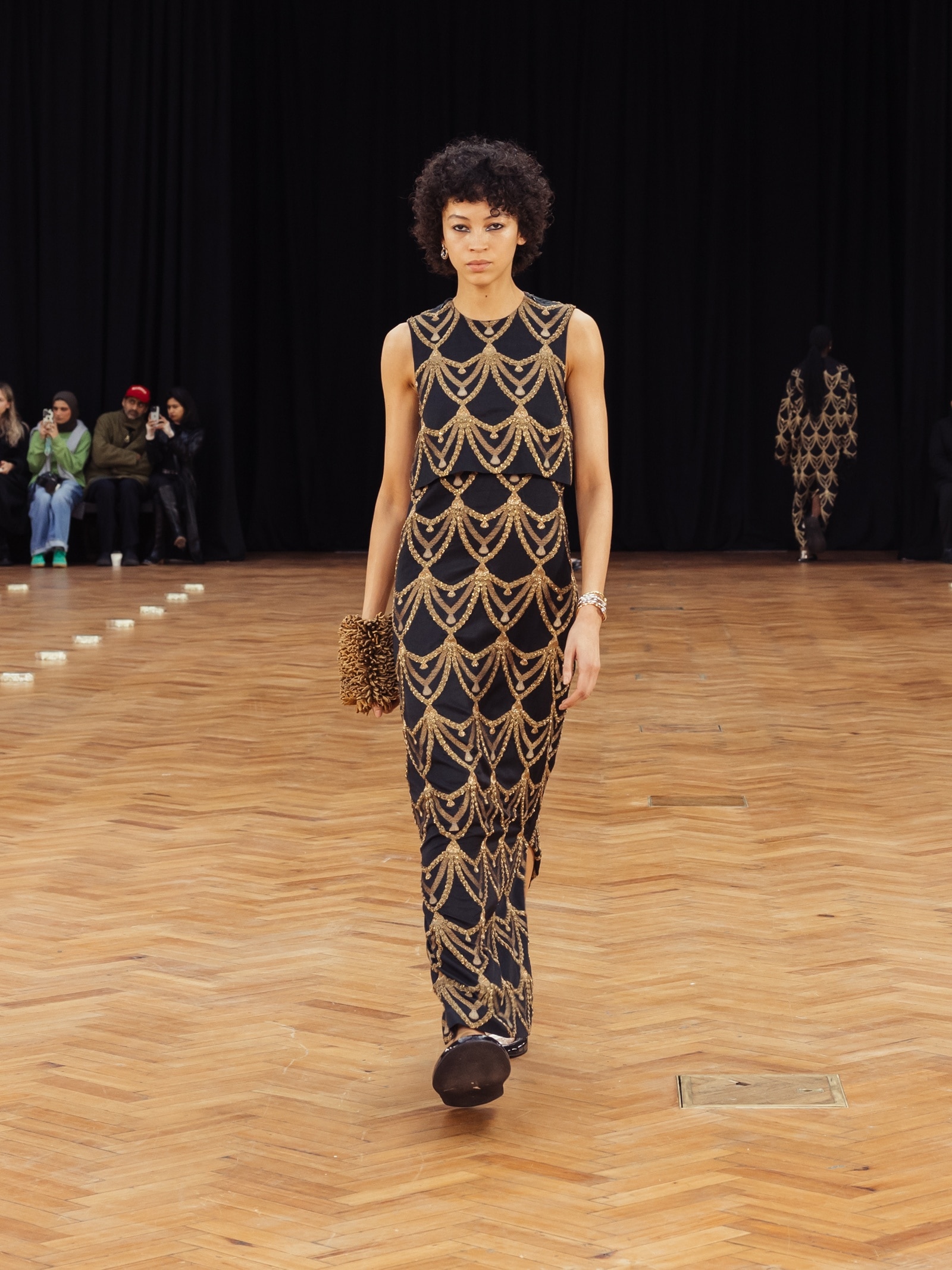 The theme, ‘It’s Not About The Flower’, stems from his love for flowers. (PR Handout)
In short, the flower and the fabric it is made out of doesn’t remain a motif or embellishment like the embroidery we are so used to seeing, it is the structure and the garment itself. “Flowers remain an important part of South-East Asia and South Asia. But we don’t really have a culture of giving one individual flower to someone, like, say, a rose on Valentine’s Day. As a culture, we are a country of garlands. Whether it’s a death, a birth, a wedding or a religious ritual, you see garlands, irrespective of the religion. It’s not about one individual flower; it’s about the plurality,” said Garg about a design aesthetic that went down well with the audience, The New York Times rating Garg as one of the names to look out for. Yes, he had black flower garlands, too.
Garg did several twists and flips. Building on the diagonal drape of the sari, he did a sash gown in black with mogra flowers on the border, much flaunted by sitarist Anoushka Shankar. More than the sari, he went with overlays, trench coats, free-flowing gowns, shirt-skirt combos and waist high pants, in striking combinations of black and white, clearly a take-off on the classic Western white shirt-black tie look. There were colour pops too, brocade with garland motifs. The perforated dresses were clearly a peep-hole metaphor, to dive deeper into what Indian craftsmanship was really about instead of what he called “surface-level engagement.”
Although the London Fashion Week showcased autumn-winter lines, Garg doesn’t believe in confining himself to boxes. London was just a platform to speak in a more forceful voice. “Presenting here is as good as presenting in Kanpur for me. At the end of the day, it is the work being presented that matters. And that doesn’t change according to who is viewing it, or where. I’m less interested in defining my audience and more interested in further exploring and articulating my design language that can cater to different audiences that transcends borders and seasons,” he said.
Story continues below this ad
Apart from Akshata Murthy and Anoushka Shankar, the UK Indian community showed up in full strength. The guest list included film director Gurinder Chadha, actor Saim Ali, artist Cyrill Ibrahim, artist Lubna Chowdhary, Rahi Chadda, founder of Openended Design Suhair Khan, art collector and philanthropist Aarti Lohia, curator Tarini Malik and creative and cultural strategist Arooj Aftab.

📣 For more lifestyle news, click here to join our WhatsApp Channel and also follow us on Instagram
© The Indian Express Pvt Ltd
