
In an interview with Fibre2Fashion on the sidelines of the Global Fashion Summit, Circulose CEO Jonatan Janmark said many brands that have set circularity targets are not backing away from them and remain committed. He noted that during Circulose’s first year, more brands began clarifying their targets for man-made cellulosic fibres (MMCF), as the company was starting to present a viable solution.
Circulose is rebuilding momentum by lowering the cost impact of circular cotton and securing brand commitments.
CEO Jonatan Janmark said brands remain committed to 2030 circularity targets, but affordability is critical for scale.
The restart of the company’s Sweden plant reflects renewed confidence in commercial-scale circular fibre adoption.
“So, brands were a bit hesitant to set targets before there was a credible solution. That is why we have so many targets on recycled polyester, because there is a solution that has been around for a while. But now, when we came back and showed a credible path to a good offering and a lower price, more brands were actually setting targets rather than backing away from them,” he explained.
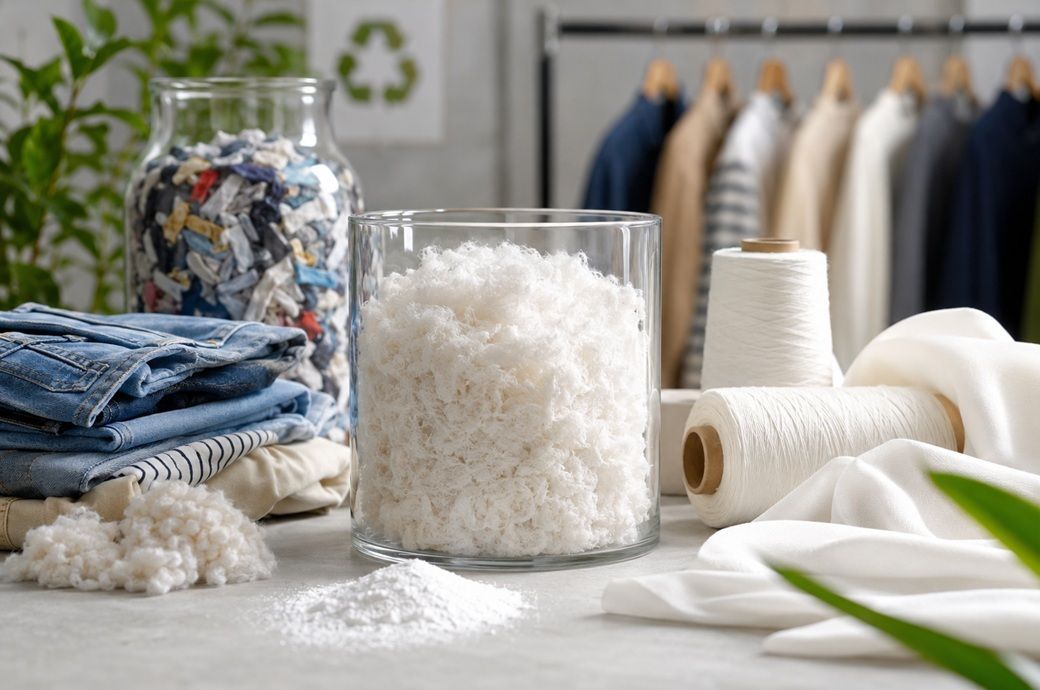
Circulose is a Swedish textile innovation company that produces CIRCULOSE, a raw material made from 100 per cent recycled cotton textiles. The company uses discarded textiles and converts them into a new raw material that can replace virgin forest-based pulp in fibre production.
The company already works with H&M, Mango, Aditya Birla, John Lewis, Marks & Spencer and Tangshan Sanyou. Janmark said most of the brands Circulose works with have clear 2030 targets and are shifting parts of their material portfolios towards circularity.
“I think that is the main run, and we are seeing the price is higher today. The price difference will come down as we scale, as the market matures, as we optimise, and the brands we are working with today are taking the stance that we are not waiting until the price is lower,” he said, adding that these brands are helping build the infrastructure and system needed to bring costs down.
Given the war and the rise in raw material costs, Janmark noted that if other raw materials become more expensive, the relative cost difference between Circulose’s products and virgin fibres would narrow. “It helps us a little bit, but the main thing is, we know the brands that now have targets, and also that they need to act now for them to reach those targets and save money down the road,” he said.
In circularity, where are consumers?
The debate has long centred on whether consumers are ready for circularity and willing to pay the additional cost that comes with it. Switching to fibres beyond conventional materials is often costly for companies, and that cost eventually reaches consumers. This makes brands cautious about scaling smarter and more sustainable materials, as customer willingness to pay remains uncertain.
“So, I think the mistake in this debate is to simplify too much and say, are consumers willing to pay for sustainability? It matters—is it 10 per cent more, is it 1 per cent more, or is it 0.1 per cent more? It makes a huge difference … and whether they are really willing to pay or not, I think many brands are still committed to adopting more circular materials,” Janmark responded.
He highlighted that Circulose focuses on making its fibres as affordable as possible. “We have shown, in many cases, we have reduced the price impact on the final garment by 80 per cent to 90 per cent by really working with the brands on making this efficient through the value chain,” Janmark said, adding that it makes a huge difference if the company can reduce the cost impact on the final garment from 10 per cent to 1 per cent.
“I think it is dangerous to be too simplistic in saying brands are not willing to pay, consumers are not willing to pay. Well, no, they are not willing to pay 10 per cent, but maybe 1 per cent … and we are really focusing on getting it down to that one, two, three per cent, instead of 10 per cent to 20 per cent,” Janmark noted.
New regulations: A step in the right direction
The Digital Product Passport (DPP), introduced under the Ecodesign for Sustainable Products Regulation (ESPR), is expected to become mandatory by 2027. According to the European Union’s website, the regulation will require nearly all products sold in the EU to carry a DPP.
The measure aims to improve transparency across product value chains by providing detailed information on a product’s origin, materials, environmental impact and disposal recommendations. The DPP is designed to bridge the gap between consumer demand for transparency and the current lack of reliable product data.
The DPP will work alongside another EU regulation, Extended Producer Responsibility (EPR), under which businesses placing products on the market must also assume financial and organisational responsibility for managing the waste generated by those products after use.
According to the European Union External Action, the regulation seeks to ensure that the cost of waste management is no longer borne only by municipalities and taxpayers, but becomes part of the real cost of the product. Janmark acknowledged that regulations are now moving “in a quite positive direction”.
“I think more and more, the idea of a recycled content requirement in the EU is feeling like a likely scenario, and that will, of course, I would say, be the right one,” he said, adding that without such progress, there is a risk of losing the momentum the industry has built so far.
“Because then every brand might take a step back and say, okay, regulation is not coming … I think some of the demand is driven by the expectation that regulation will come,” Janmark said.
Asia: The Circulose hub
Circulose’s fibre partners include Aditya Birla, CTA, Jilin Chemicals and Tangshan Sanyou. Janmark said Asia is the company’s main market, adding that “we have our current fibre producer partners … basically our direct customers; three of them are in China and one in India.”
“We sign up a brand partner, and then we look at which programmes they are going to convert to Circulose, and what their supply chain looks like today. Then we work with their suppliers, rather than forcing our suppliers onto them. So, it is more about how we work together with brands to make sure it is done in an efficient way,” he said.
He explained that there had earlier been several inefficiencies, as well as significant premium stacking across the value chain for different reasons. “We worked really hard to address that value-chain efficiency and make sure that, at the final garment level, it is much more affordable for brands,” Janmark added.
Emerging from a hurdled past, Circulose reopens factory
The raw material CIRCULOSE was originally produced by Renewcell. Before Janmark and his team took over the company, Renewcell had filed for bankruptcy and was later acquired by private equity firm Altor.
In February this year, Circulose announced the restart of its commercial-scale production plant at Ortviken in Sundsvall, Sweden, with plans to resume production of CIRCULOSE in the fourth quarter of 2026.
The restart follows commitments from 11 fashion brands, including H&M, Mango, Marks & Spencer, Bestseller, C&A and Reformation, to use the company’s product in their upcoming collections.
“When I came on board one and a half years ago, the clear mandate was: how do you secure that we have confidence? We worked a lot on understanding what the learnings were from Renewcell’s attempt to scale up, and what we needed to do differently, particularly in our commercial strategy and value proposition, to be successful this time,” Janmark outlined.
“So, we developed a new commercial strategy. A lot of that was quite price-focused: how do we make this more affordable to brands, so it can really scale up into mainstream collections and so on? We worked closely with the value chain, particularly fibre producers, to be able to offer a better proposition to brands,” he stressed.
Janmark said the company then shifted from seeing itself only as a pulp producer to positioning itself as a circularity solution provider for brands. “We changed our whole commercial model and pricing model in quite an innovative way. I think we are now at 14 brands having signed up as brand partners, and this was enough to see the momentum and have the confidence to restart the factory,” he added.
Fibre2Fashion News Desk (AMR)
