
A social media post about a 27-year-old woman whose breast cancer was diagnosed only after she reported persistent back pain has sparked a conversation about whether breast cancer in younger women sometimes presents with symptoms beyond a breast lump. “A 27-year-old girl came to me feeling a lump in her breast… and while I was examining her, I wasn’t happy about it—the lump was a bit concerning and branched out. Of course, there was a high suspicion that it could be a cancerous lesion. Anyway, while she was sitting in the clinic, she told me that her stomach was bothering her because she was taking a lot of painkillers. I asked her, why are you taking so many painkillers? She told me that her back has been hurting her a lot for a month now. Of course, I got even more suspicious. I sent her to do the necessary tests, and it turned out she had a stage four breast cancer tumor that has spread throughout the entire body, including the vertebrae of the back, which are causing her back pain,” the post on Dr Omar’s X account claimed.
DISCLAIMER: This article is based on information from the public domain and/or the experts we spoke to. Always consult your health practitioner before starting any routine.

To understand if there is actually a link, we asked experts.
Breast cancer is most often associated with a painless lump in the breast, but the reality is that cancer does not always follow a textbook pattern, experts urge. “Sometimes, the symptom that brings a patient to a doctor may not appear related to the breast at all,” said Dr Vani Parmar, head of department – Breast Oncosurgery, KIMS Hospitals, Thane.
Persistent back pain is one such example. “Most back pain in young adults is caused by lifestyle factors, muscle strain, poor posture, long working hours, or minor injuries. However, when pain continues for weeks, worsens over time, wakes a person from sleep, or is accompanied by other unexplained changes in health, it deserves closer attention,” said Dr Parmar.
Experts also challenge the common assumption that a healthy young woman is unlikely to have breast cancer. “Unfortunately, age alone does not provide protection. We are seeing an increasing number of younger women being diagnosed, and many of them are balancing careers, family responsibilities, and busy lives, which can lead them to dismiss early warning signs. It is good to have a timely consult in all cases,” remarked Dr Parmar.
 Experts advise not to panic (Photo: Getty Images/Thinkstock)
Another important point is that breast cancer is not just a disease of the breast. “If the cancer progresses, it can affect other parts of the body, and symptoms may arise from those areas. This is why doctors pay attention not only to a breast complaint but also to the overall pattern of symptoms a patient is experiencing,” said Dr Parmar.
Story continues below this ad
Dr Kanav Kumar, consultant, surgical oncology, Head & Neck Cancer Institute of India (HNCII), clarified that it is important to avoid panic. “Most breast lumps and episodes of back pain are not cancer-related. However, the message is clear: the body often gives warning signs, and early evaluation can make a significant difference. The earlier breast cancer is diagnosed, the wider the treatment options and the better the chances of achieving favorable outcomes,” said Dr Kumar.
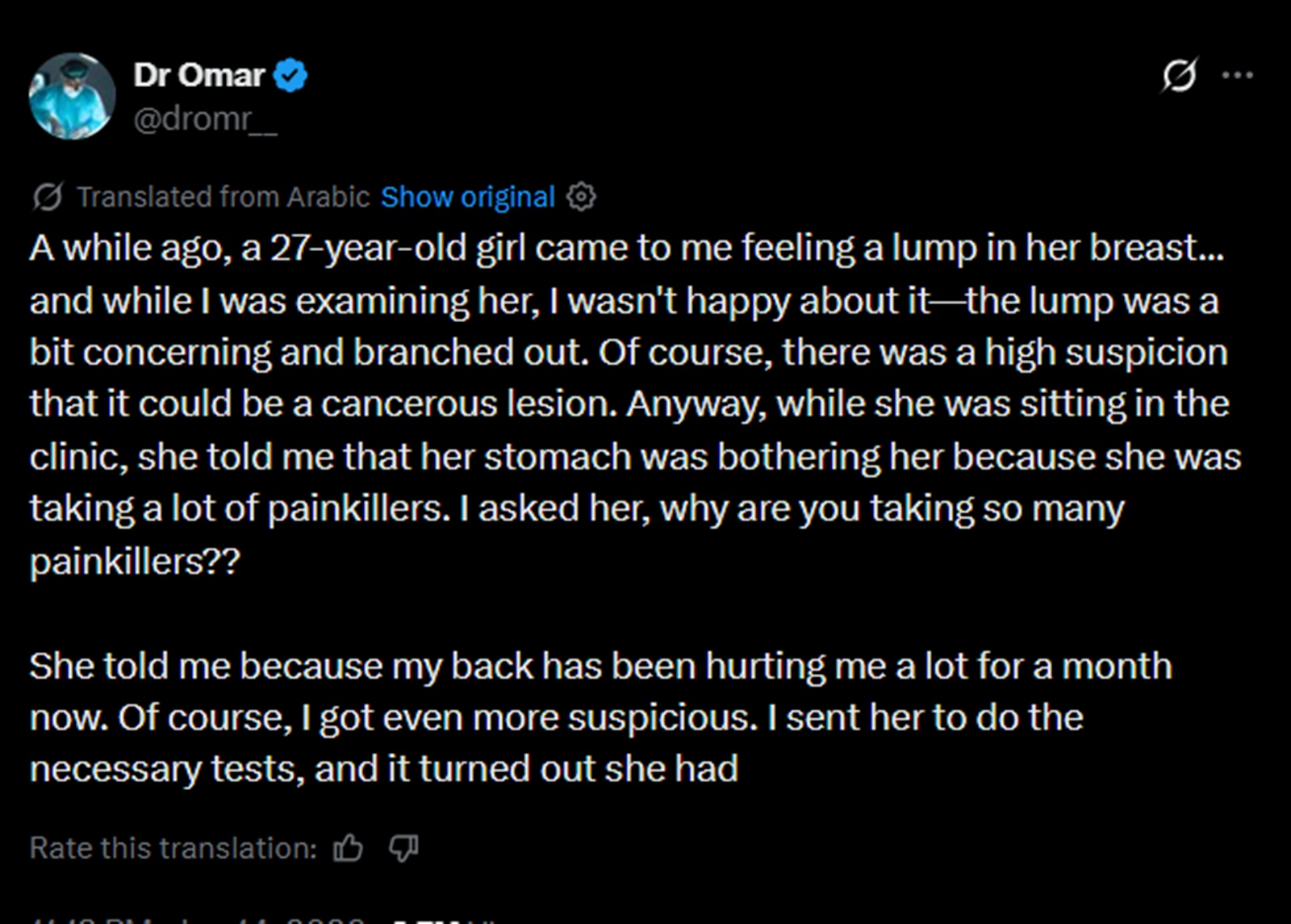 Take a look at the post (Photo: Dr Omar/X)
Regular breast awareness, knowing what is normal for one’s body, and seeking medical advice when something feels unusual remain among the most effective steps in detecting breast cancer early.
“Women should become familiar with their normal breast appearance and feel, and seek medical advice if they notice a new lump, skin changes, nipple abnormalities, or any unusual symptom that does not resolve. Early detection continues to be one of the most powerful tools in improving outcomes and reducing the burden of treatment,” urged Dr Parmar.
DISCLAIMER: This article is based on information from the public domain and/or the experts we spoke to. Always consult your health practitioner before starting any routine.
