
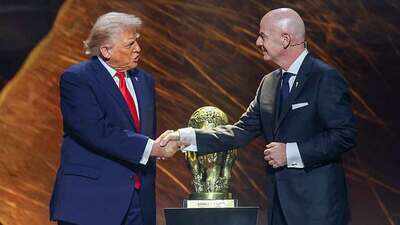
US President Donald Trump has confirmed that he personally spoke to FIFA president Gianni Infantino and asked him to review the red card and one-match suspension handed to Team USA striker Folarin Balogun during the FIFA World Cup match against Bosnia and Herzegovina. The suspension was later lifted, allowing Balogun to feature in the United States’ Round of 16 match against Belgium, a decision that has triggered widespread debate.USA are scheduled to take on Belgium in the Round of 16 clash at the Seattle Stadium in Seattle on Monday (5:30 am IST). When asked by a reporter, “Can you describe your phone call with Gianni Infantino about the red card? Belgium is appealing the decision,” Trump confirmed that he had spoken to the FIFA president.Here’s what Trump said:I did. I spoke to Gianni, who’s highly respected, who’s produced the most successful World cup in history by, they say, four times.This isn’t just a success. I actually said, johnny, we’ve got all these games. Each one is turning out to be a Super bowl, and we have all these games. You know, when you think of it, every game is like a Super Bowl.Yes. I watched last night what a game that was with Mexico and England. I mean, two countries. I don’t know the players, although I think Kane is a great player. See, I played golf with him, and I like him a lot. He’s a good golfer, but he’s really great.But I watched and no reason for me to watch. And you couldn’t take your eyes off the game because I said, johnny, you know, you have all these games because they added games in a country where really we don’t. It’s not our main sport, to put it mildly.And this has been four times more successful. He told me last night, the numbers are four times greater. They think 50 or 60 million people are going to be watching the game tonight. I mean, these are getting to be super bowl numbers.But you have a game tonight, and they think they’re projecting a minimum of 50 million people watching a game. We call it soccer. It’s called football, I guess, but we can’t really call it football because it gets a little. There’s a little confusion. So, yeah, you call it soccer. We’re the only ones that do that, but we have football, and football is great, but I’ve never seen anything like it.So I saw the play, and I’m a person that loves sports and was a good athlete. And I understand sports really well. Really well. And that wasn’t a foul. That wasn’t even an infraction.That was two guys running full speed that happened to crash into each other. You can’t take your foot and properly place it on somebody else’s foot when you’re going, no. These were two great athletes that got tangled up.And this referee, who. Is it a little bit suspect? If you check his. If you check his past. I don’t want to say that because I don’t like to create controversy, but. But very suspect. If you’d like, I’ll provide you with the past.He made a call that nobody could believe. You know, even people on the other side, they say, oh, we got lucky. Wow, that’s.And it’s very interesting. They say they don’t show them in slow motion. And I never realized that I’d never heard of that before, that they’re not allowed to review in slow motion because it’s so different, because you’ll take one little quarter of a second and you’ll see that a hand is touching a neck or you see something.Whereas when you see it in fast motion, it will look like two guys collided, which is really what happened. They got sort of entangled. He didn’t do anything wrong, and he’s our best player, or one of our best players, a very vital player.And he gave him a red card. I didn’t know what that meant. I didn’t think it meant much. Then I started hearing that that means he can’t play in the next game. At least in the next game.I said, boy, that’s a big. You know, if it happened to another player, it would have been unfair. But when they take your best player, or just about, they have some great players, but. And they say you can’t play, that’s very unfair.That’s. You know, it’s one thing to penalize somebody for the game, but how do you penalize them for a game that hasn’t been played yet? It’s very unfair. You can’t do that.So, yes, I asked for a review by FIFA. I spoke to a man who’s highly respected and, by the way, whose level of respect has gone up tenfold.
Folarin Balogun red card : What exactly happened
Balogun, the American top-scored in the tournament with three goals, received a red card for stepping awkwardly on the right ankle of Tarik Muharemovic of Bosnia-Herzegovina in a 2-0 round of 32 win on Wednesday, triggering an automatic one-game suspension.FIFA announced Sunday that the suspension had been lifted for the round of 16 match, an extraordinary move that triggered praise from Trump and outrage from Belgium’s team. It appeared to be the first time since 1962 that a red card during a World Cup did not result in a suspension.“Thank you to FIFA for doing what was right, and reversing a great injustice!” Trump later said in a statement on social media.The Royal Belgian Football Association (RBFA) said it was “astonished,” and Belgium coach Rudi Garcia mocked FIFA’s action.“I didn’t know that in the offices of FIFA the fifth of July was the first of April in Europe,” Garcia said through a translator in an April Fools’ Day comparison. “The Belgian federation does not defend itself, it does not protect the national team. She defends football in general, she defends her integrity, her ethics. I think it’s the first time in the history of the World Cup that there is this kind of decision.”FIFA said its decision relied on Article 27 of disciplinary committee rules.“The judicial body may decide to fully or partially suspend the implementation of a disciplinary measure,” the rule states. “By suspending the implementation of the sanction, the judicial body subjects the person sanctioned to a probationary period of one to four years.”
