
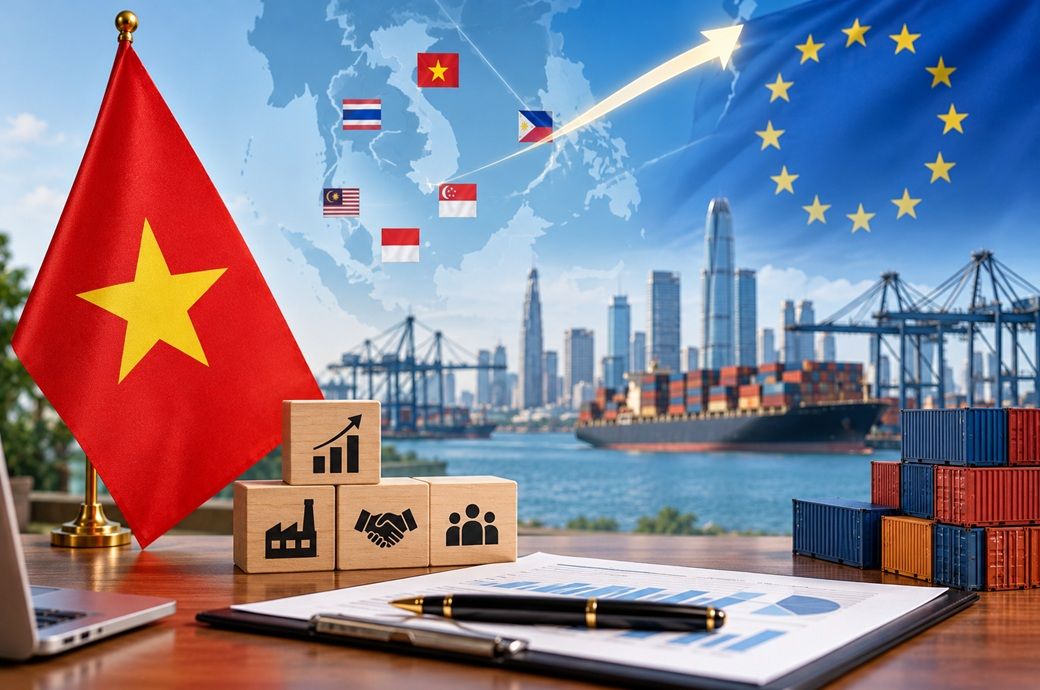
Vietnam has remained the leading Association of Southeast Asian Nations (ASEAN) market for European companies’ expansion plans, with 64 per cent of respondents to the 12th Business Sentiment Survey saying they intend to expand their operations in the country over the next five years. The survey placed Vietnam at the top of ASEAN for a second consecutive year.
In the country comparison, Indonesia ranked second at 57 per cent, followed by Malaysia and Thailand at 49 per cent each, Singapore at 44 per cent and the Philippines at 43 per cent. Among European businesses not currently operating in Vietnam, 34 per cent are considering entering the market, compared with 32 per cent for Indonesia.
The EU-ASEAN Business Council released the survey on September 8, drawing responses from around 150 European business leaders. The survey found that 78 per cent of respondents expected their companies’ trade and investment in ASEAN to increase over the next five years, up from 71 per cent in 2025.
ASEAN was ranked by 61 per cent of respondents as offering the strongest economic opportunities, ahead of China and South Asia for the fourth consecutive year and up from 56 per cent, a year earlier. The survey also found that 78 per cent of respondents planned to expand in at least one ASEAN market, while 54 per cent intended to scale up in three or more markets.
For exporters, importers, manufacturers and retail sourcing teams assessing regional operating footprints, economic recovery and growth opportunities were the leading expansion drivers, cited by 66 per cent of respondents as one of their top three reasons. Investment-friendly laws and regulations, a broader customer base and reasonable production costs were also identified as significant factors.
Among companies recalibrating their supply chains amid uncertainty over US tariff policy, 67 per cent were considering ASEAN, compared with 29 per cent for South Asia and 24 per cent for China.
Operational friction remains a concern for companies using regional supply chains. Some 73 per cent of respondents cited too many barriers to efficient supply-chain use, while 67 per cent pointed to a lack of harmonised regulations. Another 32 per cent considered customs procedures overly burdensome, while only 12 per cent described customs processes as speedy and efficient.
On trade policy, nearly 90 per cent of respondents believed European businesses were at a disadvantage compared with competitors from countries already covered by regional agreements with ASEAN. The survey found that 74 per cent favoured a region-to-region free trade agreement (FTA) over separate bilateral deals, while 49 per cent supported launching EU-ASEAN region-to-region FTA negotiations to mark the 50th anniversary of diplomatic relations in 2027.
