
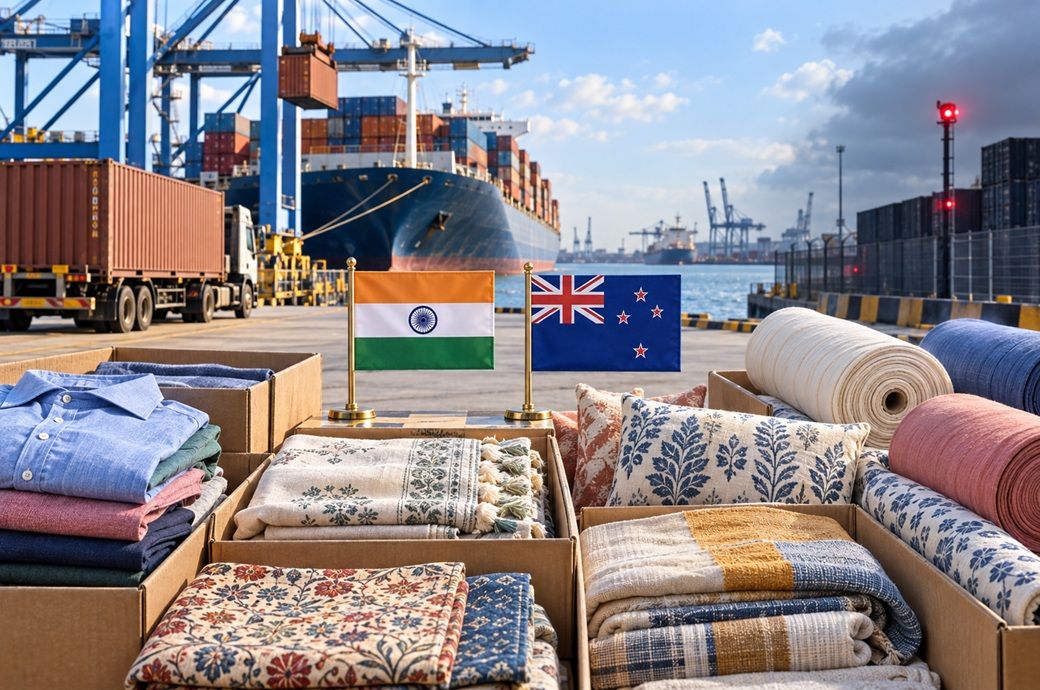
New Zealand’s Parliament on Wednesday passed legislation to implement the free trade agreement signed with India in April, bringing the pact closer to entry into force. The pact will eliminate or significantly reduce tariffs on about 95 per cent of New Zealand’s exports to India. At the same time, all Indian goods will receive duty-free access to the New Zealand market.
The agreement will take effect once both New Zealand and India complete their domestic ratification processes.
New Zealand’s Parliament has passed legislation to implement the India FTA, with all Indian goods to receive duty-free access after ratification.
For Indian textiles, apparel and made-ups, removing 5-10 per cent duties could improve price competitiveness in New Zealand.
A US sanctions bill could allow tariffs of up to 100 per cent on Russian energy buyers, adding risk to India-US trade talks.
For India, the opportunity is particularly relevant in sectors such as textiles, apparel, and made-ups. New Zealand’s global imports in these categories are estimated at $330 million, $1.27 billion, and $330 million, respectively. Its apparel market is reportedly dominated by products such as casualwear, jackets, formalwear, and sportswear, with cotton reportedly accounting for about 45 per cent of imports and man-made fibres another 36 per cent.
Indian exporters also stand to gain from removing existing duties. New Zealand has 575 dutiable most-favoured-nation (MFN) tariff lines, with duties of 5 per cent on some wool, man-made fibre (MMF), and made-up products and 10 per cent on carpets, some MMF products, and apparel, according to reports.
Removing those barriers could improve the price competitiveness of Indian products in a relatively affluent market of an estimated 5.3 million people, where per-capita income reportedly stands around $52,000.
But as India moved closer to wider market access, Washington opened up a very different tariff risk.
India is facing the prospect of another tariff threat from the administration of US President Donald Trump after the US House of Representatives approved a sweeping sanctions package aimed at Russian officials and major sectors of the country’s economy. The Lindsey O. Graham Sanctioning Russia and Iran Act of 2026 would give President Trump the authority to levy tariffs of up to 100 per cent on countries that continue to purchase Russian energy, potentially affecting countries such as India and China.
The bill, which was approved by the US Senate last month, cleared its final legislative hurdle in the House with a vote of 262-159 on Wednesday (September 16), as per reports. It will now be sent to President Trump for his signature before it can become law.
The measure represents a major US legislative effort to increase pressure on Russia and support Ukraine.
Importantly, the legislation does not automatically place a 100 per cent tariff on Indian goods. Any such duties would only be imposed on India if the bill becomes law and President Trump later decides to use the authority granted to him under the legislation.
The uncertainty is important. India has not been subjected to a 100 per cent tariff yet. But the mere possibility carries weight because it comes at a particularly sensitive moment in India-US economic relations.
The development comes as New Delhi and Washington continue to work on a broader trade framework, with market access and tariff issues remaining key elements of the negotiations.
Taken together, the two developments illustrate how India’s external economic relationships are increasingly being shaped not only by conventional market-access negotiations but also by foreign-policy and energy considerations. The potential for tariffs linked to Russian energy purchases adds a new and potentially disruptive variable to that equation.
If enacted and subsequently used, such provisions could complicate the broader trade conversation by linking India’s access to the US market with its purchases of Russian energy.
That leaves India navigating a difficult intersection of interests: expanding access to key export markets, protecting energy security, and maintaining strategic autonomy.
Fibre2Fashion News Desk (DR)
