
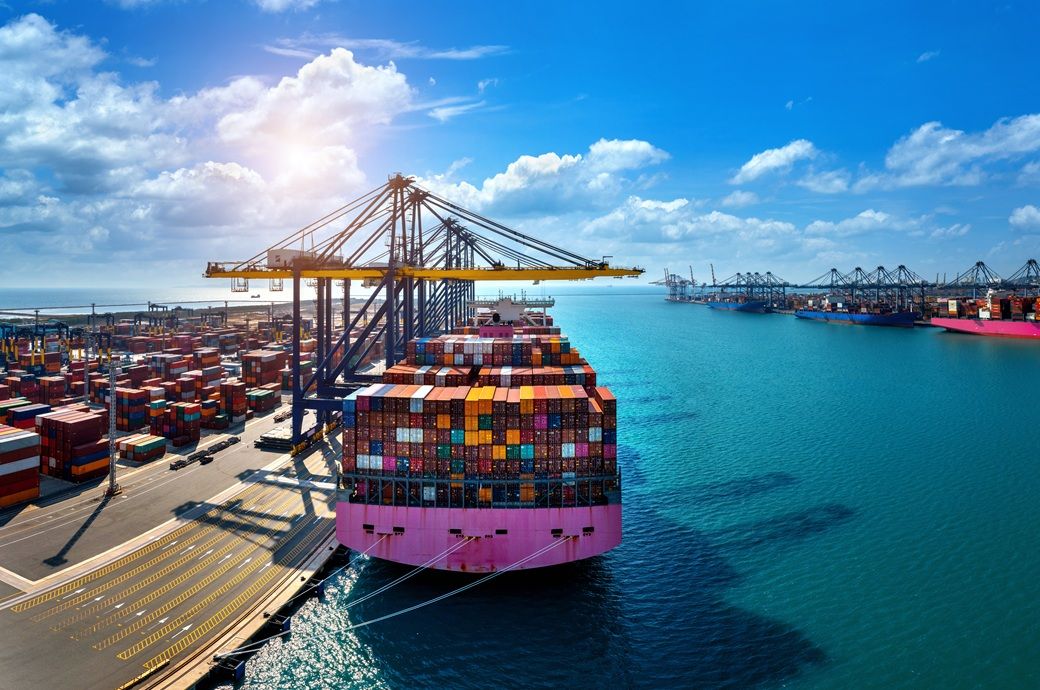
Maritime transport accounted for 73.3 per cent of all EU imports and 72.6 per cent of exports by weight. In value terms, however, its shares were lower, at 50.2 per cent of imports and 40.4 per cent of exports. This indicates that maritime routes handled the majority of trade by volume but a smaller proportion of trade by value.
According to Eurostat, air transport played a limited role in terms of physical volume but accounted for a significantly larger share of trade value. Air freight represented 0.3 per cent of imports and 2.9 per cent of exports by volume, while accounting for 20.7 per cent of total import value and 29.1 per cent of export value.
European Union sea imports reached 1.1 billion tonnes worth €1,270 billion (~$1.44 trillion) in 2025, while seaborne exports totalled 0.5 billion tonnes worth €1,069 billion (~$1.21 trillion).
Maritime transport carried over 72 per cent of the bloc’s goods trade by weight.
Air and road took smaller volume shares but higher-value cargo, shaping modal choices for sourcing and logistics teams.
Road transport also recorded higher shares by value than by volume. It accounted for 19.5 per cent of EU import value and 24.9 per cent of export value, compared with 6.0 per cent and 17.4 per cent, respectively, by volume.
Rail transport showed the opposite pattern, with its volume shares of 2.6 per cent for imports and 2.9 per cent for exports exceeding its value shares of 1.2 per cent and 1.3 per cent, respectively.
For sourcing and logistics teams, the modal split highlights the continuing importance of maritime routes for high-volume goods flows, while air and road transport are more heavily concentrated in higher-value shipments.
Fibre2Fashion News Desk (CG)
