
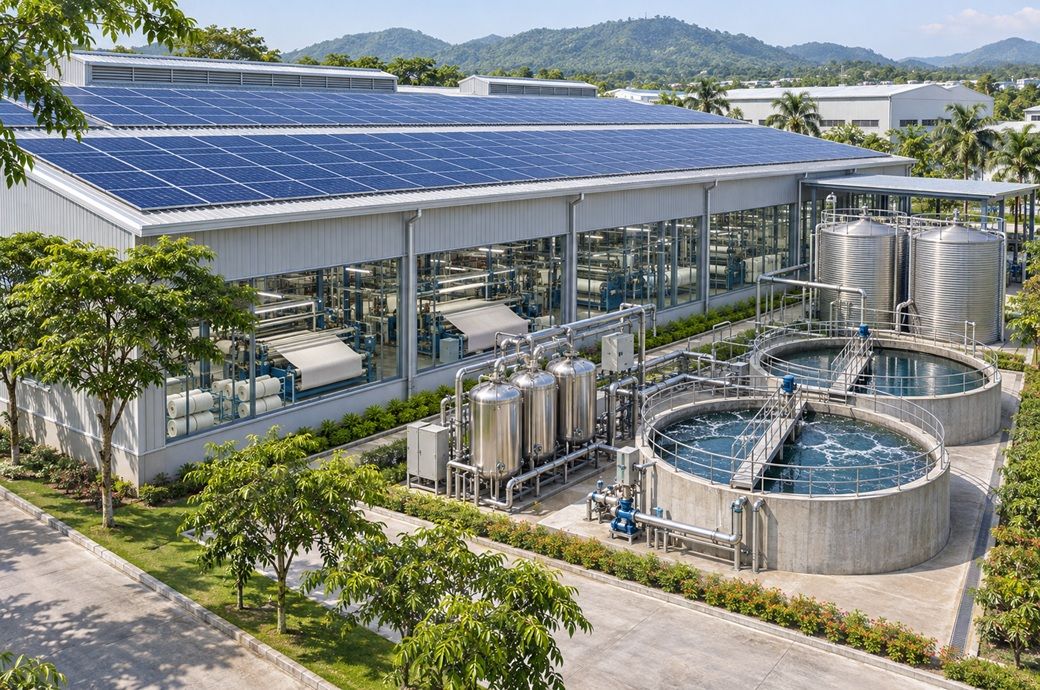
Reducing energy consumption, conserving water, and minimising waste can therefore meaningfully reduce production costs while lowering the industry’s environmental footprint.
As Vietnamese garments reach markets such as the United States, Europe, Japan, etc, manufacturers face growing expectations from buyers to ensure responsible sourcing, manage emissions effectively, maintain supply-chain transparency and adopt cleaner production practices.
Vietnam’s textile and apparel manufacturers are turning to cleaner production as energy costs hit $3 billion a year and buyers demand responsible sourcing.
Projects include Spectre’s $30 million LEED Gold factory, Tan De’s 11 MWp rooftop solar and recycling at Thanh Cong Textile and Garment.
Government programmes support the shift, but smaller firms face financing, technology and expertise gaps.
A Better Work assessment documented how environmental sustainability requirements from international brands prompted Vietnamese garment suppliers to review their operations and invest in energy-efficient machinery, wastewater recycling, and renewable energy. Sustainability is therefore emerging as a key driver of stronger buyer relationships and enhanced competitiveness in global supply chains.
The growing emphasis on sustainability is translating into tangible investments in cleaner and more efficient factory operations.
A recent $30 million investment by Danish garment manufacturer Spectre in a new factory in northern Vietnam offers a particularly striking example. Inaugurated in October 2026, the facility has achieved LEED Gold certification and incorporates solar power, energy-efficient design, rainwater harvesting and advanced manufacturing technologies. It is expected to reduce annual CO₂ emissions by approximately 1,600 tonnes compared with conventional factories of similar size.
The company is also reportedly introducing automation and artificial intelligence across various production processes, including fabric inspection, cutting, warehousing and logistics. With around 3,000 jobs expected to be created, the project illustrates how investments in cleaner production methods and advanced technologies can support both environmental sustainability and employment generation.
Far Eastern Polytex, a textile and upstream material manufacturer, offers another example of how efficiency gains can deliver measurable environmental and financial returns. Between 2020 and 2024, it reportedly reduced its energy intensity by 15.9 per cent through more efficient machinery, stronger energy management, and waste-heat recovery. One particularly effective initiative uses production-generated steam to power an absorption chiller, reportedly generating annual financial savings of around VND7.5 billion (~$292,000).
The shift towards sustainability is equally evident in the growing adoption of renewable energy and circular production practices. In 2024, garment manufacturer Tan De reportedly installed rooftop solar systems with a combined capacity of 11 megawatt-peak (MWp) across nine factories, expected to generate 12,603 megawatt-hours of electricity annually. Thanh Cong Textile and Garment, meanwhile, reported recycling more than 40.6 million plastic bottles and 122.9 million litres of water during the year. Its annual report also recorded a reduction of 9,741 tonnes in CO₂ emissions through solar energy use.
Earlier, Hong Kong-based Rise Sun Textile reportedly invested approximately $5 million in cleaner production technologies, including energy-efficient equipment, waste-heat recovery, wastewater recycling and 6,500 solar panels. The solar installation reportedly reduced the factory’s reliance on electricity from the national grid by around 25 per cent.
These initiatives highlight how strategic investments in energy efficiency, renewable power and resource recovery can deliver environmental benefits while improving operational performance and strengthening long-term business resilience.
Importantly, Vietnam’s green transition extends beyond individual manufacturers. Government-led eco-industrial park initiatives, cleaner-production programmes and circular-economy policies reflect a broader effort to embed sustainability into the country’s industrial development strategy.
A Government-UNIDO programme implemented between 2020 and 2024 identified 603 resource-efficiency and cleaner-production solutions across industrial parks in five provinces and cities. Of these, 217 were reportedly implemented by 88 enterprises, generating reported annual savings of VND69.2 billion (~$2.7 million) and reducing emissions by 8,910 tonnes of CO₂.
The National Action Plan for a Circular Economy, approved in January 2025, further reinforces the policy direction by promoting resource efficiency, recycling and reduced industrial waste.
However, the transition remains uneven. Smaller players often reportedly face constraints in accessing the financing, technology and technical expertise required to undertake similar endeavours. Extending cleaner production across the wider industry, experts maintained, will therefore require more accessible financing, stronger institutional support and closer cooperation among manufacturers, buyers and policymakers.
They emphasised that as green manufacturing moves from the periphery to the mainstream of industrial planning, the industry’s future competitiveness will increasingly depend on its ability to combine cost efficiency with resource conservation and cleaner production.
Fibre2Fashion News Desk (DR)