
The war in Iran is at a critical crossroads. Ever since the fragile ceasefire broke when the US struck 80 targets in Iran on July 8, the scale and scope of the conflict have escalated rapidly. With the war not giving the US a decisive victory, President Donald Trump is now contemplating two options.
Option 1 is to insert ground forces along the Southern Coast of Iran, possibly on Kharg Island and areas that dominate the two shoulders of the narrow Strait of Hormuz. However, most analysts opine that it would be a suicide mission, with landed troops being vulnerable to strong Iranian retaliation due to close proximity to Iran’s mainland and the open and flat terrain that offers hardly any cover.
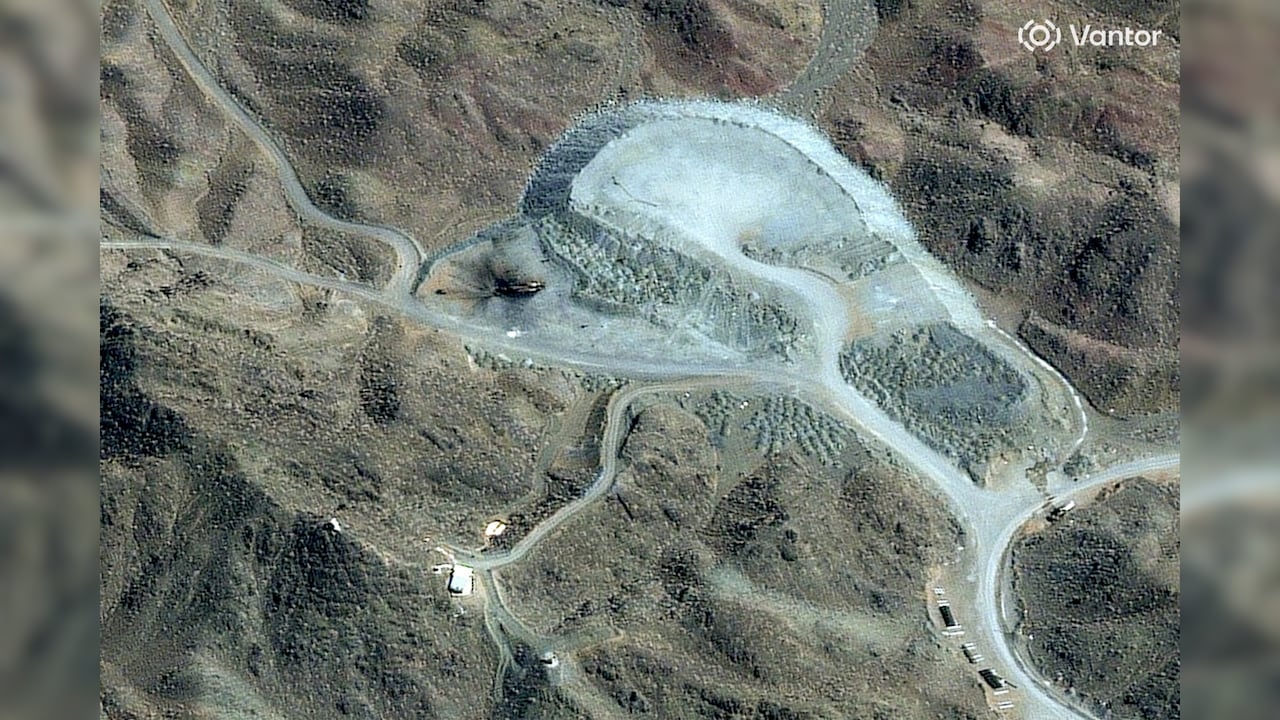
The second option being considered is the destruction of a newly constructed nuclear facility buried deep in the Pickaxe Mountain, in close proximity to the Natanz Nuclear Plant. As per American intelligence estimates, this may be the place where Iran has kept 450 kilograms of highly enriched (60%) Uranium, which has been one of the points of contention in the current war. In fact, President Trump has expressed publicly more than once his desire to take out this facility. Speaking on a TV show on July 13, he said, “We have eyes on it, and Pickaxe Mountain is a possible target for a nice big fat shot right in the front door.” He repeated it again on July 22, saying, “We’ll be hitting the area pretty soon, and very heavily.”
The option to strike the Pickaxe nuclear facility is not only tricky but also poses difficult questions. Can the US military destroy the Pickaxe nuclear facility? If yes, can this be the decisive blow that the US could consider a victory to walk away from the war? What are the precedents of such operations, and did they succeed at delivering a decisive blow? To answer some of these questions, it is important to explore the Pickaxe Mountain facility and the military options available to the US to ‘obliterate’ it completely.
An Underground Fortress
Pickaxe Mountain, also known in Iran as Kuh-e Kolang Gaz La, is a mid-size mountain around 1,680 metres above sea level and is a part of the Zagros Mountain Range. The nuclear site is a fortified underground facility, located around 220 km south of Tehran and about 2 km from Natanz, Iran’s primary nuclear enrichment facility.
The entire complex is spread around one square kilometre of mountainside, constructed in a manner that gives very few options for a direct strike via air. To provide physical security, there is an extensive security fence around the mountain. Additional defences also include a hardened tunnel layered with reinforced concrete. The alignment of tunnels is designed in a manner such that they run horizontally and vertically at different angles, making it impossible for a direct strike to destroy the facility. A direct strike may thus seal off the entrance or bury part of the tunnel, but not more.
Compared to other nuclear sites in Iran, Pickaxe is considerably newer as its construction started only after July 2020, after a sabotage operation destroyed an advanced centrifuge production plant at Natanz. Ali Akbar Salehi, the then head of Iran’s Atomic Energy Organization, had informed the Iranian Parliament’s National Security Committee that Iran would build a new centrifuge assembly hall “in the heart of the mountain”. which would be more secure than ever.
Most of the assessments based on satellite imagery place the nuclear facility buried at least 100 metres underground, with some estimates putting it at even 145 metres, that too under concrete cover. This means that the minimum depth at which the plant could be located is at a depth of 300 feet. As per assessment based on high-resolution satellite imagery done by the Institute for Science and International Security in February 2026, there was an extensive effort to harden and defensively strengthen two of the tunnel entrances into the facility. Concrete was poured on top of the Western tunnel entrance extension, and, at one of the Eastern tunnel entrances, rock and soil can be seen pushed back and levelled on top of the tunnel portal. Additionally, a concrete-reinforced headworks for the tunnel entrance extension was added. These efforts strengthened the tunnel portals and provided additional protection against an airstrike.
A Predicament For Trump
The Pickaxe mountain facility poses a formidable military challenge. The only options to take it out are either an air operation or a special ground operation. Both these routes may test the limits of American military capability. Past precedents don’t inspire confidence.
For an air strike to be successful against a deeply buried site in the mountains, the best option is the B-2 stealth bombers, delivering the GBU-57 Deep Penetration Bombs. It is the same package that President Trump claimed had obliterated the nuclear plants of Iran located at Fordow in June 2025. Despite these claims, satellite imagery and intelligence assessment provided later proved that although the Fordow plant was severely damaged, it was not obliterated, and the core buried deep inside the ground remained intact.
To examine why that happened, let us examine the capability of the GBU-57 bombs. The GBU-57A/B Massive Ordnance Penetrator (MOP) is the most powerful conventional weapon in the US arsenal, designed specifically for hard and deeply buried targets. Weighing about 13,600 kilograms, it carries an explosive warhead of about 2,600 kilograms and is delivered through the B-2 Stealth bomber aircraft. Equally important, if not more, is the outer body or the penetrator casing, which is made of reinforced steel alloy. It can withstand the initial contact, burrow deep inside earth, soil, or concrete, and then activate the Smart Fuse to deliver the desired impact. The accuracy is achieved through GPS-enabled precision. All of this means that it penetrates up to 200 feet into earth, drilling a pinhole about 32 inches wide (the diameter of the bomb) before exploding and creating a crater.
Is this capability enough to deliver the result at Pickaxe Mountain? Despite the massive destruction capability and accuracy of the GBU-57 bomb, it’s difficult. To understand this, the proof from the previous strike on Fordow may be illustrative. During Operation Midnight Hammer in June 2025, seven B2 bombers dropped twelve GBU-57 bombs on Fordow (and two on the Natanz site). The success of the operation hinged on the assumption that two or more GBU-57 bombs would create a hole deep enough to reach the plant depth and then explode. The bomb was designed to drill a hole of 32-35 inches (the diameter of the bomb is 32 inches) through the earth before activating the fuse, exploding, and creating a crater. Thus, to achieve the desired effect, two or more bombs would have to go through the same hole of 32 inches to reach a depth of 300 feet, technically an (almost) impossible task. The satellite imagery clearly showed separate groups of three-hole craters, each hole separated by a few feet at least. This meant that each bomb could have individually drilled a hole up to a maximum depth of 150-200 feet and then exploded. The rocky mountainous terrain would have made the task only harder. Intelligence assessments later confirmed the limits of damage and destruction at Fordow.
If Fordow could not be destroyed, the facility at Pickaxe is deeper, more concealed, and with added layers of concrete. Plus, the fact that it was made after July 2020 makes it evidently clear that Iran would have accounted for the destructive power of GBU-57, and maybe more.
Coming to the ground option, an operation such as this would require massive troop insertion, coordinated air effort, and huge risks. Pickaxe Mountain is located at a minimum distance of around 400 km from the Iran-Iraq border in the West. Even if the US is able to fly in troops from some base in Iraq, it would be in the range of 500-700 km, not a short distance required for a large-scale air operation. Again, recent history tells us how difficult that could be.
The Isfahan Humiliation
During the current conflict itself, an F-15 Eagle fighter aircraft was shot down by an Iranian missile on April 2 while on a deep strike mission in Isfahan province. One of the pilots ejected successfully, and the resultant rescue mission involved more than 155 aircraft, including four bombers, 64 fighters, 48 refuelling tankers, and 13 rescue aircraft, among others. At least five to seven aircraft were destroyed or shot, including one F-15 Eagle, one A-10 Warthog, one Blackhawk helicopter, two C-130 planes (destroyed in situ), and possibly two HH-60W Jolly Green II combat rescue helicopters and an MQ-9B drone too. The deployment of two C-130s raised eyebrows because each has the capacity to carry up to 90 troops. Did it imply that the rescue mission for a downed US pilot required almost 200 troops, or were troops already there inserted for another mission? The location of the rescue site near the Isfahan nuclear plant, where it was suspected that Iran had hidden the 450 kilograms of enriched Uranium, was also an uncanny coincidence. To add to that, the site of extraction was not more than 200 km from the Iran-Iraq border in the West, from where such a mission could have been executed without all the noise and destruction.
When the result of this mission is extrapolated for Pickaxe, the chances of success look extremely doubtful. Plus, this time, Iranian ground forces will be ready and waiting.
To conclude, the Pickaxe Mountain nuclear facility poses challenges. Geography makes terrain configuration harder, the construction makes the task formidable, and the limits of military capability make it unrealistic in its achievement of objectives. The risk of casualties and damages in a ground operation, and the obvious limitations of GBU-57 to penetrate deep enough to produce effect at Pickaxe, are all real problems for the US. The real danger is not that the operation may fail, but that even a fruitful strike, despite being a tactical success, may prove to be a strategic failure. If it cannot destroy Iran’s nuclear programme completely, it may trigger Iran to take steps that may plunge the region into a very dangerous situation of escalation and conflict.
(The author is a retired Army officer and a senior research consultant at Chintan Research Foundation)
Disclaimer: These are the personal opinions of the author
