
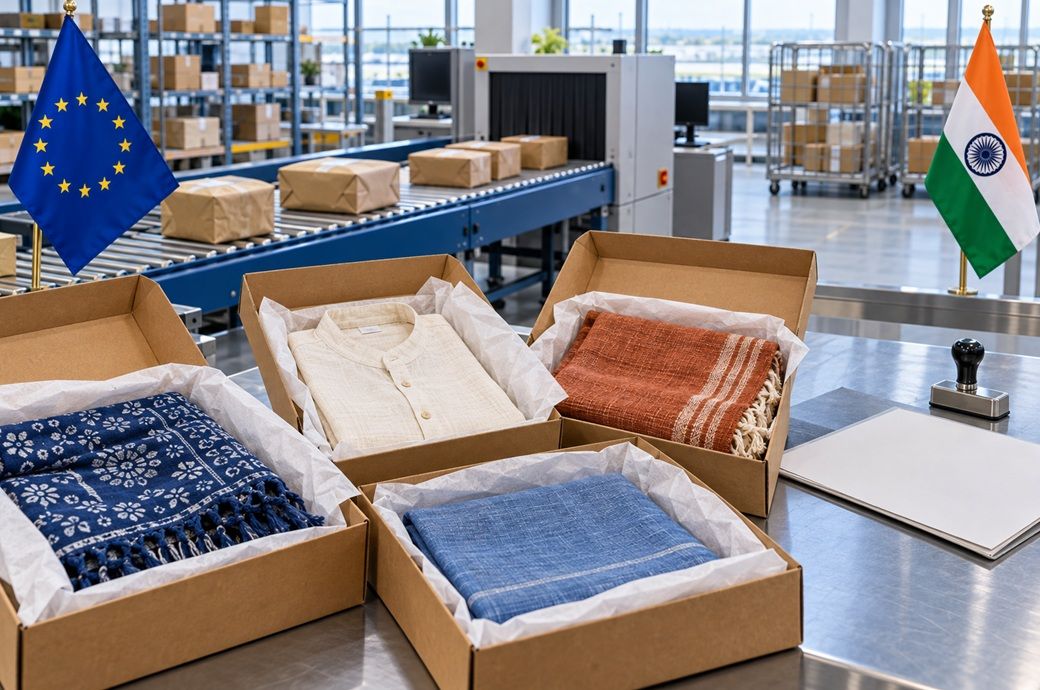
Qualifying direct-to-consumer consignments worth €*** (~$***) or less face a €* (~$*.**) customs duty per item type. A €* (~$*.**) Union handling fee is expected from November *, **** on qualifying distance sales of any value. Business-to-business shipments imported into EU stock are treated differently, although warehousing adds storage, VAT-compliance and working-capital costs. Charges are calculated per customs declaration line, which generally corresponds to a distinct product type; five identical T-shirts declared on a single line may incur one charge, whereas a T-shirt and a watch generally require separate lines. Exporters should compare direct shipping with EU fulfilment using their actual freight, customs, tax, storage and inventory costs. The EU–India FTA could reduce or eliminate tariffs on eligible textile and apparel products once it enters into force. Exporters should prepare rules-of-origin documentation but should not assume a **** start date.
September textile and apparel exports rise **.** per cent, but cumulative apparel exports fall *.** per cent
Ministry of Commerce and Industry quick estimates, as compiled by CITI, put textile and apparel exports at $*.** billion in September ****, up **.** per cent year on year. Textiles rose **.** per cent and apparel **.** per cent. Over April–September, combined exports grew *.** per cent, while apparel fell *.** per cent. These figures describe sector-wide exports, not direct-to-consumer EU shipments.