
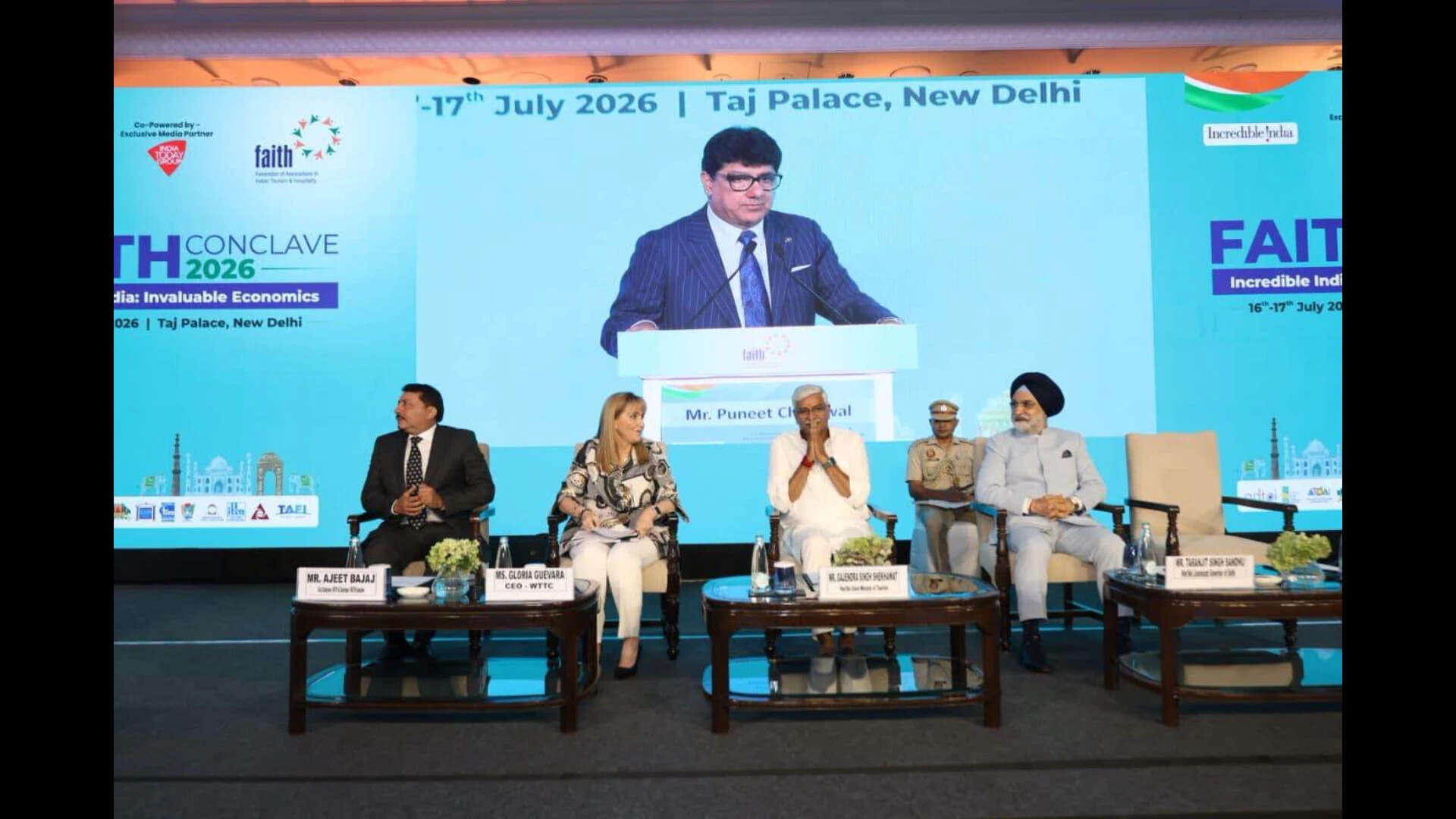
The Federation of Associations in Indian Tourism & Hospitality (FAITH) has unveiled a six-point Tourism Growth Charter, urging the Centre and state governments to implement time-bound reforms aimed at unlocking India’s tourism economy and positioning the country among the world’s leading travel destinations.Released at the FAITH Conclave 2026 in New Delhi, the Charter calls for granting infrastructure status to tourism at the Centre and industry status across all states, accelerating the development of 50 tourism destinations on a mission mode, launching a globally funded ‘Brand Bharat‘ campaign, liberalising the country’s visa regime, strengthening tourism infrastructure and rationalising taxation to improve India’s competitiveness. The two-day conclave, themed “Incredible India: Invaluable Economics”, brought together policymakers, industry leaders and global tourism experts to deliberate on how tourism can emerge as a key driver of economic growth, employment generation and regional development.Puneet Chhatwal, Chairman of FAITH and Managing Director & CEO of Indian Hotels Company (IHCL), said the sector had reached a defining moment where policy execution would determine India’s ability to unlock tourism’s economic potential. “The challenge before us is no longer proving tourism’s potential, it is harnessing it at scale. Tourism is a growth engine that has a multiplier effect on both economic and social development. By acting now on industry status, 50 destinations, Brand Bharat and ease of travel, we can position India as a global tourism powerhouse this decade. This is the essence of ‘Incredible India: Invaluable Economics’—building tourism as the pathway to national growth and global influence,” Chhatwal said. Among the key recommendations, FAITH has sought infrastructure status for tourism projects to improve access to institutional finance and reduce borrowing costs, while simultaneously urging states to accord industry status to tourism businesses. The apex industry body has also proposed fast-tracking the development of 50 tourism destinations through clearly defined implementation timelines. Recognising the growing importance of inbound tourism, the Charter advocates a sustained international marketing campaign under the ‘Brand Bharat’ umbrella, supported by increased government funding to strengthen India’s visibility in overseas markets. It also recommends expanding e-visa access and simplifying entry procedures to make travel to India more seamless for international visitors.
The Charter further emphasises investment in last-mile connectivity, convention centres, cruise terminals, digital infrastructure and visitor amenities, alongside tax rationalisation and a single-window clearance mechanism to encourage greater private sector investment in tourism projects. Addressing the conclave, Union Tourism Minister Gajendra Singh Shekhawat described tourism as a nation-building sector capable of driving inclusive growth and contributing significantly towards India’s vision of becoming a developed nation by 2047.”Tourism is not merely a supporting sector—tourism is a nation-building sector,” Shekhawat said, adding that the sector creates employment, empowers women, nurtures entrepreneurship and connects rural and remote regions to economic opportunities.Highlighting the country’s cultural and civilisational strengths, he said India’s heritage represented an irreplaceable national asset while stressing that sustained collaboration between governments and industry would be critical to attracting long-term investments. “Our goal is to make India the world’s most authentic experience destination—a country where heritage is alive, not merely surviving,” the minister said.Lieutenant Governor of Delhi, Taranjit Singh Sandhu, highlighted the national capital’s role as India’s gateway for international visitors, describing Delhi as a unique confluence of history, diplomacy, commerce and culture. Referring to the successful hosting of the G20 Summit in 2023, he said the city had demonstrated its capability to stage world-class global events and called for continued investments in connectivity, hospitality infrastructure, cultural institutions and heritage precincts to further position Delhi as one of the world’s leading tourism capitals.He also underscored the importance of balancing tourism growth with sustainability, heritage conservation and community participation, noting that the future of tourism must be built on responsible development that benefits both visitors and local communities.Offering a global perspective, Gloria Guevara, President and CEO of the World Travel & Tourism Council (WTTC), said India possesses an unmatched diversity of cultural, culinary and natural assets but needs to convert them into stronger visitor demand through targeted global promotion.Referring to WTTC projections that the global travel and tourism sector could create over 88 million jobs during the next decade, she said India was well positioned to capture a significant share of this opportunity. She also encouraged the country to leverage its global diaspora as ambassadors for Indian tourism.”It’s not that you have to create the assets. The assets are right here,” Guevara said, pointing to India’s culture, landscapes and cuisine as key competitive advantages.The opening day of the conclave concluded with a common message from policymakers and industry leaders that India’s tourism ambitions would require sustained policy support, coordinated execution and stronger public-private partnerships to transform the country’s vast tourism potential into long-term economic growth.
