
A thread of ivory runs through every collection of fashion designer Aman Verma. At first glance, it seems like an aesthetic choice. But behind that signature palette lies a personal story, one rooted in childhood memories, grief, and a rebellion against age-old social customs.
Growing up in Bihar, Verma watched his mother admire a white sari she rarely got to wear. Married women in many parts of India are discouraged from wearing white, a colour traditionally associated with widows and mourning. Decades later, that memory became the foundation of Shwetanga, the Delhi-based label he founded in 2021.
“The colour itself carried restrictions,” Verma tells indianexpress.com. “I wondered why people couldn’t wear something they genuinely loved. That question stayed with me.”
Today, the 32-year-old designer has carved a distinct niche in Indian fashion with his sculptural ivory ensembles, textured drapes, and understated craftsmanship. Verma caught the Internet’s attention after one of his Instagram Reels took the Internet by storm. The video featured several models donning Verma’s collection, walking through a ramp. Not the conventional ramp but a narrow gali in a village in Bulandshahr, Uttar Pradesh.
With several celebrities, such as Sharvari, Nia Sharma, Isha Malviya, Pratibha Ranta and others donning his outfits, Verma has been captivating fashion enthusiasts with his storytelling through textiles. Yet, his journey began far away from India’s fashion capitals, in the classrooms of Bihar, where becoming a designer wasn’t considered a conventional dream.
From engineering expectations to fashion dreams
Verma grew up between Gaya and Nawada. Like many academically bright children from small-town India, he was expected to pursue engineering or medicine. “I was good at studies,” he recalls. “Everyone assumed I would become an engineer or a doctor.”
However, things changed after Class 8, when he expressed his inclination towards sketching and painting, which slowly evolved into a love for design. Unlike most teenagers who discover their career interests much later, Verma knew almost instantly that fashion was where he belonged.
The decision surprised his family, but not in the way he expected. “I thought my parents would refuse. Instead, they said, ‘If this is what you want to do, then do it’,” he shared.
Story continues below this ad
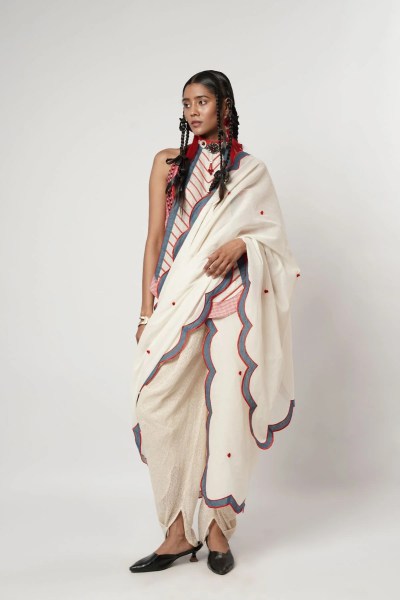 Cerulean Scalloped Dhoti Saree from Aman Verma’s Astitva collection (Photo: Shwetanga official website)
The bigger challenge wasn’t convincing his parents but was navigating a field that nobody around them fully understood. There were no designers in the family, no roadmap to follow, and very little awareness about fashion as a profession.
“Many people saw fashion designers simply as tailors. They couldn’t understand why someone who was doing well academically would choose this,” he said.
Instead of moving to Kota like his elder brother to prepare for engineering, Verma stayed back in Bihar, completed his Class 12 education, and spent a few months preparing specifically for the National Institute of Fashion Technology (NIFT) entrance examination. He secured admission to NIFT Gandhinagar.
Leaving Bihar, finding himself
For Verma, moving to Gujarat wasn’t merely about pursuing higher education. It was the first time he had stepped outside the familiarity of home. “The biggest challenge wasn’t fashion,” he says. “It was leaving Bihar.”
Story continues below this ad
Quiet and introverted by nature, he struggled with hostel life, a new culture and unfamiliar surroundings. “I had never lived away from home before. During the first year, I would cry. It took time to adjust,” he said.
Unlike many students who embraced college life with ease, Verma remained deeply focused on academics and assignments. “I thought college would be like school,” he laughed. “Everyone else was enjoying themselves while I was worried about my grades.”
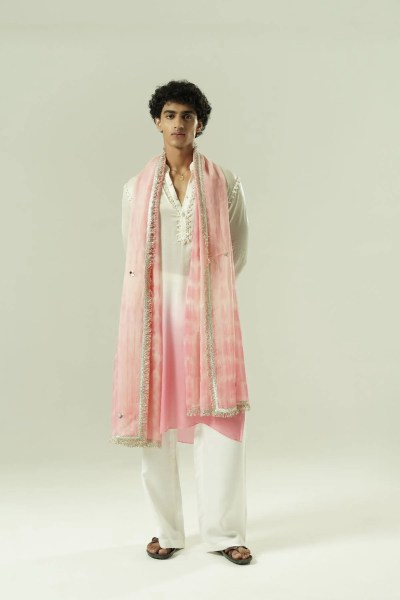 Ombre Beaded Kurta Set by Aman Verma (Photo: Shwetanga official website)
Interestingly, despite common stereotypes associated with migrants from Bihar, Verma says he never experienced discrimination during college. “I was lucky in that sense,” he shared.
After graduating, Verma joined Ahmedabad-based designer Shamal Bhumika, where he learned the realities of the fashion industry. Later, he moved to Delhi and worked with designer Shivan and Narresh, where he explored embroidery, textures, and conceptual craftsmanship. Those years gave him technical expertise, but they also planted another thought.
Story continues below this ad
“I realised I was working incredibly hard to build someone else’s dream. I wondered what would happen if I invested that same energy into my own,” Varma said.
When grief became purpose
The pandemic brought devastating personal loss. In 2020, Verma’s mother died after contracting COVID-19. Because of pandemic restrictions, he could not see her one last time. “It was heartbreaking,” he shared.
Still processing the loss, he lost his father the following year after his health deteriorated. The back-to-back tragedies, he recalled, left him emotionally shattered. For months, he withdrew from family and struggled to focus on work.
Eventually, conversations with a close friend nudged him back towards the dream he had been nurturing for years. In 2021, Shwetanga was born.
Story continues below this ad
The name itself reflects his roots. “Shwet” means white, while “Anga” is a word commonly used in Bihar for clothing.
Fashion rooted in memory
Unlike designers who begin with mood boards or trend forecasts, Verma shared that his creations are rooted in memories. “Most of my collections come from my own experiences,” he shared.
His designs often blend regional references without becoming costume-like. While collections such as Astitva feature influences from gamcha textiles and Manipuri weaves, Verma doesn’t intentionally limit himself to just one geographical identity.
“I don’t consciously think, ‘I’m going to create something inspired by Bihar’. But when you’ve grown up somewhere, those memories naturally become part of your work,” he shared.
Recalling watching everyday drapes worn by women around him while growing up, Verma said, “They weren’t dressing for fashion, but if you reinterpret those silhouettes today, they become incredibly contemporary.”
Story continues below this ad
Why Indian crafts deserve the spotlight
Verma pointed out that international luxury brands often borrow Indian aesthetics without necessarily acknowledging the artisans who preserve these traditions. The recent conversations around Kolhapuri-inspired luxury footwear and bandhani motifs have only reinforced his belief that Indian crafts deserve greater recognition.
“We don’t even know enough about our own crafts,” he said.
Verma further stressed that textile traditions should be introduced in school curricula so that children grow up understanding the heritage of their own states. “If I had the opportunity, I’d love to highlight Tangaliya weaving,” he says, referring to the intricate Gujarati craft known for its bead-like woven motifs. “It’s a beautiful tradition, but it’s slowly disappearing.”
Can Gen Z change fashion?
Unlike many designers who dismiss social media-driven fashion trends, Verma believes that Gen Z are smarter than the other generations.
Story continues below this ad
While he acknowledged that many young consumers follow global aesthetics—from Y2K fashion to nostalgic silhouettes inspired by films and television—Verma believes that the biggest strength of the younger generation lies in personal styling.
“They understand their own style much better,” he said.
Millennials, Verma emphasised, often dressed without much thought, whereas younger consumers experiment more confidently. Social media has undoubtedly accelerated that transformation.
Although Shwetanga has already found celebrity patrons, Verma isn’t in a rush to scale recklessly. He shared that he prefers moving slowly, allowing each collection to evolve organically.
“Of course I want my brand at Cannes. It may take another two or three years, but that’s definitely a goal,” he said.
