
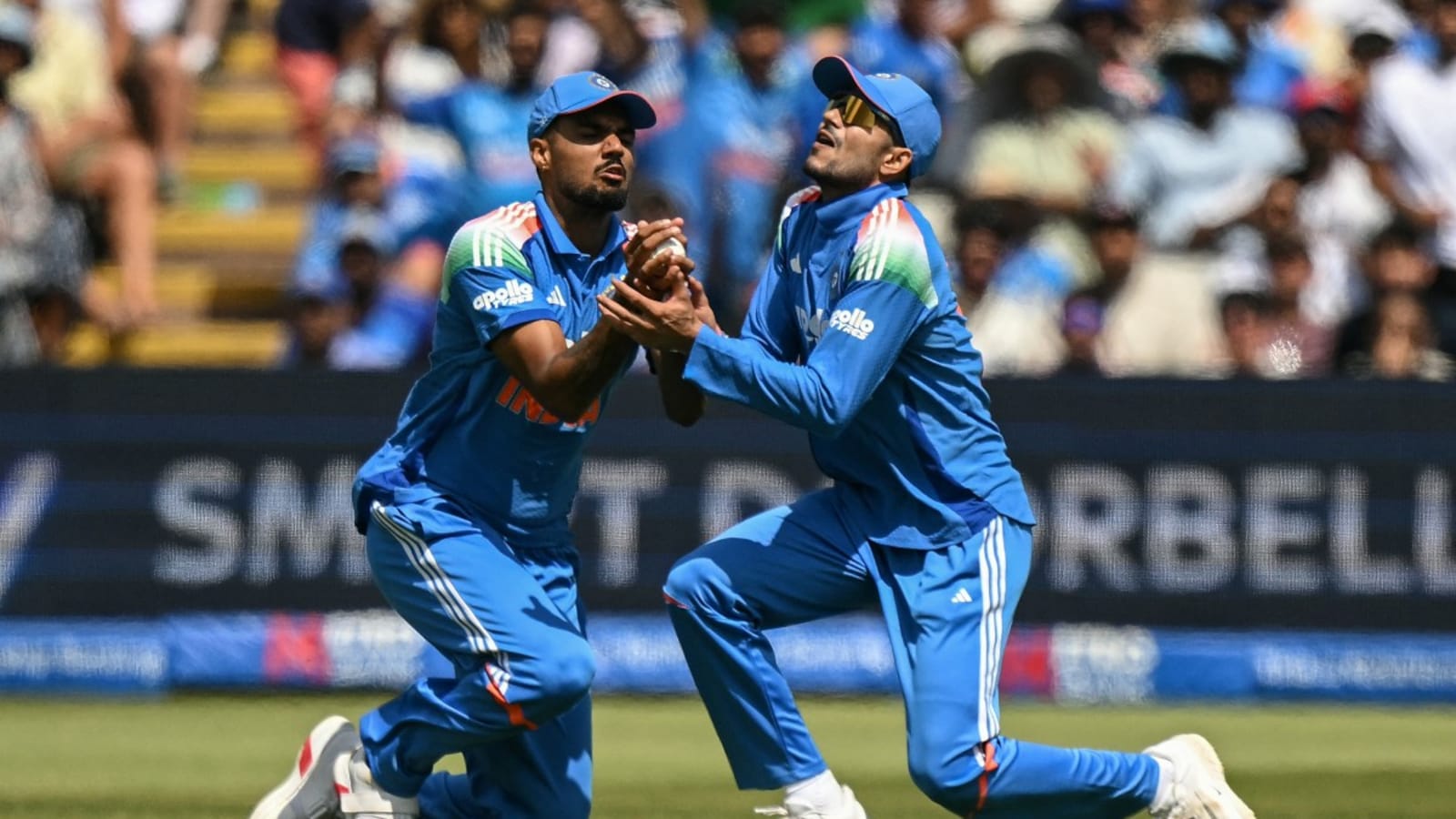
Gurnoor Brar (L) in action during first ODI against England© AFP
Indian cricket team fast bowler Gurnoor Brar was given a warning for breaching level one of the ICC Code Of Conduct during the first ODI encounter against England on Tuesday. The ICC said that Brar was found to have breached Article 2.9 of the ICC Code of Conduct for Players and Player Support Personnel. It relates to “throwing a ball at or near a player in an inappropriate and or dangerous manner during an international match”. He was also handed one demerit point for the incident.
The incident took place during the eighth over of the England innings when Brar picked up the ball off his own bowling and threw it towards England batter Ben Duckett. It was deemed to be ‘inappropriate and dangerous’ by the match referee.
The charges were levelled by on-field umpires Kumar Dharmasena and Mike Burns, third umpire Sam Nogajski, and fourth umpire Russell Warren. Level 1 breaches carry a minimum penalty of an official reprimand, a maximum penalty of 50 per cent of a player’s match fee, and one or two demerit points.
When a player reaches four or more demerit points within a 24-month period, they are converted into suspension points and the player faces a ban. Two suspension points equate to a ban from one Test, two ODIs, or two T20Is, whichever comes first.
These demerit points remain on a player’s disciplinary record for a period of 24 months from their imposition, after which they are expunged. India took a 1-0 lead in the three-match series with a six-wicket win over England, where Brar picked two wickets for the visitors. The two teams will next face in the second ODI in Cardiff on Thursday.
“Brar admitted the offence and accepted the sanction proposed by match referee Richie Richardson of the Emirates ICC Elite Panel of Match Referees, and as such, there was no need for a formal hearing,” the ICC said on Thursday.
(With agency inputs)
Featured Video Of The Day
FIFA World Cup 2026 | Argentina Fans Sing & Dance After Dramatic Comeback Against Egypt
Topics mentioned in this article
