
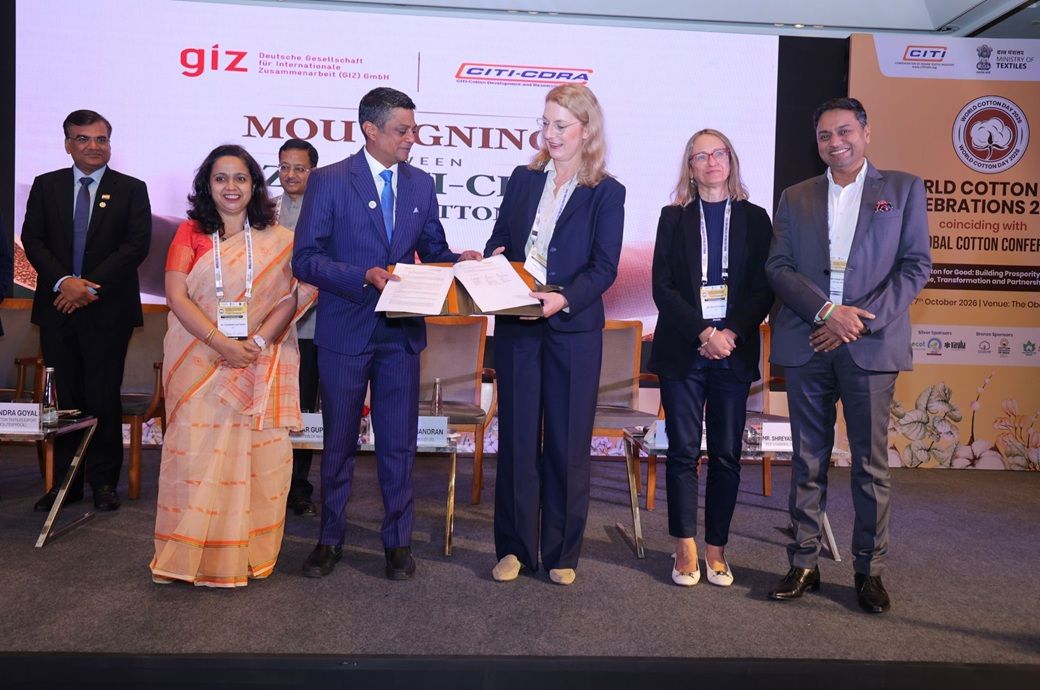
The Confederation of Indian Textile Industry (CITI), in association with the Ministry of Textiles and the Cotton Corporation of India, organised the conference on World Cotton Day 2026. The event brought together stakeholders across the cotton value chain, including women farmers, to discuss a more robust, resilient and sustainable cotton ecosystem in India.
CITI held the 5th Global Cotton Conference in New Delhi on October 7, focusing on sustainable, traceable and higher-productivity cotton.
MoUs covered ELS cotton, CottonConnect, FLA and TEXPROCIL links, while industry sought stable pricing and availability policies.
India approved ₹5,659.22 crore (~$584 million) for cotton productivity and targets $100 billion in exports by 2030.
Supported by Kasturi Cotton, CITI-Cotton Development and Research Association (CITI-CDRA) and Sharda University, the conference was themed “Cotton for Good: Building Prosperity Through Trade, Transformation and Partnership”. Discussions covered sustainability, traceability and transparency across the cotton value chain; recognising and empowering women cotton farmers during the International Year of the Woman Farmer; unlocking the value of organic cotton; using technology to improve productivity; and managing market, credit and operational risks, CITI said in a press release.
Several memoranda of understanding were exchanged at the inaugural function. These included MoUs between CITI-CDRA and German development agency GIZ on Extra Long Staple (ELS) cotton, between CITI and CottonConnect, between CITI and Fair Labor Association (FLA), and MoUs involving the Cotton Textiles Export Promotion Council (TEXPROCIL). Initiatives connected with Kasturi Cotton Bharat were also announced, and a CITI-CDRA video showcasing its activities was released.
Speakers highlighted technology, innovation, better farm practices and greater attention to quality, traceability and transparency. They said a sustainable and productive cotton value chain could help farmers prosper, allow manufacturers to scale responsibly, strengthen exporters and improve India’s position in the global textiles and apparel market.
Cotton Corporation of India chairman-cum-managing director Lalit Kumar Gupta said greater focus on quality, sustainability and traceability was needed for the growth of the Indian cotton textile sector.
Ashwin Chandran, chairman of CITI and CITI-CDRA, said Indian cotton’s quality mattered more than quantity and called for closer collaboration among stakeholders to strengthen India’s cotton textile ecosystem.
CITI vice chairman Shreyaskar Chaudhary and TEXPROCIL vice chairman Dharmendra Goyal also addressed the gathering. Textile Commissioner Vrunda Manohar Desai chaired the session titled ‘From Farm to Luxury: Unlocking the Value of Organic Cotton’.
The United Nations General Assembly officially designated October 7 as World Cotton Day in 2021, recognising cotton’s role in society. Cotton supports millions of livelihoods across India’s textile value chain, and although India is among the world’s largest cotton growers, its productivity trails that of several peer countries, affecting export competitiveness, CITI said. The productivity challenge is significant because cotton remains the primary raw material for most of India’s textile exports.
In May 2026, the Union Cabinet approved ₹5,659.22 crore (~$584 million) for the Mission for Cotton Productivity, to be implemented from 2026–27 to 2030–31. The mission is intended to address bottlenecks, declining growth and quality concerns in India’s cotton sector.
CITI said India’s textile and apparel sector is the country’s second-biggest employer and a major contributor to GDP and exports.
During April-August 2026, India’s textile exports rose 6.94 per cent in US dollar terms, while apparel exports declined 9.10 per cent, leaving cumulative textile and apparel exports marginally lower by 0.24 per cent year-on-year. India aims to build a $350 billion textile and apparel industry by 2030, including $100 billion in exports.
Fibre2Fashion News Desk (SG)