
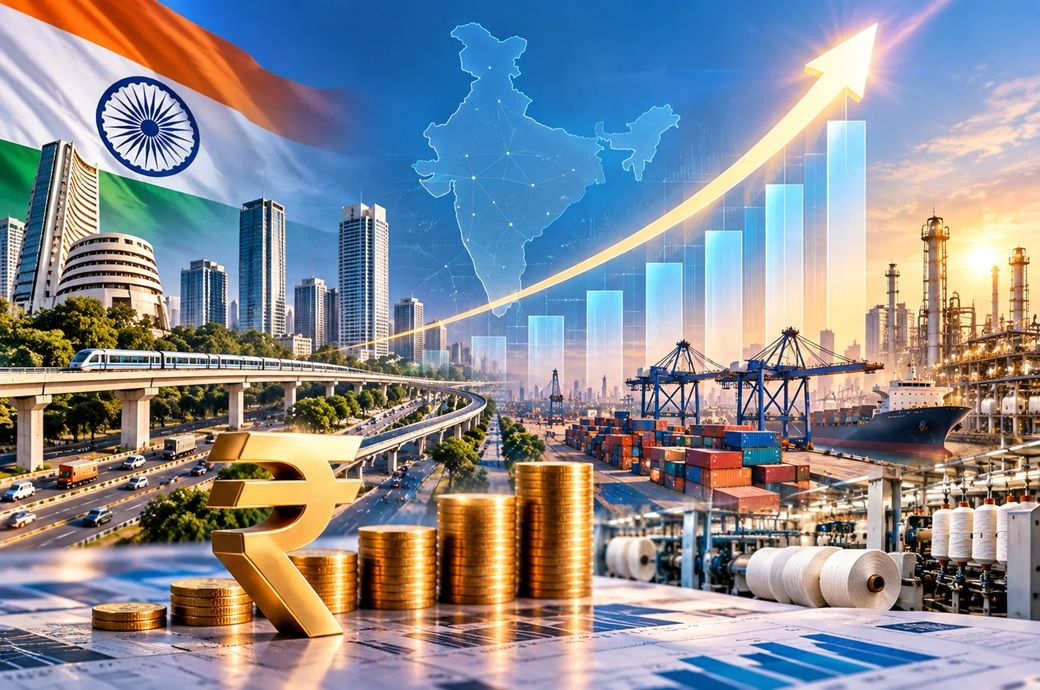
India’s economy could double in size to around $8 trillion over the next decade, driven by structural reforms and infrastructure investment, global investment firm KKR said in its October 2026 report, ‘Thoughts From the Road: Europe and Asia.’
KKR said India’s reform agenda since 2014, including Goods and Services Tax (GST) simplification, the Insolvency and Bankruptcy Code, labour market formalisation and sustained infrastructure development, had raised the country’s long-term growth potential.
India’s economy could double to around $8 trillion over the next decade, driven by structural reforms and infrastructure investment, KKR said in its October 2026 report.
The firm highlighted strong services exports, expanding Global Capability Centres and AI adoption as growth drivers, while noting that government measures could help shield consumers from high oil prices.
The investment firm said India’s economy had crossed $4 trillion and was on track to double again over the next 10 years, with further gains possible from reforms already implemented and future policy measures.
KKR maintained a positive long-term outlook for India’s consumer market, although it expected a near-term pause amid crude oil prices of around $100 a barrel. It said government measures to shield households from energy inflation could help limit the impact on discretionary spending compared with previous oil shocks.
On the external front, services exports have continued to perform strongly, while Global Capability Centres (GCCs) are emerging as an increasingly important growth driver alongside traditional information technology services, the report said.
KKR also challenged concerns that artificial intelligence (AI) could disrupt India’s IT sector, arguing that the technology could create new growth opportunities as companies integrate AI into their service delivery systems.
More broadly, KKR remained constructive on Asia, citing deeper capital markets, more flexible currencies and stronger foreign-exchange reserve positions than in the mid-1990s. However, it noted increasing differences in the strength of structural growth prospects across countries.
The firm said it had become more convinced that the global investment cycle would be broader, more durable and more inflationary than previously expected. It recommended an underweight position in government bonds, while favouring real assets and productivity-driven corporate reform opportunities in private equity.
In credit markets, KKR favoured capital solutions and higher-quality liquid credit, cautioning investors against taking on greater risk by moving into lower-quality assets.