
The trial followed the government’s decision to assign the Nepali Army to repair the dilapidated factory and restore production capacity.
Nepal’s state-owned Hetauda Textile Industry has completed its first preliminary test production after nearly 24 years of closure.
The Nepali Army restored power systems, cleared the site and serviced idle looms ahead of a two-month ministry deadline.
A Nepal Army study puts full revival capital at Rs1.93 billion, with uniform demand seen as lowering market risk.
For apparel and textile supply-chain stakeholders in Nepal, the restart plan is tied to potential domestic fabric supply for uniforms and broader efforts to revive state-owned industrial capacity.
The factory conducted its first preliminary test production last week after nearly two and a half decades of closure, as per Nepalese media reports.
A technical team from the army’s Directorate of Military Materiel Production in Kathmandu had spent 40 days at the complex, with about 40 technicians and soldiers deployed to clear the neglected premises, overhaul the ageing power supply system and service mechanical looms that had remained idle for years.
Although the initial test run was successful, significant work remains before full-scale commercial operations can resume. The Ministry of Industry, Commerce and Supplies had given the military team two months to complete initial maintenance and conduct test production.
The Ministry of Industry released Rs3 million from an emergency budget of Rs3.3 million requested for immediate repairs, added the reports.
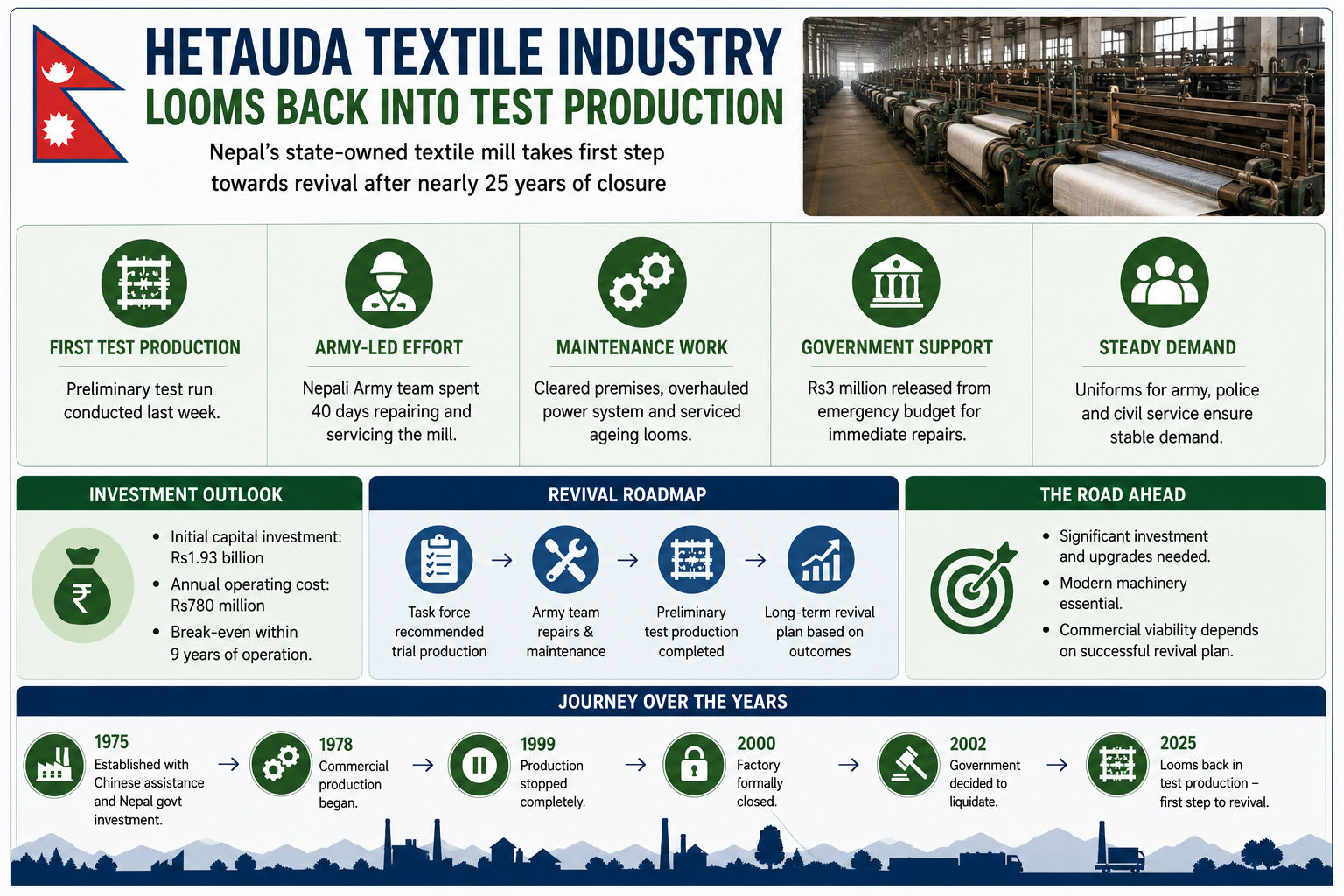
The test production follows recommendations from a government task force formed to study the revival of sick state-owned enterprises. The task force recommended an immediate trial production run, with longer-term plans to be determined based on the outcome.
A detailed feasibility study conducted by the Nepal Army under state policies for the 2023-24 fiscal year estimated that a full revival would require initial capital investment of Rs1.93 billion, with annual operating costs projected at Rs780 million. The study concluded that the factory could reach break-even and become profitable within nine years of continuous operation.
The factory owns 166 ropanis of land and retains basic infrastructure that could be used for revived operations, according to the feasibility study. The study also identified steady demand for uniforms from the Nepali Army, Nepal Police, Armed Police Force and civil service, while key raw materials are available domestically. These factors mean the factory faces minimal market risk, the study said. The broader revival project could be financed through the Army Welfare Fund.
Hetauda Textile Industry was established in 1975 with financial and technical assistance from the Chinese government and capital investment from the Nepal government. It began commercial production in 1978 and was, for two decades, a major pillar of Nepal’s manufacturing sector. Persistent political interference, weak management, load-shedding, overstaffing and failure to modernise its technology gradually undermined its financial viability. Production stopped completely in 1999, the factory was formally closed in 2000 and the government decided to liquidate the enterprise in 2002.
Military engineers have cautioned that the successful trial is only an initial step. A sustainable restart will require substantial capital investment, structural improvements and modern machinery, leaving the factory’s commercial viability dependent on whether the revival plan can move beyond bringing old looms back to life.
Fibre2Fashion News Desk
