
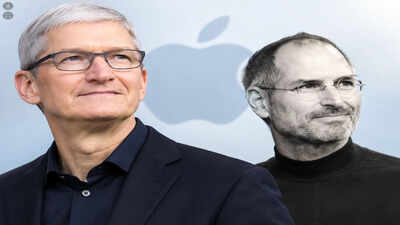
When Steve Jobs handed over the reins of Apple to Tim Cook, he left him with a piece of advice that Cook has never forgotten. He told him not to spend time wondering what he would have done, but to focus on making the right decisions himself.“Never ask what I would do, just do the right thing,” Jobs told Cook.Cook recalled the conversation in an interview with CBS Sunday Morning, explaining how Jobs wanted him to lead Apple in his own way rather than feel pressured to follow the same path.Cook joined Apple in 1998 and took over as CEO in 2011, after Jobs stepped down because of his declining health. Jobs died in October that year, but his advice has continued to shape how Cook thinks about leadership.
Why Steve Jobs didn’t want Apple to look back
Jobs had a reason for giving Cook that advice. He had seen what could happen when a company became too focused on trying to recreate the vision of its founder.According to Fortune, Jobs had noticed this while observing Disney after the death of its founder, Walt Disney. Jobs knew the company well. He had bought Pixar from Lucasfilm in 1986, and Disney went on to acquire the animation studio in 2006.During that time, Jobs noticed that people at Disney were spending too much time discussing what Walt Disney would have done instead of making decisions for themselves.“He had watched Disney go through this paralysis of sitting around and talking about what Walt [Disney] would do. And he did not want that for Apple,” Cook explained.Jobs wanted to avoid the same situation at Apple. He knew the company would have to change and grow after his departure, and he didn’t want his successor to feel that every decision had to match his own thinking.
How Steve Jobs prepared Tim Cook to become CEO
Cook said Apple had never really experienced a normal change of leadership at the top. Previous transitions had happened during difficult periods, and Jobs wanted his own departure to be different.He eventually invited Cook to his home and offered him the CEO position. But along with the offer, he made one thing clear: Cook didn’t have to lead the way he did.Looking back, Cook said that advice took a huge weight off his shoulders.“I’ll never forget that and it was such a gift for me, because he took off of my shoulder this question of, ‘What would Steve do?’” Cook said.Instead of constantly comparing himself with Jobs, Cook decided to concentrate on being the best leader he could be.“I just put my head down and thought, ‘I’m going to be the best version of myself,’” he recalled.Cook had joined Apple less than a year after Jobs returned to the company as interim CEO. He became chief operating officer in 2005 before taking over as CEO six years later.Since then, Cook has spent years building on Apple’s existing strengths while putting his own stamp on the company.
The leadership lessons Cook learned from Jobs
Cook says some of Apple’s core principles have stayed with him over the years. These include teamwork, open debate, focus and a high standard for the products the company makes.Jobs believed that people could achieve more by sharing ideas and challenging each other’s thinking than by working in isolation.“He had the vision that the collaboration was something that would produce great results. That one plus one is equal to three, not two,” Cook said.He also recalled Jobs’ belief that a good idea could become even better when people were willing to discuss it honestly. Sometimes, that meant calling a colleague late at night because a new idea couldn’t wait until the next morning.But teamwork was only one part of Jobs’ approach. He also believed that knowing what to ignore was just as important as knowing what to pursue.“[Jobs] had an idea of focus that you say ‘no’ to a thousand things to say ‘yes’ to the one that’s truly important,” Cook said.Jobs expected a lot from the people around him. For him, doing a job well wasn’t always enough. He wanted people to push themselves to produce something exceptional.That approach became a familiar part of Apple’s culture, from the way its teams worked to the attention paid to its products.
Steve Jobs also gave advice to other business leaders
Cook wasn’t the only business leader who turned to Jobs for guidance. Salesforce CEO Marc Benioff and former Starbucks CEO Howard Schultz have also spoken about advice they received from the Apple co-founder.Benioff recalled in a 2024 episode of Lenny’s Podcast that Jobs helped him work through what he described as “entrepreneurs block”.Jobs challenged him to think bigger, including growing Salesforce’s business tenfold within two years, winning a major customer for its automation product and building an application economy.Benioff took that advice as a push to create an app marketplace. The result was AppExchange, Salesforce’s platform for business applications. He later credited Jobs’ guidance with influencing his career and gave Apple the App Store trademark and the appstore.com domain.Schultz also sought Jobs’ advice during a difficult period for Starbucks in 2008. After hearing about the company’s problems, Jobs suggested replacing the entire leadership team. His reasoning was straightforward: if the existing executives weren’t right for the company’s future, many would eventually leave anyway.Schultz initially struggled with the idea but later said Jobs had been right. All but one member of the leadership team eventually departed.For Cook, though, Jobs’ advice was about something more personal. He wasn’t expected to become another Steve Jobs. He was expected to make his own decisions and take responsibility for them.And that may be the most lasting lesson Jobs left him with: respecting a founder’s legacy doesn’t mean trying to be that person. Sometimes, the best way to carry a company forward is to find your own way of leading it.