
New Delhi:
The Indian government and Elon Musk engaged in a verbal spat on Thursday after the Telecom Department rejected allegations that Starlink’s satellite internet services were being blocked by domestic business interests, leading the tech trillionaire to ask if “Ambani is the real boss of India”.
The government, earlier in the day, slammed the US business tycoon over his allegations that Starlink’s satcom services are being blocked, and made it clear that demonstrating compliance with security norms is an absolute must for every satcom licensee in the country.
Within hours of the government’s rebuttal, Musk in an X post asked whether “Ambani is the real boss of India”.
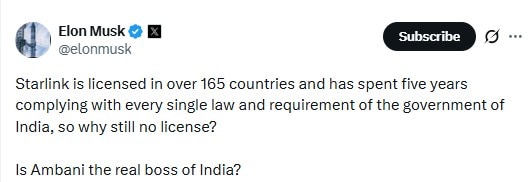
“Starlink is licensed in over 165 countries and has spent five years complying with every single law and requirement of the government of India, so why still no license?.
“Is Ambani the real boss of India?” Musk said in an X post.
The assertion came within hours of the telecom ministry saying that the country’s authorisation framework for telecom and satellite services was “fair and non-discriminatory” and that any suggestion that it was being applied selectively was “baseless and misconceived”.
The government has licensed three companies – Musk’s Starlink, Reliance Jio’s satellite venture Jio Satcom and Bharti-backed Eutelsat OneWeb – but none can begin commercial services until required security assessments and spectrum-related approvals are completed.
“Security assessment as part of this process is currently under way in respect of all three licensees,” the telecom ministry said in a statement.
Minister of State for Communications Chandra Sekhar Pemmasani said the issue was with the Ministry of Home Affairs and was not specific to any one company.
“The Department of Telecom has issued licences to all satcom companies as well as provisional spectrum. Now the issue is pending with MHA for security clearance. As soon as it is cleared, they will get it. It has nothing to do with one company,” Pemmasani told reporters on the sidelines of the India Mobile Congress.
The comments came a day after Musk alleged on X that “certain oligarchs” were blocking Starlink to protect a “monopolistic chokehold” on the Indian market. He did not identify any company.
Musk also rejected claims that Starlink services had been used by militants in Manipur, saying its satellite beams were switched off over India and therefore could not have been used for any purpose there.
“Starlink in India would enable high-speed, affordable internet connectivity for those who can’t afford current prices or who don’t have a connection at all!” Musk said in another post.
India’s telecom market is dominated by Reliance Jio, Bharti Airtel and Vodafone Idea, while satellite broadband represents a new potential segment that could extend connectivity to remote and underserved areas.
Bharti Airtel Chairman Sunil Bharti Mittal, whose group backs OneWeb, said his own satellite venture was also waiting for regulatory approvals.
“We are waiting for our own approvals,” Mittal said at the India Mobile Congress when asked about Musk’s allegations.
Jio Platforms Managing Director Akash Ambani declined to comment, saying he had not seen Musk’s remarks.
The government’s response comes as the India Mobile Congress, the country’s flagship telecommunications industry event, is under way in New Delhi.
Starlink has said it is ready to begin operations in India. Lauren Dreyer, SpaceX’s vice president for Starlink business operations, said on Wednesday that the company had invested in infrastructure specifically designed to meet Indian regulatory and security requirements.
Starlink has built 20 gateway sites in India with hundreds of antennas and has established controls intended to keep Indian user data within the country, Dreyer said.
The regulatory dispute highlights the challenges facing satellite broadband operators as India seeks to expand connectivity while imposing security and data-protection requirements on communications networks.
Under the government’s framework, a licensed satellite operator can move to the spectrum-assignment stage once it completes the required security process. The telecom ministry said all three licensees were currently “broadly at the same regulatory stage.
The companies are therefore competing to enter a market where satellite connectivity could complement terrestrial mobile networks, particularly in areas where conventional telecom infrastructure remains difficult or uneconomic to deploy.
(Except for the headline, this story has not been edited by NDTV staff and is published from a syndicated feed.)
