
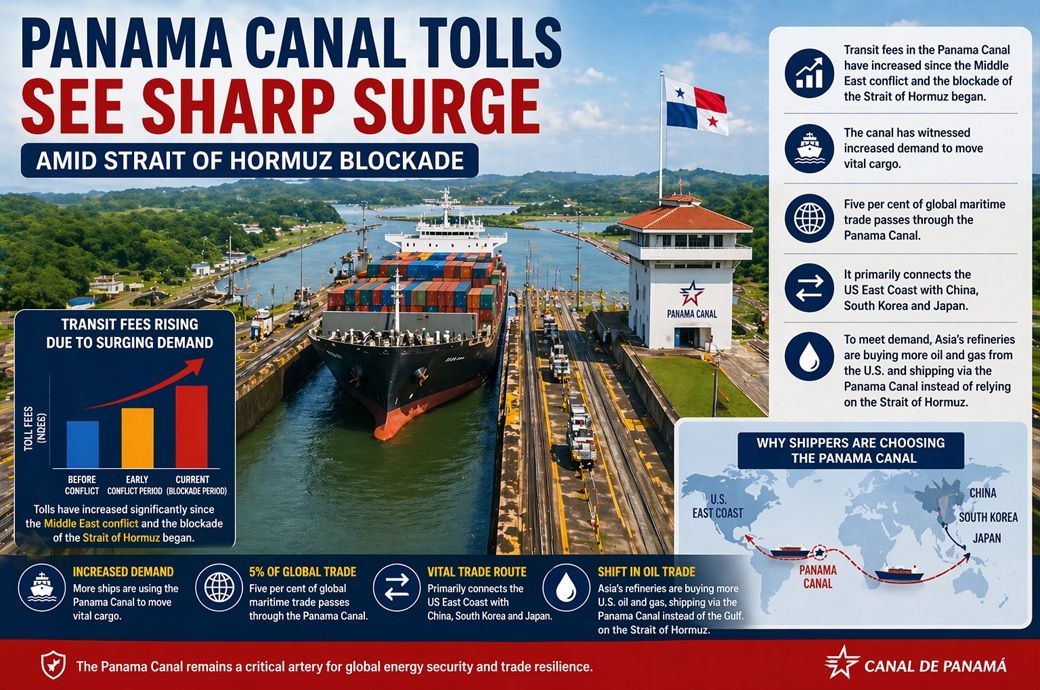
The canal has witnessed increased demand to move vital cargo.
Transit fees in the Panama Canal have risen since the Middle East conflict and the blockade of the Strait of Hormuz began, according to the Panama Canal Authority.
The canal has witnessed increased demand to move vital cargo.
The average price in an auction before the conflict was in the $135,000-$140,000 range.
However, since the conflict began, this rose to as much as $385,000 during March and April.
Five per cent of global maritime trade passes through the Panama Canal, which primarily connects the US East Coast with China, South Korea and Japan.
To meet demand, Asia’s refineries are preferring to purchase oil and gas from the United States and ship those through the transoceanic waterway instead of buying from Gulf countries that rely on the Strait of Hormuz, the Authority said.
The average number of ships passing through the canal on a daily basis has ‘remained strong’, the Authority told a global news wire.
Ships using the canal book their transit in advance, and ships without bookings wait an average of five days to get through, but there is an auction where last-minute transits can be purchased.
The average price in an auction before the conflict was in the $135,000-$140,000 range. However, since the conflict began, this average rose to as much as $385,000 during March and April this year. Past average auction prices between October last and February stood at around $130,000.
The most recent auction included a $4 million bid for an LNG vessel, and in recent weeks two oil tankers exceeded bids of $3 million, the authority said.
Daily canal slot auctions are drawing around five times more bids than before the crisis, pushing average prices for the widely used Panamax locks to $837,500 and Neopanamax slots to $331,250, according to data compiled by Argus Media.
Around 70 per cent of vessels transiting the waterway use the Panamax locks, where auction prices have climbed nearly ten-fold since the disruption began. The rise reflects stronger demand for shipments of oil, fuel and dry bulk commodities, including coal.
The Panamanian government has reportedly stepped up efforts to keep the canal sustainable amid rising demand for transits and tonnage.
Fibre2Fashion News Desk (DS)
