
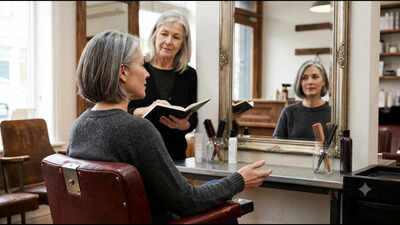
Picture a woman in her late forties sitting in a salon chair, the same chair she has used for years, and quietly deciding not to book the usual touch-up. Nothing dramatic happens. No one applauds. But a small decision has been made, and psychology suggests it can carry more weight than it looks.
Where grey actually comes from
Grey hair is not a sign that something has gone wrong. Hair gets its colour from pigment-producing cells called melanocytes, and over time those cells slow down and eventually stop. Genetics largely decide when. Stress may play a part too: a 2020 study in Nature, carried out on mice, found that stress responses can drain the stem cells that feed pigment production. So grey is biology doing what biology does. Treating it as a flaw is a social habit, not a medical need.
The pressure nobody talks about
Writer Susan Sontag described a “double standard of ageing” in a 1972 essay, arguing that women are judged far more harshly than men for looking older. Grey hair on a man is often read as distinguished. On a woman, it still gets read as neglect. That quiet gap explains why so many people start colouring years before they feel ready to, and why stopping can feel oddly exposed.
What self-acceptance really means
Psychologist Carol Ryff, whose widely used model of psychological well-being lists self-acceptance as a core piece, describes it as holding a positive attitude toward oneself, including one’s past and present. Letting grey grow in can be one visible expression of that. It rarely means indifference to appearance. It often means choosing which standards to follow, rather than inheriting all of them.Sophia Loren is quoted as saying that the real fountain of youth is your mind, your talents and the creativity you bring to your life. Nothing in that line asks anyone to hide a single strand.
A fair look at the other side
Here is where honest analysis matters. Research directly tying grey hair to confidence is still thin, so bold claims should be treated with caution. Colouring hair can be creative, joyful and entirely self-assured. Someone who goes grey may still feel anxious about it, and someone who dyes may feel perfectly at peace. The strands themselves prove nothing. What matters is whether the choice feels free or forced.
The small act that spreads
Still, choices made in public are never fully private. Each person who lets grey show makes it a little more ordinary for the next, shifting what a “normal” fifty-year-old looks like. That ripple may be the most lasting part of this story. Ageing, after all, is one of the few things everyone is guaranteed to do. Choosing to meet it without disguise is less about hair and more about deciding who gets to define a face: the mirror, the market, or the person wearing it.Disclaimer: This article is for general informational purposes only and does not constitute psychological or medical advice. Individual experiences with ageing and appearance vary widely, and choosing to colour or not colour hair is a personal decision.