
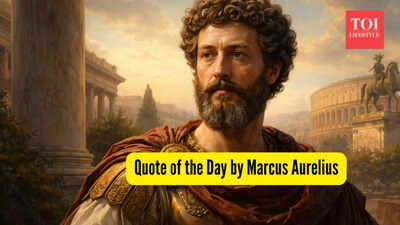
The Roman emperor Marcus Aurelius is often regarded as one of the strangest characters of the ancient world, a man who spent the majority of his life thinking not about power, riches or conquest, but about how a person should live. Born in Rome in AD 121, Marcus Aurelius was emperor from AD 161 until his death in AD 180. He inherited one of the most powerful positions in the ancient world, but his most lasting legacy is not a military victory, nor a political reform. It is a collection of personal philosophical reflections called Meditations. Written mostly as notes to himself, the work provides an unusually intimate glimpse into the mind of a ruler trying to remain rational, disciplined and humane while facing war, disease, political responsibility and personal loss.And more than 1,800 years later, he remains one of the best-known exponents of Stoic philosophy. Its central questions are still eerily familiar, and that is why his writing is still read: What do we do about things we have no control over? How do we deal with disappointment? How do we use our precious time? And what does it mean to have a good life?Marcus Aurelius Antoninus was born in a wealthy Roman family. He was educated in rhetoric, literature and philosophy and became a student of Stoicism as a young man. By early adulthood philosophy was more than an intellectual interest; it was a structure by which he tried to conduct his life.Roman succession politics shaped his road to the imperial throne. He was adopted by Antoninus Pius, who was himself adopted by the emperor Hadrian. Eventually Antoninus Pius was succeeded by Marcus who became emperor in AD 161.At first he was not sole ruler. It was unusual in the history of Roman emperors for Marcus to be co-emperor with his adoptive brother Lucius Verus. Lucius died in AD 169 and Marcus became the sole emperor.His rule was by no means peaceful. Wars on the eastern and northern frontiers of Rome. Uprisings and a devastating epidemic, popularly known as the Antonine Plague. Many of Marcus’s philosophical writings come from the difficult last years of his rule, including times when he was fighting wars.This background is important to reading Meditations. These weren’t the thoughts of a man who has led a quiet, sheltered life. While writing Marcus was carrying great political responsibility and facing circumstances often beyond his control.The emperor who wrote himself intoWhat makes Meditations so interesting is that Marcus apparently never wrote it as a book for an audience. It is written in Greek and consists of a series of private reflections and admonitions, mainly intended for his own moral and philosophical improvement. The title Meditations was appended later; the original title, if Marcus did, in fact, assign one, is unknown. He kept telling himself to keep his temper, to be patient, to do his duty and to think of what was really in his power. And this is the essence of Stoicism.The Stoics didn’t assert that people can control everything that happens to them. Instead, they focused on the difference between external events and our interpretations of external events. The circumstances may be unpredictable, but we can shape how we respond to them with reason, discipline and character. The Stoics’ goal was not to feel good, it was to live virtuously and rationally in any circumstance.Philosophy was not something separate from everyday life for Marcus. It was a pattern. He used it to remind himself how an emperor should behave, how to respond to people who angered him, how to deal with setbacks, and how to remember that even an emperor’s life was temporary.His impact on Stoicism and modern lifeMarcus Aurelius is the last great Stoic philosopher of antiquity and one of the most famous of Rome’s so-called Five Good Emperors. His Meditations is one of the most popular classical works of practical philosophy. Part of his enduring power is the simplicity of his questions.He asks us to look beyond status, wealth and reputation to the quality of our character. He keeps coming back to the theme of mortality, reminding himself that fame is fleeting, life is short, and that external success can’t ultimately protect anyone from ageing or death. But his philosophy isn’t merely about retreat from the world.Marcus believed man to be a social animal and to have obligations to his fellow man. To an emperor this meant that philosophical discipline must be translated into public duty. Stoicism, he felt, demanded that one contribute to the larger human community and not seek only personal comfort.This is one of the reasons why his writings still speak to us today. His concerns are not really old ones. They include procrastination, anger, ambition, relationships, disappointment, mortality, anxiety about the future and the difficulty of doing what we know to be right.Quote of the day“Consider yourself dead. You have lived your life. “Now take what’s left and live it right.” –Marcus Aurelius, Meditations, Book VII, 56The quote may sound harsh at first. Marcus is not saying people should dwell on death, or that they should stop caring about life. Not at all. He is using death-consciousness as a way of attaining more meaning to life. The thought experiment is straightforward. Imagine that the life you have already lived is over. The past is unalterable. The years already lost cannot be regained. You’ve only got time left in front of you.This question changes our point of view on the normal life. We act like there’s an infinite amount of time. We delay conversations, delay important decisions, delay creative ambitions and tell ourselves there will always be another opportunity. Marcus challenges that assumption:What would we stop wasting our time on if we really knew how limited our time was? What does it really mean to “think of yourself as dead”? The first part of the quote is not a call to be a pessimist. It is a reminder of death.For Marcus, the remembering of death was a philosophical exercise meant to strip away distractions. Status, praise, resentment, rivalry and material possessions can seem hugely important when we are caught up in the daily grind. Yet many of these worries lose their edge when set against the narrow scope of human life.The idea is quite similar to the Stoic practice often called memento mori – remembering that we are mortal. Again and again, Marcus used mortality to create urgency, not fear. If life is not infinite, then the now becomes more precious. The second sentence “You have lived your life” allows us to close the chapter on the past in our mind.That is not to say that we forget our memories or refuse to learn from mistakes. It means realising you can’t change what happened yesterday. Regret can be another way to waste the time that we have left.You cannot fix a mistake made five years ago by thinking about it for five more years. You can think of what might have happened till the cows come home, but a missed opportunity is missed. The Stoic response is to learn from what happened, and then bring attention back to what can still be done.“Now take what’s left and live it right” This is the crux of the quote. Marcus does not say, “Take what remains and enjoy it. He says, “live it right.” For him a proper life was not necessarily a comfortable or successful life. It was a life of character. It meant to act rightly, to do one’s duty, to deal fairly with other people, to repress needless anger, to refuse to let external circumstances determine one’s moral character.The message is especially relevant in an age of constant distraction. People are pressured to measure themselves by what they achieve, what they own, how many followers they have on social media and their professional status. Instead, Marcus suggests measuring not how much attention you receive, but how well you live the life you have.A reminder not to put life offThe quote also carries a strong message about procrastination. There is always the temptation to think that real life will start later – after the promotion, after retirement, after the children grow up, after financial worries are gone or after a difficult phase is over. Marcus’ philosophy challenges that idea. There never may be a time that is perfect. The life we’ve got is the one happening right now. This is not to abandon ambition. This means refusing to put off everything that matters until some imagined future happens. Work hard, make plans and pursue goals – but also recognise the process itself is life.
