
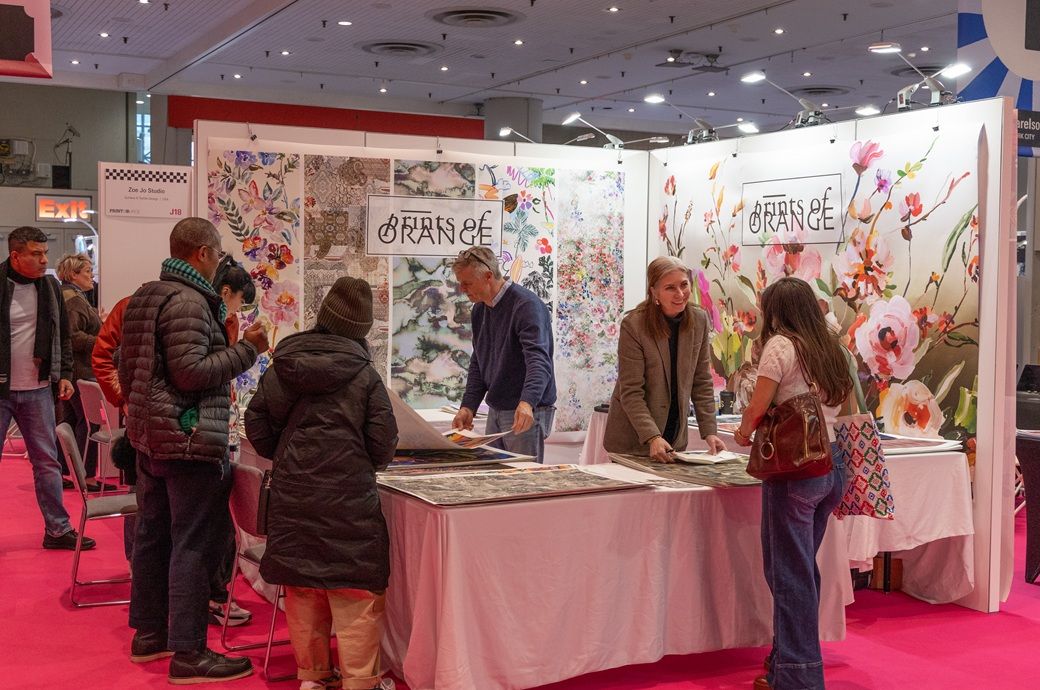
“As we celebrate 20 years of Texworld NYC, we’re also celebrating the incredible global community of designers, brands, manufacturers, and industry leaders that have shaped the event into what it is today,” said Jennifer Bacon, Vice President, Fashion and Apparel Shows at Messe Frankfurt Inc. “This milestone edition reflects our continued commitment to providing meaningful opportunities for sourcing, education, and collaboration while creating space for the conversations and innovations that will define the future of the industry.”
Texworld NYC’s opening day highlighted how AI, connected data and collaboration are reshaping sourcing decisions amid tariff uncertainty.
Speakers stressed the need to combine cost, supply chain and market intelligence with sustainability and regional manufacturing.
FW 2027/28 trend forecasts also showcased innovative materials, responsible production and evolving consumer preferences.
The show is organized into areas for maximum impact, including Textile Talks, Innovation Hub, Exhibitor Pitch — Powered by Texpertise, Hands-On Workshops, and Specialty Sourcing Opportunities including sustainable materials, Deadstock and Low MOQ ideal for emerging brands and businesses looking for greater flexibility.
Texpertise econogy: Making ‘Sustainability Spotting’ easy
Sustainability is an increasingly important factor for the industry and companies must view it in the framework of their economic success. David Suzuki, Canadian biologist, publicist and winner of the Alternative Nobel Prize coined the word Econogy — combining the words economy and ecology. Messe Frankfurt’s sustainability initiative Econogy highlights exhibitors committed to environmentally and socially responsible production practices. Those who quality (look for the Econogy icon!) are listed in the show’s curated Econogy Finder (both online and in print), situated in the show’s Econogy Hub and highlighted during Econogy Tours and Talks.
Data, prices and sourcing shifts in textiles and apparel
In an environment defined by tariff uncertainty, shifting sourcing strategies and rapid technological change, data alone just isn’t enough. The real advantage comes from knowing which data matters and how to act on it.
Moderated around the theme of market intelligence, the panel Reading the Market: Data, Prices and Sourcing Shifts in Textiles and Apparel, featured Robert Antoshak and Radhika Shrinivas of Gherzi Americas, Rasha Alomar of Grey Matter Concepts, Josh Nieuwsma of Reshoring Textiles/Spinnere, and Visalakshi Kannan of VTM Limited. Together, they explored how companies can navigate today’s increasingly volatile textile and apparel landscape.
For Kannan, every sourcing decision starts with what she called the “three C’s: Cost, Customer and Competition.” She explained that companies need visibility into raw material costs, customer behavior and competitive intelligence, but only when those data points are connected to broader market realities.
Additionally and crucially, “data must be connected.” Cost information alone is incomplete without tariff intelligence, delivery timelines and factory performance.
“If you don’t know that a new tariff is here, your data isn’t accurate or relevant,” Alomar said, adding that agility has become a competitive advantage as companies prepare multiple sourcing scenarios. Factories themselves are also investing into additional countries — China into Egypt, for example — as a hedge to keep existing customers when tariffs shift.
Shrinivas advises balancing short-term operational data with long-term macroeconomic trends. “Cost information today is important, but you need to know the macro data for three to five years from now,” she said. The real value comes from translating broad market indicators into business-specific decisions, and not getting bogged down in extraneous data.
“Take tariffs — what can you affect and what can you not affect? Then focus on what you can actually impact. Find the two or three data points that will help you decide what to do. You don’t need a hundred.”
Nieuwsma argued that too many companies overlook “total cost of ownership,” especially when supply chain data remains siloed between upstream and downstream partners. “When you correlate the data, you get total cost so you don’t end up focusing on the wrong thing.”
Greater collaboration, combined with emerging technologies like agentic AI, could unlock efficiencies that individual companies cannot achieve alone. Consider Correlation and Collaboration the fourth and fifth C’s.
On the topic of AI, however, panelists cautioned that technology is only as valuable as the information feeding into it. In short: garbage in, garbage out. AI still requires experienced operators because “it’s still hallucinating,” and Nieuwsma predicted that “a lot of people will waste a lot of money on AI” before understanding where it creates real value.
Beyond technology, relationships emerged as a powerful theme. “Relationships are just as important as data. Data is info, relationships solve the problems,” Alomar said, particularly when companies need to pivot production quickly between countries or suppliers. Kannan also highlighted the importance of diversifying both products and manufacturing locations while modeling multiple cost scenarios to stay prepared for changing trade conditions.
Rebuilding Regional Supply Chains in Fashion
As the fashion industry confronts mounting climate challenges and supply chain instability, rebuilding regional textile ecosystems has become both an environmental imperative and a business opportunity. The panel From Soil to Studio: Rebuilding Regional Supply Chains in Fashion brought together leaders working across the fiber value chain to explore how regenerative agriculture, domestic manufacturing, and cross-sector collaboration can reshape the future of American textiles.
Moderated by Laura Sanson of New York Textile Lab, the discussion featured Mary Kate Randolph, Climate Beneficial Systems Director at Fibershed; Tameka Peoples, founder and CEO of Seed2Shirt; and Trevor Davis, founder of William Ellery. Together, they argued that rebuilding regional supply chains requires more than relocating production — it requires rebuilding trust, investing in communities and creating stronger connections between growers, manufacturers, brands and consumers.
For Randolph, regenerative agriculture succeeds only when environmental outcomes translate into economic opportunity. Through Fibershed’s Climate Beneficial™ program, farmers and ranchers adopt practices that improve soil health, biodiversity, water systems, carbon capture and rural communities. But, she emphasized, “the most important thing is connecting that to markets.” And while data is essential, “we all need to keep it human,” ensuring that measurable outcomes are tied to the stories of growers and the landscapes they steward.
Peoples emphasized that rebuilding supply chains must also address long-standing inequities. Through Seed2Shirt, she works to ensure Black cotton farmers are represented in regenerative sourcing while helping brands align their material strategies with growers’ production cycles.
“Everyone’s looking for de-risking,” she said, explaining that success depends on coordinating farmers, mills, logistics providers and brand teams years in advance. Beyond cotton merchandising, Seed2Shirt invests in research and development because, as Peoples described it, “the R&D is just about the love of what is possible and navigating the systems that are creating.”
For Davis, rebuilding American manufacturing also begins with relationships. William Ellery has committed to producing in the United States “unless there’s a reason not to,” rejecting offshore manufacturing simply to lower costs. Instead, the brand builds lasting connections with domestic suppliers and customers alike.
“Everyone that I meet with…they are essentially my community,” he said, adding that he hopes every brand strives to support “the people around you, so that these aren’t really business relationships, but rather your own community.” That philosophy extends to storytelling, where customers become “a lifelong part of the community rather than just a customer.”
Looking ahead, the panelists envisioned a more regional and collaborative textile economy. Davis called for greater “geographical diversity,” where products reflect the fibers and landscapes of their regions. Randolph imagined consumers discovering textiles that express the unique qualities of local fiber systems, while Peoples advocated for treating small farmers as “research and development partners” and creating cooperative investment models that share both risk and opportunity.
Ultimately, rebuilding domestic manufacturing will require cooperation across brands, governments, mills and growers. “Working together is the only way to really move forward,” concluded Sanson.
Trends to watch
Before you even hit the show floor, you’ll want to know the biggest colors, materials and consumer trends influencing fashion development. Yvonne Debruyn, creative director of trend forecasting service Peclers Paris has outlined the four major apparel and textile trends for FW 27/28, complete with Guided Trend Showcase tours led by Peclers Paris experts for more insights. A display featuring exhibitor textile samples from the show floor will bring each trend to life. A FW 27/28 preview:
Urban Outdoors: Reinventing urban adventure, outdoor utility fuses with metropolitan chic for a new citywear aesthetic. High-performance features are discreetly integrated into protective, airy layers, creating a subtle aesthetic of opaqueness, shine, and versatile comfort, with enveloping silhouettes.
Key Materials and Elements: Look for high-performance materials and enveloping silhouettes, with fabrics like brushed gabardine, quilted checks, irregular stripes, checked overshirts, mellow scuba, lightweight ripstops, matte puffers, textured whipcords, oily coatings, felted knits and patched sherpa. Black is less important, and earthy colors are balanced out by mustard yellow and midtone blues and both natural and synthetic greens.
Tender Craft: Folk tradition is revitalized, reinterpreting handcrafted comfort with a contemporary, soft-hued elegance. This theme celebrates the intimacy of handmade, weaving a soothing, sensorial experience from tactile materials inspired by nature’s gentle forms.
Key Materials and Elements: Look for blurred checks, fine gage-layering, brushed woolens, quilted corduroy, suede, irregular dyeing (and overdyed denim), crinkle georgette, authentic shearling, fringing, rustic cable knits, heritage jacquard, smocking, soft-touch joggers, washed and rumpled textures and soft florals. Colors are soft and muted, including neutrals tans, ballet pink and soft gray.
Preppy Street: Relive the vibrant energy of 90s pop culture, merging carefree youth with bold nostalgia. This iconic style fuses rock-infused streetwear and preppy codes, delivering grungy, unruly glamour that redefines casual, plus sports stripes and elements as sports help to “unite us.”
Key Materials and Elements: Featured styles include macro rugby stripes, vintage rock tees, wooly micro checks, XL sequins, micro check shirting, fun fur, mega argyle, quilted micro checks, animal print fur, bleached denim, distressed leather. Colors include muted brights, layered primaries with burgundy subbing in for red.
High Minimal: Redefining contemporary luxury, this timeless, essentialist aesthetic is an ode to masterful craftsmanship. Pure, refined elegance emerges from noble materials, generous proportions, and meticulous details.
Key Materials and Elements: Polka dots, XXL herringbone, heritage shirting, Art Deco geometric, fluffy knits, flannels, glossy leather, delicate lace, Prince of Wales, softened pinstripe, jacquard shirting, raw denim, fluid suiting, houndstooth and glossy suiting. Colors are often expressed through deep, nuanced blacks.
If you missed today’s presentation and tour by creative director Yvonne Debruyn, you can still catch Peclers Paris’ managing director Jennifer Karuletwa’s presentation on Friday, July 31.
Note: The headline, insights, and image of this press release may have been refined by the Fibre2Fashion staff; the rest of the content remains unchanged.
Fibre2Fashion News Desk (MS)
