
The hidden bottleneck in Asia’s textile machine
For all the talk of ‘China+*’ diversification sweeping through Asia’s garment industry, one stage of production has stubbornly resisted geographic spread: dyeing and finishing. More than ** per cent of Asia-Pacific’s synthetic fabric finishing capacity remains concentrated in just two Chinese provinces: Zhejiang and Jiangsu. For an industry that prides itself on flexible, multi-country sourcing, this is an uncomfortable structural fact, and one that brands, buyers, and investors are only now starting to price in.
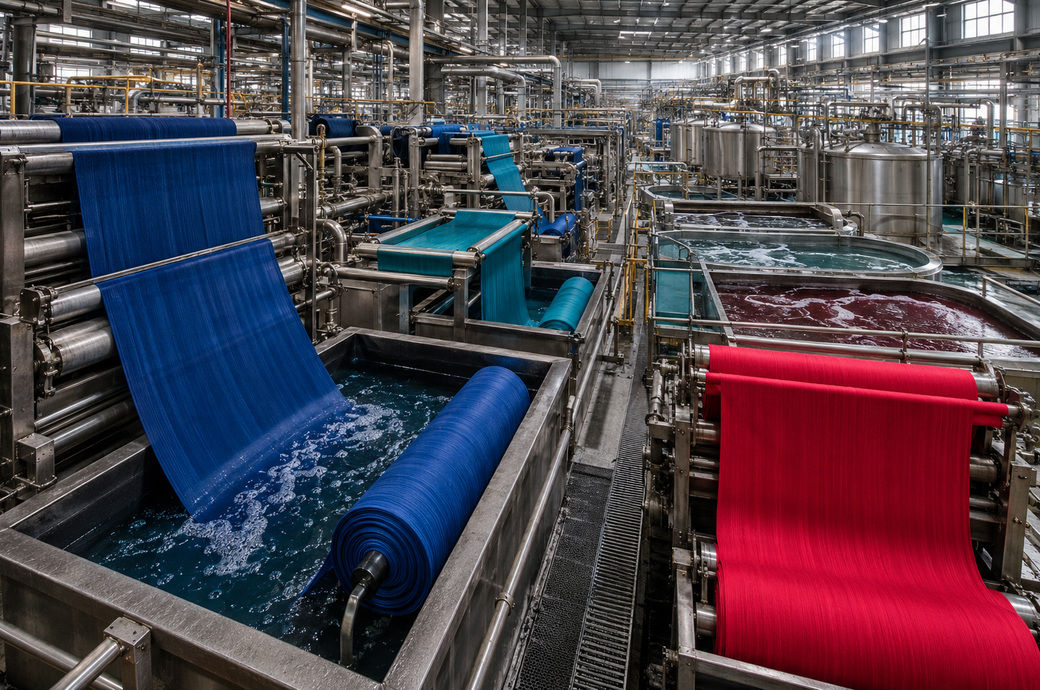
While spinning, weaving, and garment assembly have fanned out across Vietnam, Bangladesh, India, and Indonesia over the past decade, wet processing, including dyeing, printing, and chemical finishing, has stayed anchored in the Yangtze River Delta. The reason is straightforward economics: dyehouses require enormous capital investment in effluent treatment infrastructure, steady access to speciality dye chemicals, and skilled technical labour, all of which the Zhejiang-Jiangsu cluster has spent three decades building. Zhejiang alone is home to a dense concentration of leading dye manufacturers, with a handful of large players such as Zhejiang Longsheng and Runtu Co. accounting for roughly half of the country’s total dye production capacity. Jiangsu, meanwhile, hosts an equally dense web of intermediate chemical suppliers and finishing mills, particularly around its coastal chemical parks in Nantong, Yancheng, and Lianyungang.
