
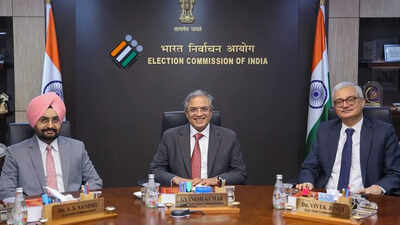
NEW DELHI: The Election Commission on Wednesday conceded that “operational queries or inputs” were raised by election commissioners S S Sandhu and Vivek Joshi on matters including the special intensive revision (SIR) exercise, but insisted that these pertained to the draft stage and were “part of standard administrative practice aimed at safeguarding voter rights”.Claiming that the “suggestions” given by the commissioners were for further improving the electoral process and part of a decision-making process before a final decision, the EC stressed that differing views and observations are a normal part of deliberation in any institution, “Not only the three commissioners, but every officer of the commission is fully authorised to give his suggestions…for improving the electoral system,” EC said in a statement put out following news reports in a section of the media, alleging that the two elections commissioners had raised written objections 14 times in 10 months, to steps taken by the commission, and even written separately to Cabinet secretary against “gradual centralisation of the electoral roll database”.“Highlighting certain specific internal notes/observations spread over the period of 10 months while overlooking the much larger body of approvals, decisions, instructions and initiatives give only one part of the picture. In recent months, the Commission has taken numerous decisions, issued instructions, introduced around 40 new initiatives and undertaken many electoral reforms including the conduct of electoral roll revision (including SIR) across the country. All these decisions are an outcome of the unanimous decisions of the full Commission in the past one year,” the commission stated.The statement reiterated that EC, a constitutional body functioning under the strict mandate of Article 324 of the Constitution, statutory roles and established institutional conventions, operates as a multi-member constitutional body, “Written notes, observations, technical suggestions and internal checks-and-balances are standard, ongoing practices designed to ensure complete transparency, legal compliance and operational rigour,” it noted.The commission said all official orders, decisions and administrative directions issued by the Commission carry full legal sanction and follow established statutory procedures under The Chief Election Commissioner and Other Election Commissioners (Appointment, Conditions of Service and Term of Office) Act, 2023.“The Commission has recently successfully conducted major elections of Bihar, Kerala, Tamil Nadu, Puducherry, Assam and West Bengal and election-related exercises during this period. This work involved wide-ranging administrative and operational machinery and many Commission approvals and instruction,” it was stated.On the commissioners’ alleged objection to centralisation of the electoral roll database or ERONet/ECINet, with restricted access to electoral registration officers (EROs) who are authorised under the Representation of the People Act to decide on addition of deletion of names in the electoral roll, the Commission said digital platforms such as ECINet operate under strict data security protocols to prevent unauthorised tampering, manipulation, etc.
Share your thoughts in the comments
Be respectful · TOI community guidelines
“IT security checks and audit controls are standard cybersecurity measures implemented across national databases. Statutory authorities, including EROs and district election officers (DEOs), function as per statutory powers for registration and deletion under law,” said EC.The poll body signed off saying that it “remains fully committed to executing its constitutional duties with complete integrity, recognizing its vital role in advancing our democracy”.
