
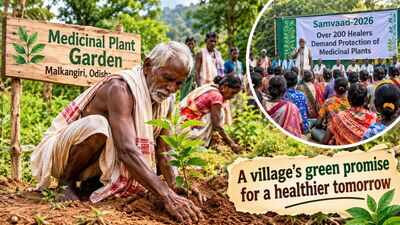
For generations, tribal healers walked into forests knowing which roots to collect, which leaves to preserve and which plants their communities traditionally turned to for common ailments. But today, some of those plants are becoming increasingly difficult to find. The forests they once relied on are changing, and with them, a tradition that has survived through generations of oral knowledge faces the risk of being lost.In Odisha’s Malkangiri district, a group of traditional healers is trying to prevent that loss, not by waiting for the plants to return to the forest, but by growing them. At Makamanali village, Nilakantha Krisani, a traditional healer from the Parenga community, is tending medicinal plants on half an acre of land. The space was donated by septuagenarian Deba Gallori, a Kandh tribal healer who wanted to help safeguard the plants that have long been central to traditional healing practices.Other healers have also brought medicinal species from their villages to grow here. The garden is not a commercial venture or a laboratory experiment. It is an effort to preserve plants before they disappear while ensuring that the knowledge surrounding them does not die with the people who carry it.
When the forest no longer has everything it once did
For healers like Gallori, the change has become personal. Plants, roots and climbers that were once accessible are now harder to locate, forcing practitioners to travel farther into forest areas in search of them. Speaking about the changing situation, Gallori said that many plants they once depended on were no longer available nearby. He explained that healers were now required to walk longer distances into forests to collect them.This growing scarcity affects more than their work. Traditional knowledge is often passed from one generation to another through observation, practice and storytelling. When a plant disappears from a landscape, younger learners may lose the opportunity to understand how elders identify it, where it grows and how it has traditionally been used.Climate change, deforestation, habitat disturbance and other human pressures are contributing to concerns about the availability of forest resources. For tribal communities, the disappearance of medicinal plants can also mean the gradual erosion of a cultural practice closely tied to the natural world.
More than 200 healers raise their voices
The issue reached a wider platform at Samvaad-2026, a five-day tribal convention organised by Tata Steel Foundation in Jamshedpur. More than 200 tribal healers from different parts of India raised concerns over the disappearance of medicinal plants and the challenges it poses to their traditional practices.The gathering became an opportunity for practitioners to share their experiences, discuss the difficulties of finding plants and call for stronger conservation efforts. Their demands included government support for dedicated nurseries, propagation of medicinal species and afforestation initiatives.The concerns were not limited to Odisha. Healers from states including Chhattisgarh, Madhya Pradesh, Maharashtra and Jharkhand spoke about the difficulties of preserving plant-based knowledge and resources. Sourav Roy, CEO of Tata Steel Foundation, said traditional healing and ethnomedicine emerged as major subjects during discussions at Samvaad, reflecting the growing concerns of tribal communities about threats to their knowledge and way of life.
Saving plants also means saving knowledge
The effort in Malkangiri highlights an important connection between biodiversity and indigenous knowledge. A medicinal plant garden can help conserve species, but it can also provide a space where younger generations learn directly from experienced healers.The district itself has a rich botanical landscape. Research cited in the report notes that Malkangiri’s forests support several medicinal plant species and that researchers have documented plants traditionally used by local communities for different ailments. The challenge, however, is ensuring that conservation efforts are sustained and that traditional knowledge is respected, documented responsibly and passed on with the consent of the communities who hold it.The healers are asking for support to protect these resources before the loss becomes irreversible. Their half-acre garden may be modest in size, but its purpose reaches beyond its boundaries. It is an attempt to ensure that when the next generation walks into the forest, the plants are still there to be found, and the knowledge of what they mean has not disappeared with the elders.