
Key takeaways:
- The most common types of project methodologies include Waterfall, Agile, and Hybrid.
- The right project management methodology for your needs will depend on the nature of the project, team expertise, and org culture.
- Waterfall works best when the budget, timeline, and requirements are defined upfront and unlikely to change. Agile is ideal when requirements are uncertain, and stakeholders want active involvement.
One of the biggest mistakes in project management is treating methodologies as one-size-fits-all. Throughout my career, I’ve seen teams adopt Agile because it was popular, only to discover the project needed more structure, while others implemented Waterfall when changing requirements demanded flexibility. Project management methodologies cater to different goals, constraints, and team dynamics, so understanding your options is critical before choosing an approach.
What is a project management methodology?
A project management methodology is the system that governs how a project gets done. It defines the rules, principles, and sequence of work your team follows from kickoff to close.
Think of it as the operating system behind your project. Waterfall and Agile can both use the same “apps” — your project management software, meetings, timelines, and task lists — but they process the work differently.
Waterfall works more like a locked-down enterprise system: structured, sequential, and built around set steps. Agile works more like an OS built for frequent updates: iterative, flexible, and designed to adapt as the work evolves. Same tools, same project type, very different way of working.
Methodology vs framework vs process
These three terms get used interchangeably, but they mean different things:
- Methodology is the governing philosophy. It sets the overall approach (e.g., predictive, adaptive, or hybrid) and defines the principles your team works within.
- Framework is the operational structure built on top of a methodology. Scrum and SAFe, for example, are frameworks that implement Agile principles through specific roles, ceremonies, and artifacts.
- Process is the repeatable sequence of steps used to execute specific types of work. Processes sit inside frameworks and handle recurring activities like approvals, status reporting, or change requests.
💡Tip: A simple way to remember the hierarchy: methodology sets the rules, frameworks translate them into structure, processes carry out the work.
Why project management methodologies matter
Using a project methodology helps teams work more effectively and improve project outcomes. According to Wellington’s State of Project Management Report 2026, 58% of project managers mostly or always apply a defined project management methodology.
A project management methodology can help you:
- Reduce ambiguity: Roles, decision rights, and escalation paths are defined upfront rather than improvised mid-project.
- Create predictability. Teams that follow a consistent approach develop repeatable delivery patterns over time.
- Align stakeholders. A shared methodology gives everyone a common way to discuss scope, risk, and progress.
The right methodology won’t guarantee success, but it can help teams avoid common project problems and make more informed decisions throughout the project.
Project management methodologies compared
The comparison table below provides a quick overview of the most common methodologies, followed by a closer look at how each approach works and where it fits best.
| Agile | Evolving projects | Iterative delivery | Adapts to change | Scope can shift |
| Waterfall | Fixed-scope projects | Sequential phases | Easy to plan | Difficult to change |
| Lean | Process improvement | Waste reduction | Increases efficiency | May overlook long-term needs |
| PRINCE2 | Enterprise projects | Stage-based governance | Strict control | Documentation-heavy |
| CPM | Complex schedules | Critical task tracking | Improves scheduling | Less flexible |
| Hybrid | Mixed project needs | Combined approaches | Flexible | Harder to manage |
| Six Sigma | Quality improvement | Data-driven decisions | Reduces defects | Requires training |
Agile
The problem it solves: Agile was originally created for software development, where teams often don’t have all the answers at the start. It is best suited for projects that will change as you learn more.
Agile organizes work into short iterations, usually one to four weeks long. At the end of each sprint, the team completes the agreed-upon items in the sprint backlog and adjusts future work based on feedback. Rather than finalizing every requirement at the start, Agile allows each sprint to be planned around completed work, current priorities, and what the team learns as the project evolves.
When to use it: Software development, product design, marketing campaigns, or any project where stakeholder needs are likely to shift. If your biggest risk is building the wrong thing, Agile gives you the checkpoints to catch that early.
Limitations: When deliverables, timelines, or budgets are fixed and non-negotiable from day one. That’s where Waterfall tends to hold up better.
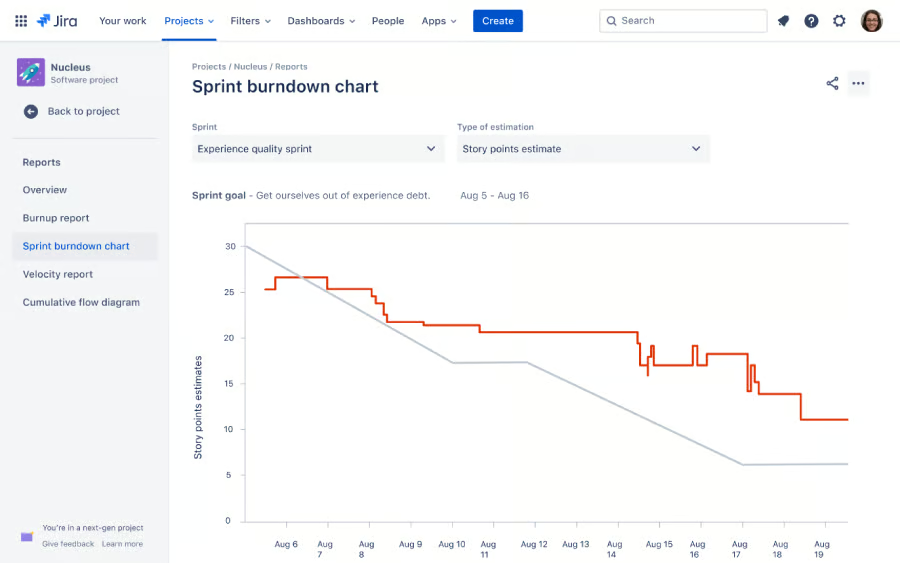
Jira is a widely used project management tool for running Agile projects. It supports sprint planning, backlog management, progress tracking, and sprint reporting through burndown charts and velocity tracking. Teams can create and prioritize user stories, assign tasks to sprints, and track work through custom board views.
Scrum
Scrum is an Agile framework that organizes work into short sprints with defined roles, backlog planning, and regular review sessions. It works best for software or product teams that need frequent feedback and a predictable delivery rhythm.
When to use it: Software teams, product teams, or any group doing iterative delivery work that benefits from short feedback loops and accountability. This is ideal when the team is closely coordinated and committed to the ceremony.
Limitations: Not ideal for operational or maintenance work with no clear backlog. Kanban fits that scenario better.
Kanban
Kanban is another Agile framework that visualizes work on a board, and limits work in progress so teams can reduce bottlenecks. It works well for support, content, maintenance, and bug-fix work where tasks arrive continuously.
When to use it: Support teams, content production, maintenance work, and bug-fix queues. It is particularly useful when work arrives continuously and teams need to respond without fixed sprint schedules.
Limitations: If your work is project-based with an end date and deliverables, Scrum or Waterfall gives you more control over scope and timeline.
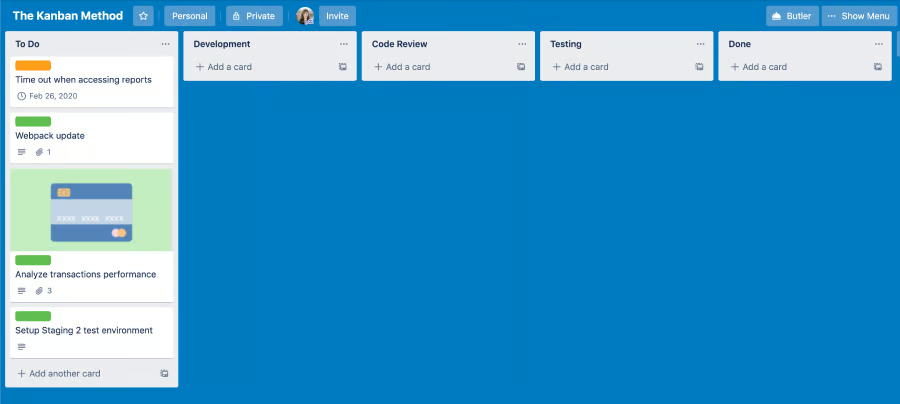
Trello is one of the most accessible tools for running a Kanban workflow. Its board and card format mirrors the Kanban board, columns track workflow stages, cards carry task details, and the drag-and-drop interface makes it straightforward to move work through the pipeline.
Waterfall
The problem it solves: You need a fixed, predictable plan where every phase is approved before the next one begins.
In Waterfall, projects progress through a fixed sequence of phases, from requirements and design to testing and deployment. Each phase must be completed and approved before the next begins, leaving limited opportunity to revisit earlier decisions.
When to use it: Construction, manufacturing, government, and other compliance-heavy projects where the scope is fixed and documentation is required at every stage. If your biggest risk is going over budget or missing a regulatory requirement, Waterfall’s phase-by-phase approach provides greater control.
Limitations: Less effective when requirements are unclear at the start or when stakeholders expect the scope to evolve during the project. In those situations, Agile provides greater flexibility.
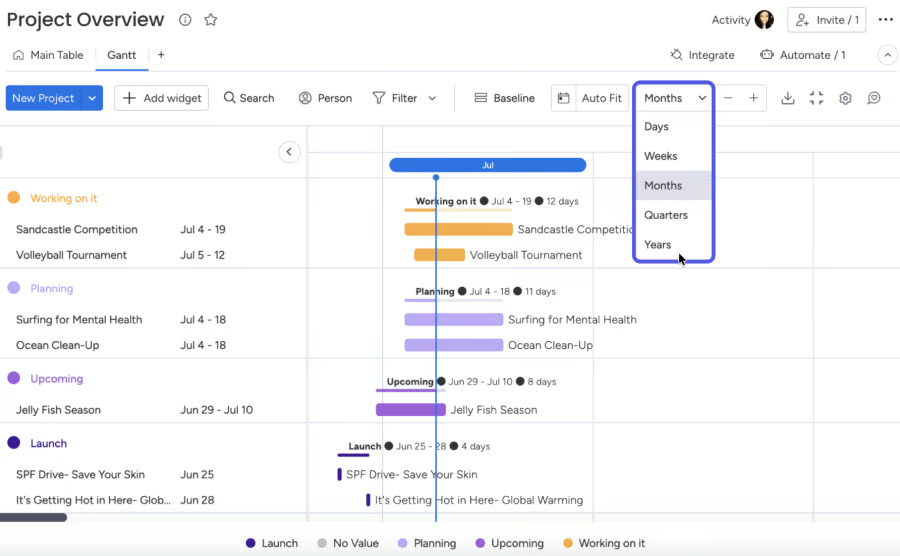
monday work management is a visual project management platform that supports the sequential nature of Waterfall projects. Its Gantt charts, task dependencies, and milestone tracking features help teams plan and monitor work across project phases without extensive setup or customization.
Hybrid
The problem it solves: Your project has parts that need rigid control and parts that need flexibility, and no single methodology handles both well.
Hybrid combines elements of predictive and adaptive methodologies within the same project. A common pattern is using Waterfall for planning, procurement, and compliance phases while running Agile sprints for design and development. There is no universal definition of hybrid, so the split is usually defined by the organization or project team based on where requirements are fixed versus where they need to evolve.
When to use it: Enterprise software, healthcare IT, construction technology, and regulated industries where some project phases must follow contractual or compliance requirements while others require iteration. According to PMI’s 2024 report, hybrid adoption grew from 20% in 2020 to 31.5% in 2023, reflecting its increasing use across industries.
Limitations: Teams that describe themselves as hybrid without defining where Waterfall ends and Agile begins often add complexity without gaining the benefits of either approach. Document the methodology split before the project starts so everyone understands which practices apply to each phase.
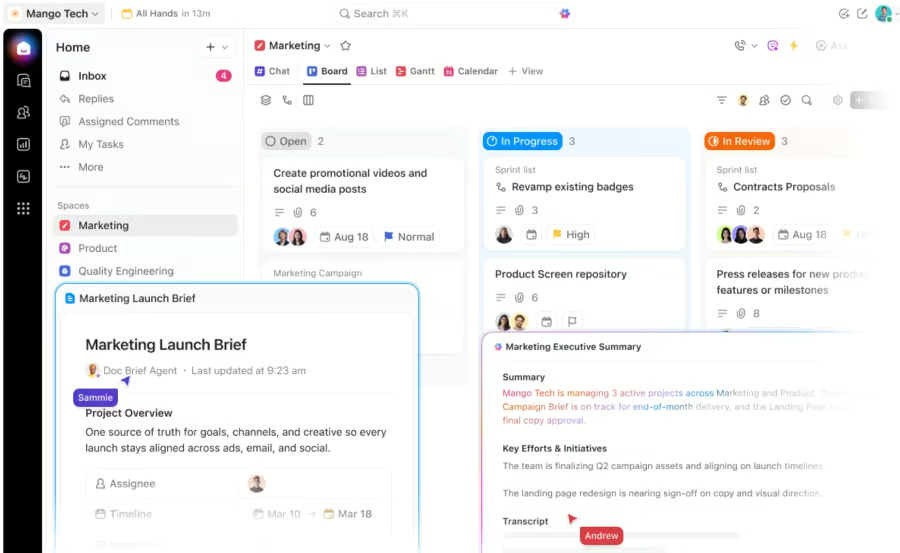
ClickUp works well for hybrid projects because it does not force a single workflow on the entire team. Gantt charts, Kanban boards, sprint views, and list views all live in the same workspace, so a project can run Waterfall-style phases alongside Agile sprints without switching tools or duplicating work.
Lean
The problem it solves: Your process has too many steps, handoffs, or wait times that add cost without improving the final outcome.
Lean originated in Toyota’s manufacturing system and centers on one idea: eliminate waste. Waste can mean excessive approvals, unnecessary rework, duplicated effort, and delays between tasks. Lean teams analyze workflows to identify these inefficiencies and remove or reduce them.
When to use it: Manufacturing, operations, and process improvement initiatives where efficiency and cycle time are key concerns. It is also used alongside Agile to simplify workflows and reduce unnecessary process overhead.
Limitations: Less effective as a standalone approach for projects with highly creative work or unpredictable outcomes that cannot be easily standardized.
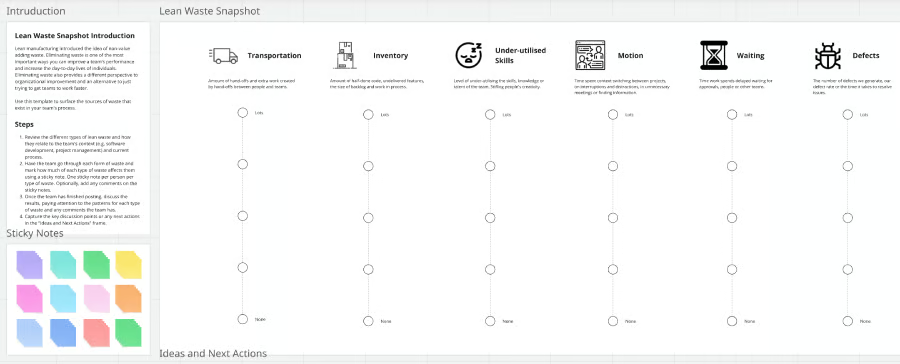
Miro works well for Lean projects because value stream mapping, a Lean technique for identifying waste, is a visual exercise that benefits from a shared digital canvas. Teams can map current-state workflows, mark problem areas, and collaborate on future-state processes in real time.
PRINCE2
The problem it solves: Your project involves multiple stakeholders, a significant budget, and real consequences if governance breaks down.
PRINCE2 (Projects IN Controlled Environments) emphasizes governance, accountability, and business justification throughout the project lifecycle. Each project requires a documented business case, defined responsibilities, and formal review points where stakeholders decide whether the project should proceed to the next stage.
When to use it: Enterprise projects, government contracts, infrastructure programs, and any environment where audit trails, accountability, and documented decision-making are non-negotiable. It is widely adopted in the public sector, particularly in the UK, Europe, and Australia.
Limitations: Carries significant documentation overhead. For smaller or faster-moving projects, that overhead can slow delivery more than it helps. Agile or a lighter hybrid will serve those better.
Critical Path Method (CPM)
The problem it solves: Your project has multiple dependent tasks, and delays in one activity could affect the final delivery date.
CPM maps project tasks and their dependencies to identify the critical path, the longest sequence of activities that determines the project’s completion date. Any delay on a critical path task delays the project. Tasks off the critical path have float, meaning they can slip slightly without affecting the end date.
When to use it: Construction, engineering, event planning, and any project with complex task dependencies and a fixed deadline. CPM answers the question most project managers ask but rarely have hard data for: which tasks matter most to the timeline?
When to use it: On exploratory or research-heavy projects where timelines are unpredictable, the model loses accuracy quickly.
Six Sigma
The problem it solves: A process is producing inconsistent or defective outputs, and you need a data-driven method to find the root cause and fix it.
Six Sigma is not technically a project management methodology. It is a process improvement methodology used to reduce defects, control variation, and improve the consistency of measurable outputs.
Six Sigma uses the DMAIC framework: Define, Measure, Analyze, Improve, Control. It requires trained practitioners, designated as Green Belts or Black Belts, to lead improvement projects using statistical analysis.
When to use it: Manufacturing, healthcare, finance, and any operational environment where quality consistency is measurable and defects have a direct cost. Often combined with Lean (Lean Six Sigma) to address both waste reduction and quality control simultaneously.
Limitations: Not suited to creative or exploratory projects where outputs are subjective and variation is expected. The methodology requires enough data to identify patterns and measure improvement.
More project management coverage
How to choose the right project management methodology
Selecting a methodology isn’t about finding the “best” approach. It’s about choosing the one that fits your project’s requirements, stakeholders, and working environment. Consider the factors below to determine which approach is the best fit.
1. Evaluate project complexity
Start by evaluating your project’s scope, timeline, dependencies, and level of uncertainty. Projects with complex task dependencies often benefit from CPM, which identifies the activities that determine the completion date. Agile is better suited for projects where requirements may change, while Waterfall works best when scope, deliverables, and project phases are fixed.
2. Assess stakeholder requirements
Ask how involved stakeholders need to be during delivery, not just at kickoff and close. If they expect to review and provide input throughout, an iterative approach like Scrum offers them regular touchpoints. If they want a detailed plan up front and minimal interruptions during execution, Waterfall fits that expectation.
3. Consider team experience
A team using Scrum for the first time under a tight deadline may face unnecessary challenges. Consider your team’s experience and familiarity with the methodology, as a simple approach applied consistently often delivers better results than a more complex methodology that the team does not fully understand.
4. Determine regulatory constraints
If your project operates in a regulated environment, confirm what governance standards apply before choosing a methodology. Government, healthcare, and financial services organizations often use PRINCE2 or Waterfall because these approaches support formal approvals, audit trails, and extensive documentation.
5. Review organizational culture
Agile requires trust, autonomy, and acceptance for iterative change. If leadership expects detailed plans and resists mid-project pivots, an Agile approach will face constant resistance regardless of how well the team executes it.
Conversely, a fast-moving product team forced into heavy PRINCE2 documentation may view the process as unnecessary overhead. Match the methodology to your organization’s decision-making style, and way of working.
💡Tip: If you’re deciding between multiple methodologies, start with these questions:
- How much do you need to know before the project starts?
- How will you handle scope changes during the project?
- What does “progress” mean to your team and stakeholders?
- Who owns accountability, and how often do they need to check in?
Methodologies by industry
While organizations may customize their approach, some methodologies are more common in certain industries due to their requirements and constraints. Here is what each sector typically uses:
Software development
Software teams almost universally run some form of Agile. Scrum is the most common framework, used for its sprint structure, roles, and feedback loops. Kanban is preferred for continuous delivery environments, support queues, and bug-fix workflows where work arrives unpredictably. Larger organizations coordinating multiple Agile teams often adopt SAFe (Scaled Agile Framework) to manage dependencies at scale.
Waterfall still appears in software contexts where contracts are fixed-price or where a client requires a fully documented specification before development. In those cases, a hybrid approach is common: Waterfall for scoping and contracting, Agile for the build itself.
Construction
Construction projects run predictive methodologies almost exclusively. Waterfall and CPM are the standards. Deliverables are physical, sequential, and largely non-negotiable: you cannot iterate on a foundation. Tasks have hard dependencies, procurement has long lead times, and regulatory inspections require sign-offs.
CPM identifies which tasks directly affect the completion date and which have scheduling flexibility. In construction projects, this allows teams to address delays before they affect the overall timeline.
Lean principles are also applied in construction to reduce material waste, cut down wait times between trades, and improve coordination between subcontractors.
Healthcare
Healthcare projects must balance regulatory requirements with the realities of clinical work, where needs and priorities can change during implementation. As a result, hybrid approaches are often the best choice.
For example, healthcare organizations may use Waterfall for procurement, compliance reviews, and system validation, then adopt Agile during configuration, testing, and user rollout. Lean and Six Sigma are also common in hospital operations, where teams focus on reducing waste, shortening patient wait times, and improving process quality.
PRINCE2 is frequently used in large NHS and public health initiatives in the UK because it provides the governance, documentation, and accountability required by public-sector contracting authorities.
Manufacturing
Manufacturing was the original home of Lean and Six Sigma, and both remain dominant. Lean focuses on reducing waste, such as excess inventory, unnecessary movement, and production delays. Six Sigma focuses on improving quality by identifying and reducing defects through data analysis and the DMAIC framework. Combined as Lean Six Sigma, the two address both efficiency and quality.
Waterfall and CPM are often used for plant expansions, equipment installations, and other capital projects that involve fixed budgets, sequential phases, and regulatory approvals. Agile is less common on the production floor, but many manufacturers use it in product development, engineering, and research teams where requirements evolve over time.
Government projects
Government projects often have strict requirements for documentation, procurement, approvals, and accountability. PRINCE2 is widely used across the UK and Europe because it supports formal governance, audit trails, and business case reviews throughout the project lifecycle.
In the US, many federal projects follow project management practices aligned with PMI’s PMBOK framework while also meeting requirements such as FedRAMP, FISMA, and agency-specific regulations. Agile is increasingly used for federal IT initiatives, but it usually operates alongside governance processes.
Government projects typically have fixed timelines, documented accountability, and formal change-control procedures. As a result, the chosen methodology must support oversight, compliance, and detailed documentation from the outset.
Common methodology selection mistakes
Picking the wrong methodology rarely looks like an obvious error at the start. It shows up later, in missed deadlines, rework, and teams that have stopped following the process. These are the most common ways it goes wrong.
1. Choosing a methodology before understanding the stakeholders
A methodology can be technically appropriate for the work and still create friction with stakeholders. Stakeholders who expect detailed plans and formal status reports may struggle with Agile’s iterative approach and evolving priorities. Effective methodology selection should account for both project requirements and stakeholder expectations around decision-making, reporting, and communication.
2. Treating Hybrid as permission to skip discipline
Hybrid is an increasingly common approach, but it can also become a catch-all term for teams that lack a defined way of working. An effective hybrid methodology defines where the handoff between predictive and adaptive work happens, and who owns governance at each stage. Without those guidelines, teams often fall back on ad hoc decision-making driven by whoever has the most authority.
3. Choosing based on industry trend rather than project fit
Agile is the default assumption in most technology and product organizations right now. That is not always wrong, but it is often unexamined. A software project with a fixed-price contract, a locked specification, and a client who wants a delivery date is not a good Agile candidate, regardless of what the rest of the industry is doing. The methodology should match the project, not the trend.
FAQs
What is the most commonly used project management methodology?
Agile is one of the most widely adopted methodologies, particularly in software development. Many organizations also use hybrid approaches that combine Agile practices with traditional project management methods.
What is the difference between Agile and Waterfall?
Agile uses iterative development cycles and welcomes change throughout a project. Waterfall follows a sequential process where each phase must be completed before the next begins.
Can multiple project management methodologies be used together?
Yes. Many organizations combine methodologies to balance flexibility with governance. Hybrid approaches are increasingly common across industries.
